. 2024 May 4;13(5):320.
doi: 10.3390/biology13050320.

Early Animal Origin of BACE1 APP/Aβ Proteolytic Function

Affiliations

Early Animal Origin of BACE1 APP/Aβ Proteolytic Function

James A Langeland et al. Biology (Basel). .

Abstract

Alzheimer's disease is characterized, in part, by the accumulation of β-amyloid (Aβ) in the brain. Aβ is produced via the proteolysis of APP by BACE1 and γ-secretase. Since BACE1 is the rate-limiting enzyme in the production of Aβ, and a target for therapeutics, it is of interest to know when its proteolytic function evolved and for what purpose. Here, we take a functional evolutionary approach to show that BACE1 likely evolved from a gene duplication event near the base of the animal clade and that BACE1 APP/Aβ proteolytic function evolved during early animal diversification, hundreds of millions of years before the evolution of the APP/Aβ substrate. Our examination of BACE1 APP/Aβ proteolytic function includes cnidarians, ctenophores, and choanoflagellates. The most basal BACE1 ortholog is found in cnidarians, while ctenophores, placozoa, and choanoflagellates have genes equally orthologous to BACE1 and BACE2. BACE1 from a cnidarian (Hydra) can cleave APP to release Aβ, pushing back the date of the origin of its function to near the origin of animals. We tested more divergent BACE1/2 genes from a ctenophore (Mnemiopsis) and a choanoflagellate (Monosiga), and neither has this activity. These findings indicate that the specific proteolytic function of BACE1 evolved during the very earliest diversification of animals, most likely after a gene-duplication event.

Keywords: BACE; amyloid precursor protein (APP); animal; evolution; β-amyloid (Aβ).


Conflict of interest statement

The authors declare no conflicts of interest.

Figures
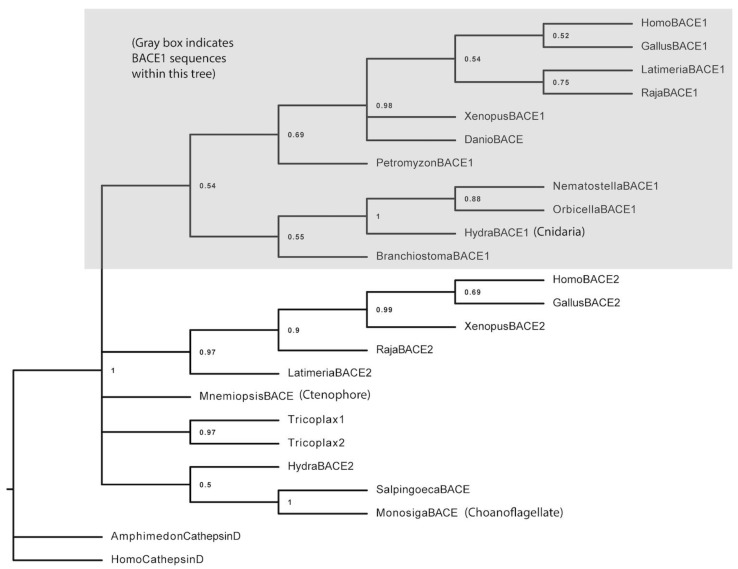
Figure 1
Figure 1
Cnidarians are the most basal group with a BACE1 ortholog. Maximum-likelihood tree of BACE sequences with nodes collapsed below the 50% bootstrap support. BACE1 and BACE2 sequences form clear clades with cnidarians being the most basal group found in our search to have a BACE1 sequence (shown in the gray box). Other BACE-like sequences can be found in basal animal taxa such as ctenophores (e.g., Mnemiopsis) and placozoans (Tricoplax), as well as in the sister group to animals, choanoflagellates (Monosiga). These sequences form a polytomy with the BACE1 and BACE2 groups, mirroring the polytomies that are found in phylogenies at the whole-organism level. As a tentative model, we consider them to be single-gene, pre-duplicate precursors to BACE 1 and BACE 2. Tricoplax appears to have undergone an independent duplication of this BACE1/2 precursor. Cathepsin D aspartyl proteases are the sister group to the BACE genes; we can find this gene but not BACE genes in porifera (Amphimedon).
Figure 2
Figure 2
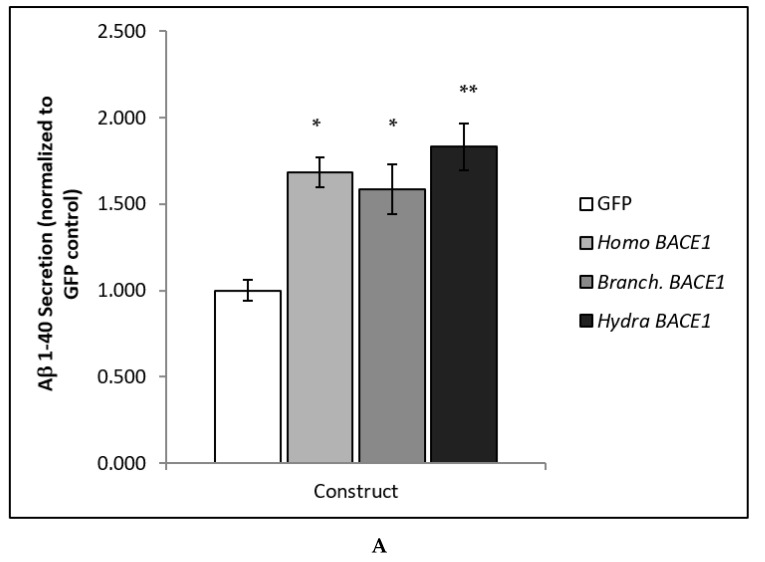
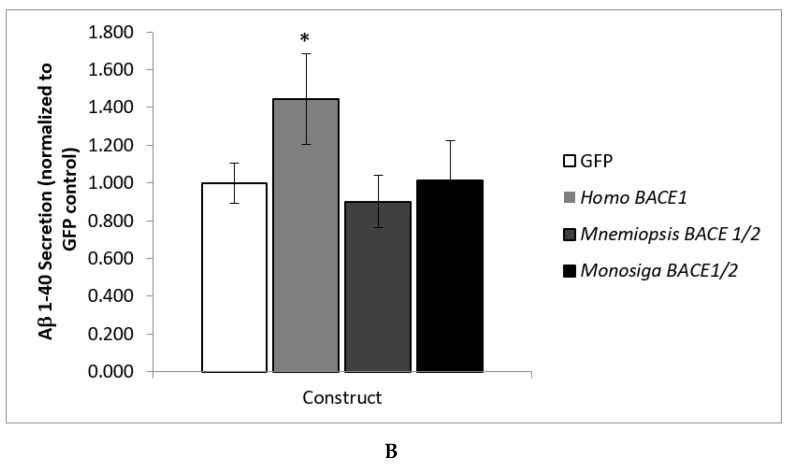
BACE1 functional activity towards human APP/Aβ is conserved in cnidarians but not in ctenophores or choanoflagellates. CHO 695 cells stably transfected with human APP were transiently transfected with the following cDNA expression constructs: GFP (negative control), Hydra BACE1, Mnemiopsis BACE 1/2, or Monosiga BACE 1/2. Homo BACE1 and Branchiostoma (Branch.) BACE1 constructs were used as positive controls. Conditioned media were harvested after 16 h, and the secretion of human Aβ was determined via ELISA. Data were normalized to total protein and analyzed with one-way ANOVA followed by Tukey’s post hoc test (* p < 0.05; ** p < 0.01). Data are representative of three independent transfection rounds. Homo, Branchiostoma, and Hydra BACE1 all elevated Aβ secretion (A), while Mnemiopsis and Monosiga BACE 1/2 did not (B).
Figure 2
Figure 2
BACE1 functional activity towards human APP/Aβ is conserved in cnidarians but not in ctenophores or choanoflagellates. CHO 695 cells stably transfected with human APP were transiently transfected with the following cDNA expression constructs: GFP (negative control), Hydra BACE1, Mnemiopsis BACE 1/2, or Monosiga BACE 1/2. Homo BACE1 and Branchiostoma (Branch.) BACE1 constructs were used as positive controls. Conditioned media were harvested after 16 h, and the secretion of human Aβ was determined via ELISA. Data were normalized to total protein and analyzed with one-way ANOVA followed by Tukey’s post hoc test (* p < 0.05; ** p < 0.01). Data are representative of three independent transfection rounds. Homo, Branchiostoma, and Hydra BACE1 all elevated Aβ secretion (A), while Mnemiopsis and Monosiga BACE 1/2 did not (B).
Figure 3
Figure 3
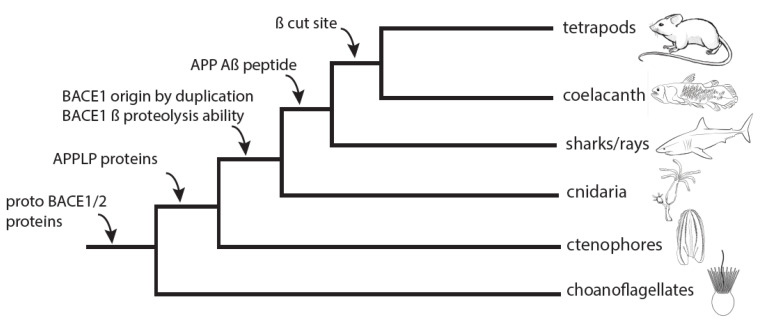
Relative timeline for BACE1 and Aβ evolution. Simplified animal phylogeny with key events supported in this paper and our previous paper [11]. Pre-duplicate BACE1/2 predates animal origins and can be found in extant choanoflagellates, as well as in ctenophores and placozoans (not shown for simplicity). Cnidaria are the most basal group that definitively shows BACE1. We demonstrate that this gene can proteolyze APP/Aβ, while BACE1/2 genes cannot. This proteolytic ability thus correlates with the likely advent of BACE1 by gene duplication. Strikingly, the ability of BACE1 to proteolyze APP/Aβ predates the actual origin of Aβ in vertebrates by several hundred million years.

References

    1. Gouras G.K., Olsson T.T., Hansson O. β-Amyloid Peptides and Amyloid Plaques in Alzheimer’s Disease. Neurotherapeutics. 2015;12:3–11. doi: 10.1007/s13311-014-0313-y. - DOI - PMC - PubMed
    1. Murphy M.P., LeVine H. Alzheimer’s Disease and the β-Amyloid Peptide. J. Alzheimers Dis. 2010;19:311. doi: 10.3233/JAD-2010-1221. - DOI - PMC - PubMed
    1. Wang X., Zhou X., Li G., Zhang Y., Wu Y., Song W. Modifications and Trafficking of APP in the Pathogenesis of Alzheimer’s Disease. Front. Mol. Neurosci. 2017;10:294. doi: 10.3389/fnmol.2017.00294. - DOI - PMC - PubMed
    1. Vassar R., Bennett B.D., Babu-Khan S., Kahn S., Mendiaz E.A., Denis P., Teplow D.B., Ross S., Amarante P., Loeloff R., et al. Beta-Secretase Cleavage of Alzheimer’s Amyloid Precursor Protein by the Transmembrane Aspartic Protease BACE. Science. 1999;286:735–741. doi: 10.1126/science.286.5440.735. - DOI - PubMed
    1. Ahmed R.R., Holler C.J., Webb R.L., Li F., Beckett T.L., Murphy M.P. BACE1 and BACE2 Enzymatic Activities in Alzheimer’s Disease. J. Neurochem. 2010;112:1045–1053. doi: 10.1111/j.1471-4159.2009.06528.x. - DOI - PMC - PubMed

LinkOut - more resources