


The Aesthetic Developmental Characteristics of Contour Features in Children and Adolescents with High- and Low- Level Visual Aesthetic Sensitivity across Grade Levels
- PMID: 38785908
- PMCID: PMC11117876
- DOI: 10.3390/bs14050416
The Aesthetic Developmental Characteristics of Contour Features in Children and Adolescents with High- and Low- Level Visual Aesthetic Sensitivity across Grade Levels
Abstract
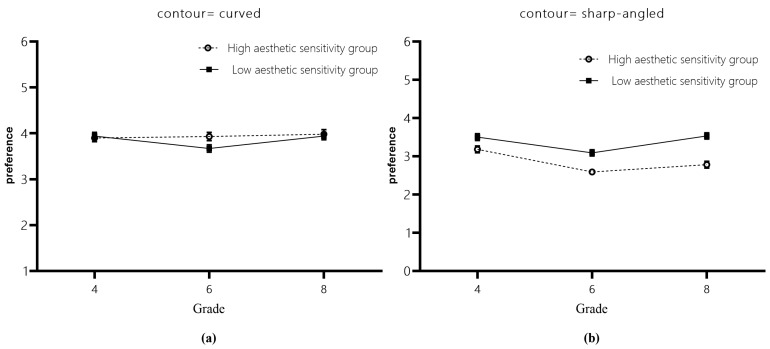
This study examined the aesthetic developmental characteristics of contour features (curved and sharp corners) among children and adolescents with different levels (high and low) of visual aesthetic sensitivity in three grades (4, 6, and 8). The results revealed that (1) there was a significant main effect of contour features, with children and adolescents liking curved contours and perceiving them as more beautiful than sharp-angled contours; (2) there was a significant interaction with contour features in grades 6 and 4, and there was no significant difference in liking curved contours and perceiving them to be more beautiful between students in grades 6 and 4. However, grade 6 students disliked sharp-angled contours and perceived them as more unattractive than grade 4 students; and (3) there was a significant interaction between the level of visual aesthetic sensitivity and contour features, as children and adolescents with both high and low levels of visual aesthetic sensitivity preferred curved contours and considered them more beautiful. However, children and adolescents with high-level visual aesthetic sensitivity disliked sharp-angled contours and considered them more unattractive compared to students with low-level visual aesthetic sensitivity. The results proposed that children and adolescents preferred curved contours, 6th graders were more sensitive to curved contours than 4th graders, and children and adolescents with high-level visual aesthetic sensitivity were more sensitive to sharp-angled contours than children and adolescents with low-level visual aesthetic sensitivity.
Keywords: adolescents; children; contour features; developmental characteristics; high and low levels; visual aesthetic sensitivity.
Conflict of interest statement
The authors declare no conflicts of interest.
Figures


References
-
- Corradi G., Munar E. The Curvature Effect. In: Nadal M., Vartanian O., editors. The Oxford Handbook of Empirical Aesthetics. Oxford University Press; Oxford, UK: 2020. pp. 510–532.
-
- Silvia P.J., Barona C.M. Do People Prefer Curved Objects? Angularity, Expertise, and Aesthetic Preference. Empir. Stud. Arts. 2009;27:25–42. doi: 10.2190/EM.27.1.b. - DOI
-
- Hevner K. Experimental Studies of the Affective Value of Colors and Lines. J. Appl. Psychol. 1935;19:385–398. doi: 10.1037/h0055538. - DOI
-
- Lundholm H. The Affective Tone of Lines: Experimental Researches. Psychol. Rev. 1921;28:43–60. doi: 10.1037/h0072647. - DOI
LinkOut - more resources
Full Text Sources
