. 2024 May 20;13(10):879.
doi: 10.3390/cells13100879.

Pre-Clinical Assessment of SAR442257, a CD38/CD3xCD28 Trispecific T Cell Engager in Treatment of Relapsed/Refractory Multiple Myeloma

Affiliations

Pre-Clinical Assessment of SAR442257, a CD38/CD3xCD28 Trispecific T Cell Engager in Treatment of Relapsed/Refractory Multiple Myeloma

Anna Luise Grab et al. Cells. .

Abstract

Current treatment strategies for multiple myeloma (MM) are highly effective, but most patients develop relapsed/refractory disease (RRMM). The anti-CD38/CD3xCD28 trispecific antibody SAR442257 targets CD38 and CD28 on MM cells and co-stimulates CD3 and CD28 on T cells (TCs). We evaluated different key aspects such as MM cells and T cells avidity interaction, tumor killing, and biomarkers for drug potency in three distinct cohorts of RRMM patients. We found that a significantly higher proportion of RRMM patients (86%) exhibited aberrant co-expression of CD28 compared to newly diagnosed MM (NDMM) patients (19%). Furthermore, SAR442257 mediated significantly higher TC activation, resulting in enhanced MM killing compared to bispecific functional knockout controls for all relapse cohorts (Pearson's r = 0.7). Finally, patients refractory to anti-CD38 therapy had higher levels of TGF-β (up to 20-fold) compared to other cohorts. This can limit the activity of SAR442257. Vactoserib, a TGF-β inhibitor, was able to mitigate this effect and restore sensitivity to SAR442257 in these experiments. In conclusion, SAR442257 has high potential for enhancing TC cytotoxicity by co-targeting CD38 and CD28 on MM and CD3/CD28 on T cells.

Keywords: T cell engager; cell avidity; microenvironment; refractory multiple myeloma.


Conflict of interest statement

We disclose that Sanofi employees may hold shares and/or stock options in the company. RMR, IS, DS are employed by a commercial company (LUMICKS).

Figures
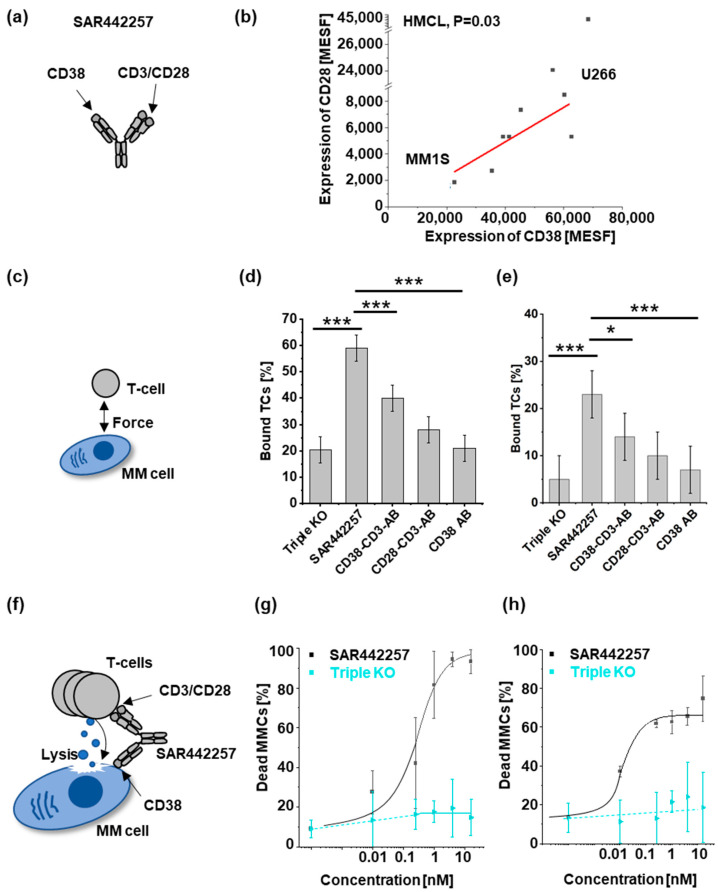
Figure 1
Figure 1
Characterization of SAR442257 potency in human multiple myeloma cell lines (HMCLs): (a) SAR442257 geometry; (b) correlation of target expression (in molecules of equivalent soluble fluorochrome (MESF)) of CD38 and CD28 on 10 HMCL. We measured CD38 and CD28 target expression and found a linear relationship with Pearson’s r = 0.7, p = 0.03. (ce) Cellular avidity ranks as a percentage of TCs bound to MM cells by indicated TC engagers (triple knockout (KO), SAR442257, CD38-CD3-antibody (AB), CD28-CD3-AB, CD38 AB) for U266 (d) and MM1S (e). (fh) Dose response curves of SAR442257 or triple KO control in (g) U266 and (h) MM1S with healthy donor TCs (E:T = 10:1). (Significance was determined using TTEST, * p < 0.05, *** p < 0.001).
Figure 2
Figure 2
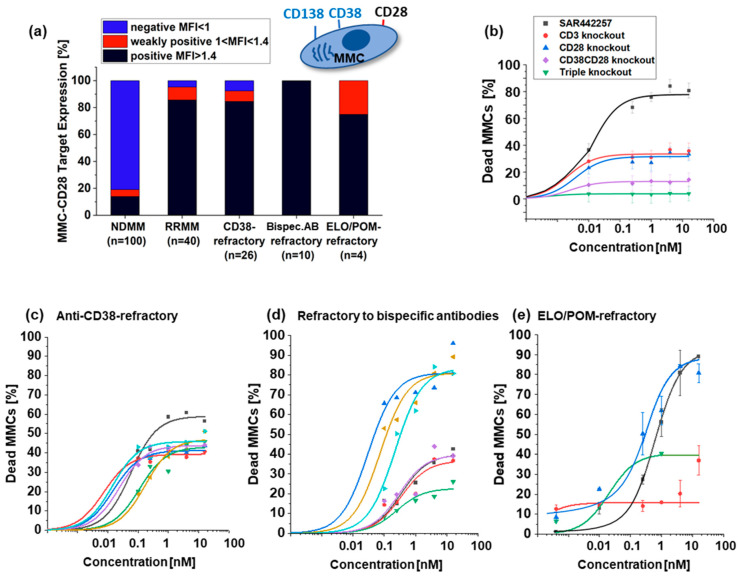
(a) Percentage of CD28 positive NDMM (n = 100) and the mean values of CD28 positive RRMM (n = 40), anti-CD38-refractory (n = 26), bispecific antibodies for TC engagement-refractory (n = 10), and ELO/POM-refractory (n = 4) patients (black bar indicates CD28 positive target expression, red bar weakly positive and blue bar CD28 negative target expression). (b) Mean value of dose-response curves of indicated TC engagers for 40 investigated samples from refractory MM patients. We show the percentage of dead MMCs after contact to SAR442257 (black), CD3 knockout antibody (red), CD28 knockout (blue) CD38CD28 knockout (violet) and triple knockout (green). (ce) Dose response curves for patients with different pretreatment (c) anti-CD38 antibody refractory, (d) refractory to bispecific antibodies for TC engagement, and (e) ELO/POM refractory patients. Each patient is represented in a different color.
Figure 3
Figure 3
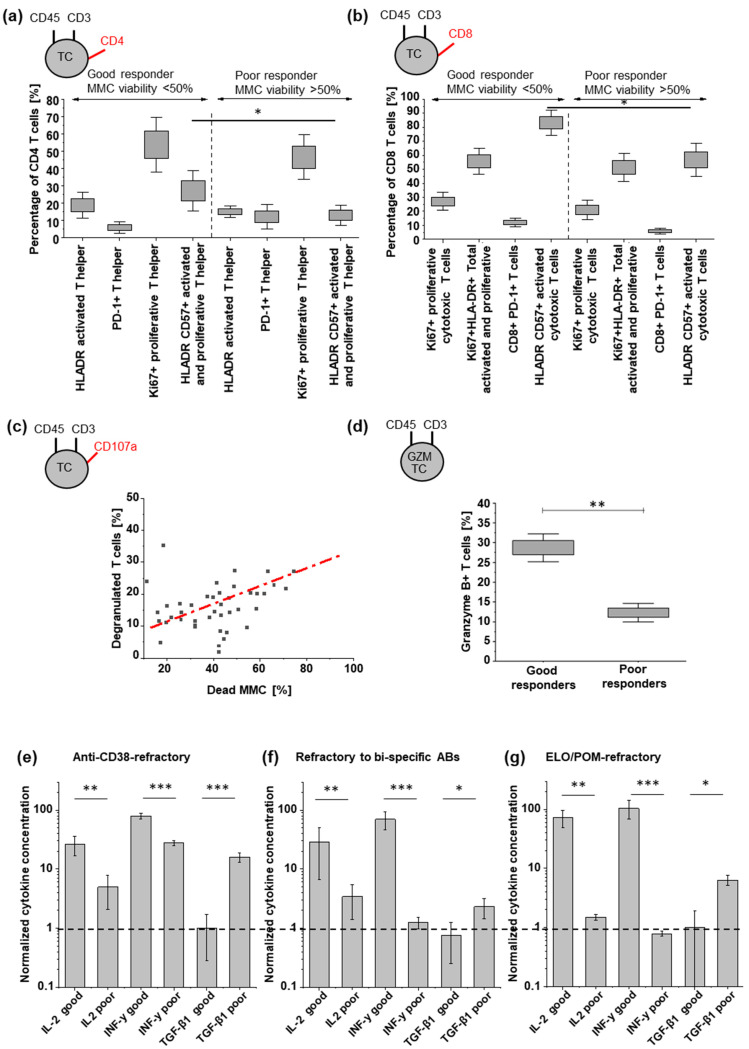
Characterization of CD4 and CD8 TC states, degranulation, and cytokine release. (a,b) TC subpopulations indicated by respective markers, according to good and poor response groups. (c) Tumor killing correlates with SAR442257-induced TC activation (Pearson’s r = 0.7). (d) frequency of granzyme B-positive TCs and (eg) comparison of respective concentrations of IL2, INF-y, and TGF-β1 for good and poor responders after 24 h of exposure to SAR442257 (significance was determined using TTEST, * p < 0.05, ** p < 0.01, *** p < 0.001). The dotted line represents a normalized cytokine concentration of 1.
Figure 4
Figure 4
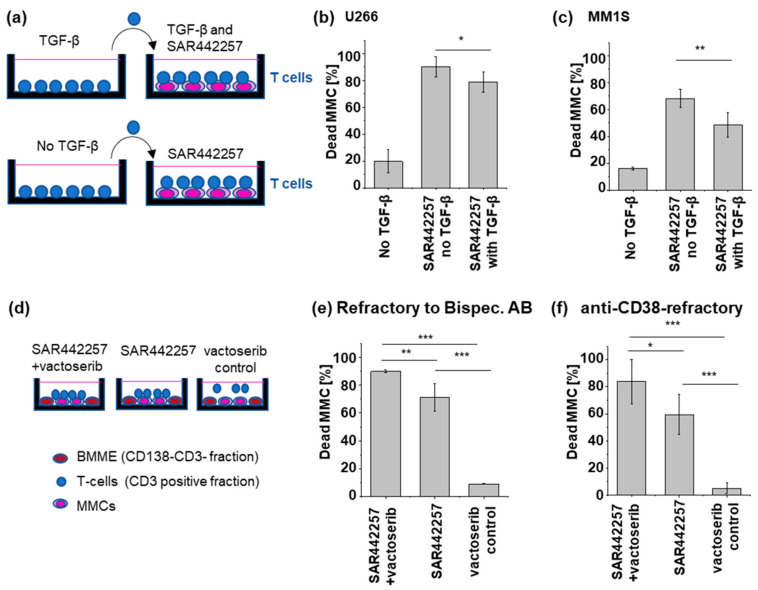
Presence of TGF-β in co-culture reduces TCE efficiency. (a) Sketch of the experimental setup (b,c) After a 24-hour culture in TGF-β-supplemented medium, healthy donor TCs are subsequently introduced into a co-culture with (b) U266 and (c) MM1S. TGF-β significantly reduced the drug potency of SAR442257. (df) Primary T cells were isolated from patient samples, and MM cells (MMCs) were co-cultured in the presence of the natural bone marrow microenvironment (BMME, CD138-CD3 fraction). Vactoserib, SAR442257, or a combination of vactoserib and SAR442257 were then added to the co-culture system. Vactoserib-SAR442257 combinations overcome TGF-β-induced T cell exhaustion. SAR442257 induced significantly higher MM cell killing in the presence of vactoserib in (e) bispecific antibodies for TC engagement and (f) anti-CD38-refractory samples. Viability was measured after 24 h of co-culture using FACS. All measurements were carried out in duplicates (significance was determined using TTEST, * p < 0.05, ** p < 0.01, *** p < 0.001).

References

    1. Raje N., Mateos M.-V., Iida S., Reece D. Clinical evidence for immune-based strategies in early-line multiple myeloma: Current challenges in decision-making for subsequent therapy. Blood Cancer J. 2023;13:41. doi: 10.1038/s41408-023-00804-y. - DOI - PMC - PubMed
    1. Mateo G., Castellanos M., Rasillo A., Gutierrez N.C., Montalban M.A., Martin M.L., Hernandez J.M., Lopez-Berges M.C., Montejano L., Blade J., et al. Genetic abnormalities and patterns of antigenic expression in multiple myeloma. Clin. Cancer Res. 2005;11:3661–3667. doi: 10.1158/1078-0432.CCR-04-1489. - DOI - PubMed
    1. Almeida J., Orfao A., Ocqueteau M., Mateo G., Corral M., Caballero M.D., Blade J., Moro M.J., Hernandez J., San Miguel J.F. High-sensitive immunophenotyping and DNA ploidy studies for the investigation of minimal residual disease in multiple myeloma. Br. J. Haematol. 1999;107:121–131. doi: 10.1046/j.1365-2141.1999.01685.x. - DOI - PubMed
    1. Bahlis N.J., King A.M., Kolonias D., Carlson L.M., Liu H.Y., Hussein M.A., Terebelo H.R., Byrne G.E., Jr., Levine B.L., Boise L.H., et al. CD28-mediated regulation of multiple myeloma cell proliferation and survival. Blood. 2007;109:5002–5010. doi: 10.1182/blood-2006-03-012542. - DOI - PMC - PubMed
    1. Chung D.J., Pronschinske K.B., Shyer J.A., Sharma S., Leung S., Curran S.A., Lesokhin A.M., Devlin S.M., Giralt S.A., Young J.W. T-cell Exhaustion in Multiple Myeloma Relapse after Autotransplant: Optimal Timing of Immunotherapy. Cancer Immunol. Res. 2016;4:61–71. doi: 10.1158/2326-6066.CIR-15-0055. - DOI - PMC - PubMed

Publication types

MeSH terms