. 2024 Apr 27;9(5):264.
doi: 10.3390/biomimetics9050264.

Seahorse-Tail-Inspired Soft Pneumatic Actuator: Development and Experimental Characterization

Affiliations

Seahorse-Tail-Inspired Soft Pneumatic Actuator: Development and Experimental Characterization

Michele Gabrio Antonelli et al. Biomimetics (Basel). .

Abstract

The study of bio-inspired structures and their reproduction has always fascinated humans. The advent of soft robotics, thanks to soft materials, has enabled considerable progress in this field. Over the years, polyps, worms, cockroaches, jellyfish, and multiple anthropomorphic structures such as hands or limbs have been reproduced. These structures have often been used for gripping and handling delicate objects or those with complex unknown a priori shapes. Several studies have also been conducted on grippers inspired by the seahorse tail. In this paper, a novel biomimetic soft pneumatic actuator inspired by the tail of the seahorse Hippocampus reidi is presented. The actuator has been developed to make a leg to sustain a multi-legged robot. The prototyping of the actuator was possible by combining a 3D-printed reinforcement in thermoplastic polyurethane, mimicking the skeletal apparatus, within a silicone rubber structure, replicating the functions of the external epithelial tissue. The latter has an internal channel for pneumatic actuation that acts as the inner muscle. The study on the anatomy and kinematic behaviour of the seahorse tail suggested the mechanical design of the actuator. Through a test campaign, the actuator prototype was characterized by isotonic tests with an external null load, isometric tests, and activation/deactivation times. Specifically, the full actuator distension of 154.5 mm occurs at 1.8 bar, exerting a maximum force of 11.9 N, with an activation and deactivation time of 74.9 and 94.5 ms, respectively.

Keywords: bio-inspired soft pneumatic actuator; experimental characterization; finite element analysis; seahorse tail; soft robotics.


Conflict of interest statement

The authors declare no conflicts of interest.

Figures

Figure 1
Figure 1
(a) H. hippocampus with its tail anchored to plant on seabed; (b) detail of plates and rings of H. reidi species; (c) detail of detaching from seabed; (d) seahorse with tail slightly bent backward.
Figure 2
Figure 2
(a) Detail of seahorse dimensions: fish height (A–B, with stretching tail), head length (A–C), tail length (D–B, with stretched tail), maximum width (E–F), and constituent elements of tail segment with its characteristic dimensions (W, t, γ); (b) detail of the components of tail segment; (c) examples of logarithmic spiral in different natural structures: (1) pinecone, (2) chameleon tail, (3) shell, and (4) seahorse tail.
Figure 3
Figure 3
Dimensions of the H. reidi segments: (a) experimental and adopted W; (b) experimental and adopted t; (c) experimental and adopted γ.
Figure 4
Figure 4
Details of logarithmic spirals: (a) a = 6 mm and b equal to 0.15 (blue line), 0.18 (orange line), 0.20 (yellow line); (b) b = 0.18 and a equal to 4 mm (blue line), 6 mm (orange line), 8 mm (yellow line). The thick orange line represents the spiral adopted in the present work.
Figure 5
Figure 5
CAD model: (a) reinforcement with 33 segments connected along the dorsal side and a detail about the guiding logarithmic spiral profile (green line); (b) the covering inspired by epithelial tissue with the detail about labyrinth gaskets (black circle) and a virtual hinge (green ellipse); (c) the assembled SPA.
Figure 6
Figure 6
The FEM model of the actuator: (a) constraints and boundary conditions; (b) deformation results at different pressure levels.
Figure 7
Figure 7
The reinforcement in TPU: (a) designed reinforcement with the core; (b) prototyped reinforcement with the core; (c) fully unrolled reinforcement (perspective effects are visible in the figure).
Figure 8
Figure 8
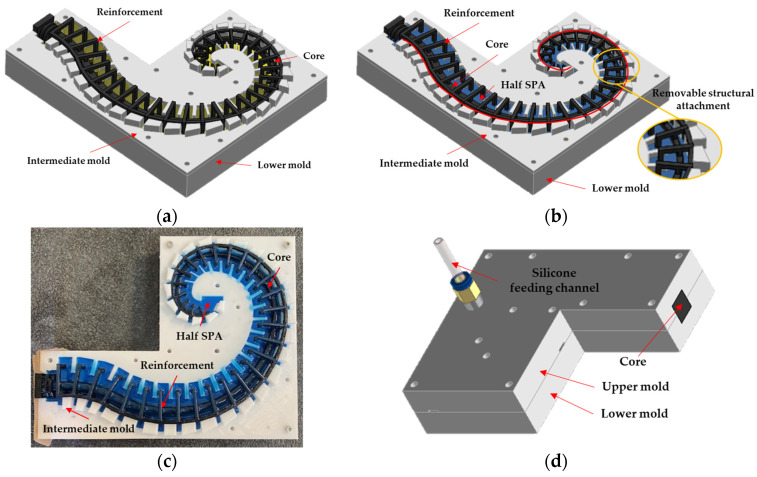
SPA manufacturing process: (a) stage I: mold assembly with the cavity to be filled (in yellow); (b) stage I: half SPA realized (blue), the link between intermediate mold and reinforcement (along red line) and the detail about reinforcement–core connection (yellow circle); (c) experimental top view of the end of stage I; (d) stage II: the intermediate mold is replaced with the upper mold, and silicone rubber is injected by a double-acting cylinder.
Figure 9
Figure 9
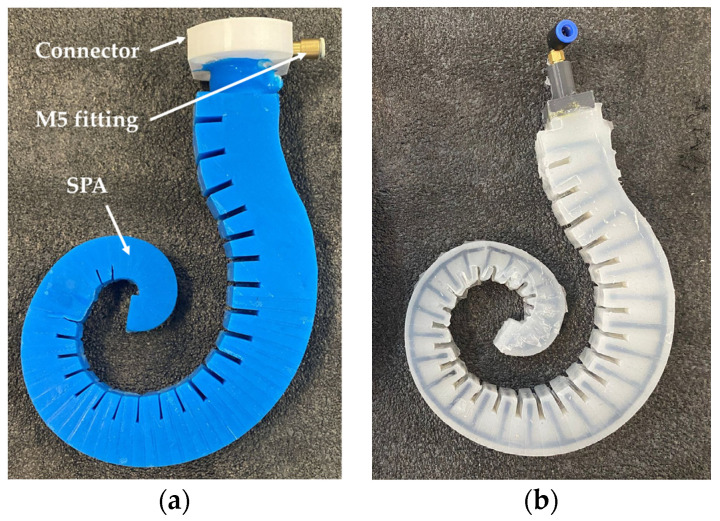
The prototype of the SPA: (a) the prototype made of R PRO20 adopted for the present work; (b) a similar prototype for showing the reinforcement within the covering.
Figure 10
Figure 10
The test bench: (a) a schematic with the components and details about PLA plates (red circle) to limit the radial deformation and markers (blue points in the red circles); (b) a detail of the actuator placed by the cobot on the load cell.
Figure 11
Figure 11
Deformations of the actuator in isotonic tests with a null external load as a function of the pressure at: (1) −0.85 bar; (2) −0.8 bar; (3) −0.6 bar; (4) −0.4 bar; (5) −0.2 bar; (6) 0.0 bar; (7) 0.2 bar; (8) 0.4 bar; (9) 0.6 bar; (10) 0.8 bar; (11) 1.0 bar; (12) 1.2 bar; (13) 1.4 bar; (14) 1.6 bar; (15) 1.8 bar.
Figure 12
Figure 12
Kinematic and dynamic behavior of the actuator: (a) displacement of the sector markers at different feeding pressure values; (b) positions along the X and Z axes of point P of the actuator; (c) moving experimental and numerical centrode of point P; (d) isometric test results.
Figure 13
Figure 13
Time tests: activation and deactivation times as a function of the feeding pressure.

References

    1. Hepp J., Badri-Spröwitz A. A Novel Spider-Inspired Rotary-Rolling Diaphragm Actuator with Linear Torque Characteristic and High Mechanical Efficiency. Soft Robot. 2022;9:364–375. doi: 10.1089/soro.2020.0108. - DOI - PMC - PubMed
    1. Pena-Francesch A., Jung H., Demirel M.C., Sitti M. Biosynthetic self-healing materials for soft machines. Nat. Mater. 2020;19:1230–1235. doi: 10.1038/s41563-020-0736-2. - DOI - PMC - PubMed
    1. Ratwani C.R., Kamali A.R., Abdelkader A.M. Self-healing by Diels-Alder cycloaddition in advanced functional polymers: A review. Prog. Mater. Sci. 2023;131:101001. doi: 10.1016/j.pmatsci.2022.101001. - DOI
    1. Antonelli M.G., Beomonte Zobel P., D’Ambrogio W., Durante F. Design Methodology for a Novel Bending Pneumatic Soft Actuator for Kinematically Mirroring the Shape of Objects. Actuators. 2020;9:113. doi: 10.3390/act9040113. - DOI
    1. Antonelli M.G., D’Ambrogio W., Durante F. Development of a pneumatic soft actuator as a hand finger for a collaborative robot; Proceedings of the 2nd International Conference on Mechatronics Systems and Control Engineering; Amsterdam, The Netherlands. 21–23 February 2018; pp. 67–71.

LinkOut - more resources