Review
. 2024 May 10;14(5):277.
doi: 10.3390/metabo14050277.

Salivary Metabolites Produced by Oral Microbes in Oral Diseases and Oral Squamous Cell Carcinoma: A Review

Affiliations
Review

Salivary Metabolites Produced by Oral Microbes in Oral Diseases and Oral Squamous Cell Carcinoma: A Review

Bina Kashyap et al. Metabolites. .

Abstract

In recent years, salivary metabolome studies have provided new biological information and salivary biomarkers to diagnose different diseases at early stages. The saliva in the oral cavity is influenced by many factors that are reflected in the salivary metabolite profile. Oral microbes can alter the salivary metabolite profile and may express oral inflammation or oral diseases. The released microbial metabolites in the saliva represent the altered biochemical pathways in the oral cavity. This review highlights the oral microbial profile and microbial metabolites released in saliva and its use as a diagnostic biofluid for different oral diseases. The importance of salivary metabolites produced by oral microbes as risk factors for oral diseases and their possible relationship in oral carcinogenesis is discussed.

Keywords: dysbiosis; metabolites; oral cancer; oral disease; oral microbiome; saliva.


Conflict of interest statement

The authors declare no conflicts of interest.

Figures
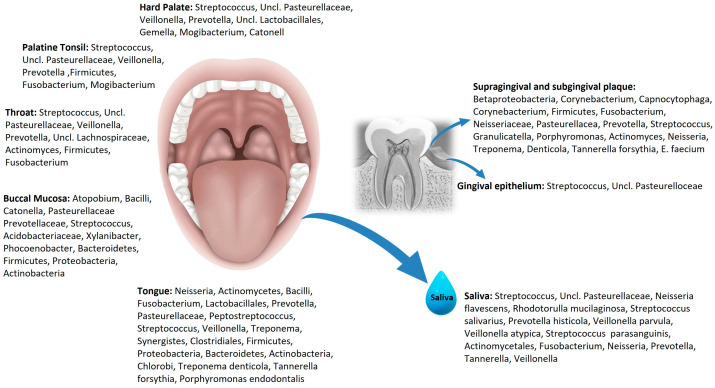
Figure 1
Figure 1
Site-specific oral microbial distribution in the oral cavity.
Figure 2
Figure 2
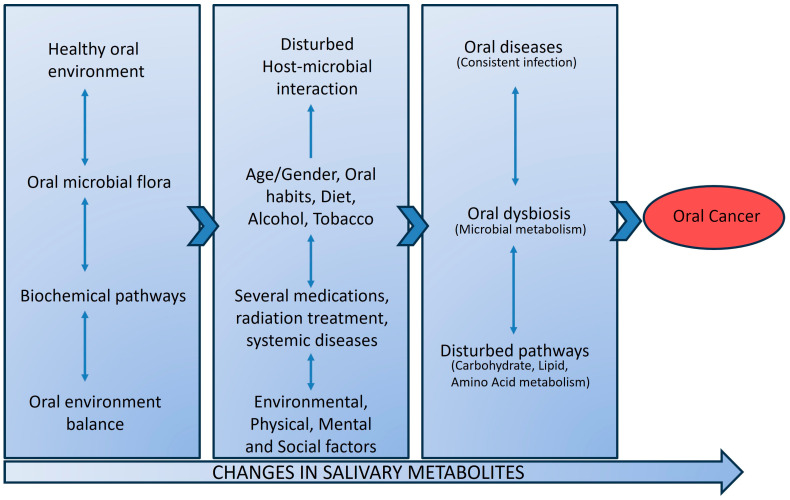
Pathologic model presenting oral dysbiosis and microbial metabolite with disturbed pathways influencing oral cancer development. In disease-free conditions, the oral microbial flora and their related biochemical pathways are in harmony to maintain a healthy oral environment. Disturbances in the host and oral microbiome can result in oral dysbiosis with disturbed biochemical pathways. Continued oral infection and oral dysbiosis affect the carbohydrate, amino acid, and lipid metabolism. The bacterial end-product in saliva as salivary metabolites can have carcinogenic effects, resulting in oral cancer.

References

    1. Sung H., Ferlay J., Siegel R.L., Laversanne M., Soerjomataram I., Jemal A., Bray F. Global cancer statistics 2020: GLOBOCAN estimates of incidence and mortality worldwide for 36 cancers in 185 countries. CA A Cancer J. Clin. 2021;71:209–249. doi: 10.3322/caac.21660. - DOI - PubMed
    1. Kurago Z., Loveless J. Microbial colonization and inflammation as potential contributors to the lack of therapeutic success in oral squamous cell carcinoma. Front. Oral Health. 2021;2:739499. doi: 10.3389/froh.2021.739499. - DOI - PMC - PubMed
    1. Bacali C., Vulturar R., Buduru S., Cozma A., Fodor A., Chiș A., Lucaciu O., Damian L., Moldovan M.L. Oral Microbiome: Getting to Know and Befriend Neighbors, a Biological Approach. Biomedicines. 2022;10:671. doi: 10.3390/biomedicines10030671. - DOI - PMC - PubMed
    1. HOMD Human Oral Microbiome Database. [(accessed on 13 November 2023)]. Available online: http://www.homd.org/
    1. Hyvärinen E., Savolainen M., Mikkonen J.J.W., Kullaa A.M. Salivary Metabolomics for Diagnosis and Monitoring Diseases: Challenges and Possibilities. Metabolites. 2021;11:587. doi: 10.3390/metabo11090587. - DOI - PMC - PubMed

LinkOut - more resources