


Multidimensional influencing factors of postpartum depression based on the perspective of the entire reproductive cycle: evidence from western province of China
- PMID: 38789557
- PMCID: PMC11522041
- DOI: 10.1007/s00127-024-02686-2
Multidimensional influencing factors of postpartum depression based on the perspective of the entire reproductive cycle: evidence from western province of China
Abstract
Objective: China has a serious burden of Postpartum depression (PPD). In order to improve the current situation of high burden of PPD, this study explores the factors affecting PPD from the multidimensional perspectives with physiology, family support and social support covering the full-time chain of pre-pregnancy-pregnancy-postpartum.
Methods: A follow-up survey was conducted in the Qujing First People's Hospital of Yunnan Province from 2020 to 2022, and a total of 4838 pregnant women who underwent antenatal checkups in the hospital were enrolled as study subjects. Mothers were assessed for PPD using the Edinburgh Postnatal Depression Scale (EPDS), and logistic regression was used to analyse the level of mothers' postnatal depression and identify vulnerability characteristics.
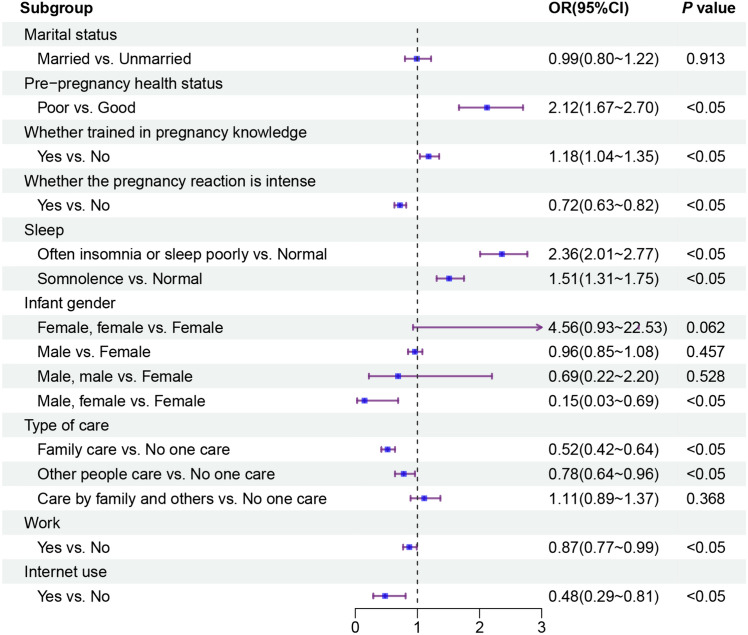
Results: The prevalence of mothers' PPD was 46.05%, with a higher prevalence among those who had poor pre-pregnancy health, had sleep problems during pregnancy, and only had a single female fetus. In the family support dimension, only family care (OR = 0.52, 95% CI 0.42-0.64) and only other people care(OR = 0.78, 95% CI 0.64-0.96) were the protective factors of PPD. The experience risk of PPD was higher among mothers who did not work or use internet.
Conclusion: The PPD level in Yunnan Province was significantly higher than the global and Chinese average levels. Factors affecting mothers' PPD exist in all time stages throughout pregnancy, and the influence of family support and social support on PPD shouldn't be ignored. There is an urgent need to extend the time chain of PPD, move its prevention and treatment forward and broaden the dimensions of its intervention.
Keywords: Family support; Postpartum depression; Risk factors; Social support.
© 2024. The Author(s).
Conflict of interest statement
All authors declare that they have no conflicts of interest.
Figures
Similar articles
-
The Prevalence of Postpartum Depression and the Correlation of Perceived Social Support and Quality of Life with Postpartum Depression: A Longitudinal Study.P R Health Sci J. 2020 Dec;39(4):327-335. P R Health Sci J. 2020. PMID: 33320462
-
Effects of postpartum fatigue, parenting stress, and family support on postpartum depression in Chinese first-time mothers: a cross-sectional study.Womens Health Nurs. 2024 Sep;30(3):226-237. doi: 10.4069/whn.2024.09.02.1. Epub 2024 Sep 30. Womens Health Nurs. 2024. PMID: 39385549 Free PMC article.
-
Prevalence and Risk Factors of Postpartum Depression Among Women in Low-Income Developing Rural Areas: A Cross-Sectional Study in China.Depress Anxiety. 2024 Oct 1;2024:8841423. doi: 10.1155/2024/8841423. eCollection 2024. Depress Anxiety. 2024. PMID: 40226729 Free PMC article.
-
Status of postpartum depression in Turkey: A meta-analysis.Health Care Women Int. 2018 Jul;39(7):821-841. doi: 10.1080/07399332.2018.1466144. Epub 2018 Jun 8. Health Care Women Int. 2018. PMID: 29693507
-
India's Silent Struggle: A Scoping Review on Postpartum Depression in the Land of a Billion Mothers.Indian J Psychol Med. 2025 May;47(3):207-213. doi: 10.1177/02537176241245773. Epub 2024 May 13. Indian J Psychol Med. 2025. PMID: 39564219 Free PMC article. Review.
References
-
- Lanjewar S, Nimkar S, Jungari S (2021) Depressed motherhood: prevalence and covariates of maternal postpartum depression among urban mothers in India. Asian J Psychiatry 57:102567. 10.1016/j.ajp.2021.102567 - PubMed
-
- Stewart DE, Robertson E, Phil M et al (2003) Postpartum depression: literature review of risk factors and interventions. University Health Network Women’s Health Program for Toronto Public Health, Toronto
-
- Hendrick V, Altshuler LL, Suri R (1998) Hormonal changes in the postpartum and implications for postpartum depression. Psychosomatics 39:93–101. 10.1016/S0033-3182(98)71355-6 - PubMed
MeSH terms
Grants and funding
- 82073569/National Natural Science Foundation of China
- 81960592/National Natural Science Foundation of China
- 202001AW070021/Outstanding Youth Science Fundation of Yunnan Basic Research Project
- 2012005AC160023/Reserve Talent Project for Young and Middle-aged Acadamic and Technical Leaders
- 202101AS070040/Key Science Fundation of Yunnan Basic Research
LinkOut - more resources
Full Text Sources
Medical
