


Review
doi: 10.1186/s10195-024-00768-0.
Cellular therapies for bone repair: current insights
Affiliations
- PMID: 38789881
- PMCID: PMC11132192
- DOI: 10.1186/s10195-024-00768-0
Item in Clipboard
Review
Cellular therapies for bone repair: current insights
J Orthop Traumatol.
.
Abstract
Mesenchymal stem cells are core to bone homeostasis and repair. They both provide the progenitor cells from which bone cells are formed and regulate the local cytokine environment to create a pro-osteogenic environment. Dysregulation of these cells is often seen in orthopaedic pathology and can be manipulated by the physician treating the patient. This narrative review aims to describe the common applications of cell therapies to bone healing whilst also suggesting the future direction of these techniques.
Keywords: Cellular therapy; Clinical applications; Fracture healing; Stem cells.
© 2024. The Author(s).
Conflict of interest statement
All authors declare no conflict of interest.
Figures
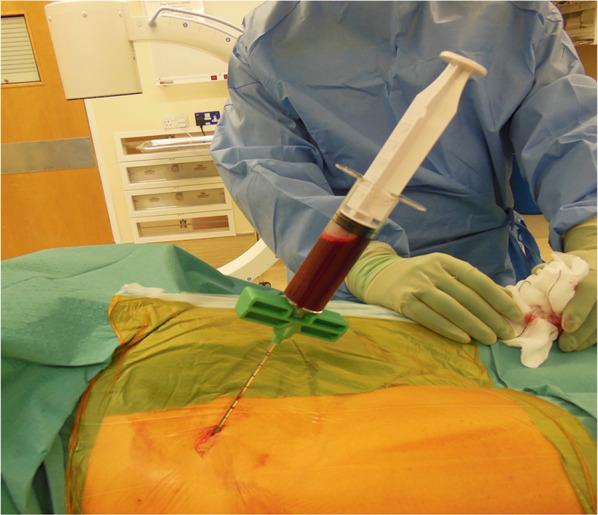
Intraoperative image showing aspiration of bone marrow aspirate from the anterior pelvic iliac crest
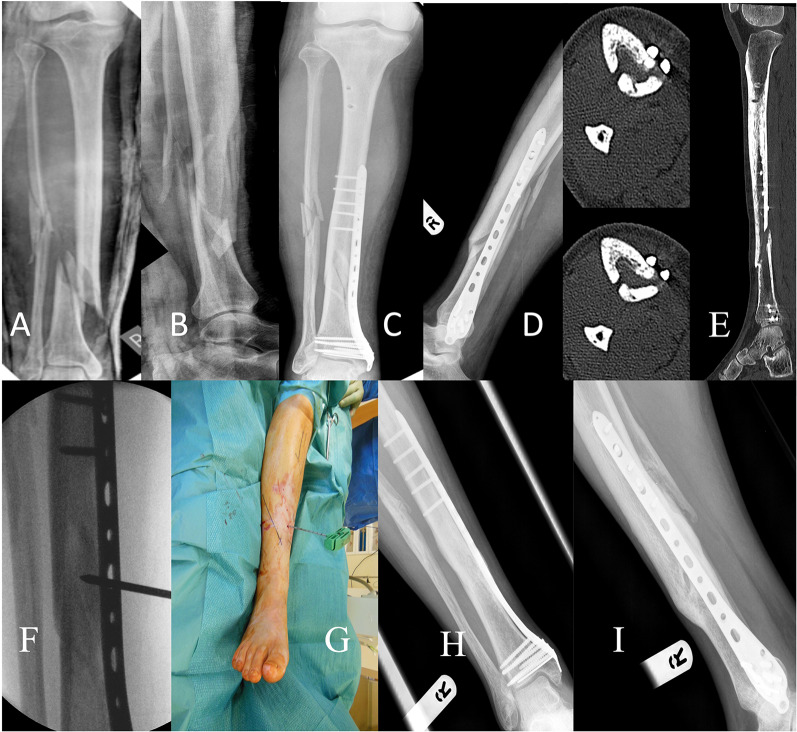
A 42-year-old male sustained a closed distal tibial fracture following a fall (A, B). The fracture was stabilised with a MIPO plate and demonstrated little callus formation 6 weeks after surgery (C, D). A CT scan taken at 6 months demonstrates an established nonunion (E). The patient underwent the harvesting of 60 ml bone marrow from the ipsilateral iliac crest, which was concentrated down to 7 ml of BMAC. This was injected by a percutaneous technique into the nonunion site (F, G). Following this technique, union was achieved within 4 months (H, I). MIPO Minimal invasive plate osteosynthesis
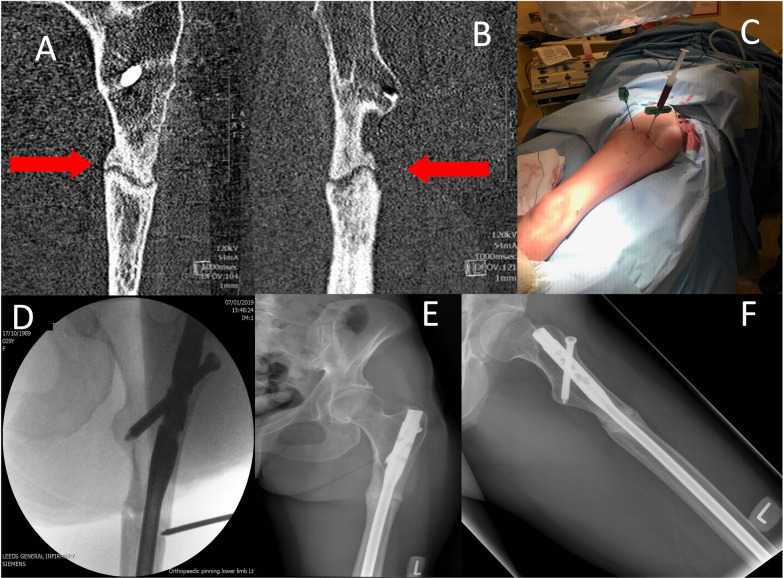
A 30-year-old female presented a CT-proven atrophic nonunion at 9 months following an IM nail for a closed femoral fracture (A, B). The patient underwent the harvesting of 60 ml of bone marrow, which was concentrated down to 8 ml volume and injected into the nonunion site (C, D). Images E and F demonstrate union at 3 months post-operation. IM Intramedullary
References
-
- Cohnheim J. Ueber entzündung und eiterung. Arch Für Pathol Anat Und Physiol Und Für Klin Med. 1897;40(1):1–79. doi: 10.1007/BF02968135. - DOI
-
- Caplan AI (1991) Mesenchymal stem cells. J Orthop Res 9(5):641–650. 10.1002/jor.1100090504 - PubMed
-
- Dominici M, Le Blanc K, Mueller I et al (2006) Minimal criteria for defining multipotent mesenchymal stromal cells. the International Society for Cellular Therapy position statement. Cytotherapy 8(4):315–317. 10.1080/14653240600855905 - PubMed
Publication types
MeSH terms
LinkOut - more resources
Full Text Sources
