Review
. 2024 May 24;22(1):285.
doi: 10.1186/s12964-024-01663-1.

Molecular mechanisms of aging and anti-aging strategies

Affiliations
Review

Molecular mechanisms of aging and anti-aging strategies

Yumeng Li et al. Cell Commun Signal. .

Abstract

Aging is a complex and multifaceted process involving a variety of interrelated molecular mechanisms and cellular systems. Phenotypically, the biological aging process is accompanied by a gradual loss of cellular function and the systemic deterioration of multiple tissues, resulting in susceptibility to aging-related diseases. Emerging evidence suggests that aging is closely associated with telomere attrition, DNA damage, mitochondrial dysfunction, loss of nicotinamide adenine dinucleotide levels, impaired macro-autophagy, stem cell exhaustion, inflammation, loss of protein balance, deregulated nutrient sensing, altered intercellular communication, and dysbiosis. These age-related changes may be alleviated by intervention strategies, such as calorie restriction, improved sleep quality, enhanced physical activity, and targeted longevity genes. In this review, we summarise the key historical progress in the exploration of important causes of aging and anti-aging strategies in recent decades, which provides a basis for further understanding of the reversibility of aging phenotypes, the application prospect of synthetic biotechnology in anti-aging therapy is also prospected.

Keywords: Aging; Aging triggers; Anti-aging strategies; Senolytic; Synthetic.


Conflict of interest statement

The authors declare no competing interests.

Figures
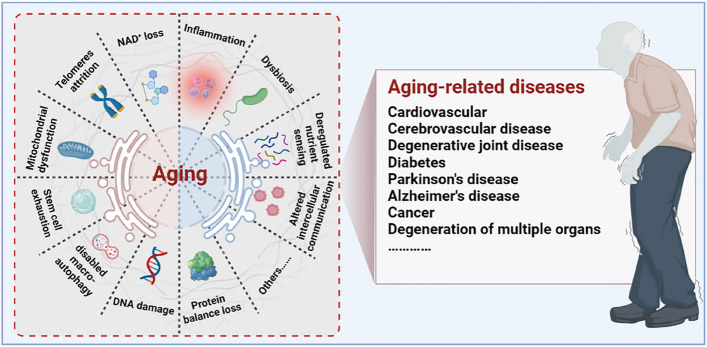
Fig. 1
Fig. 1
Aging drivers and age-related diseases. Major physiological features of aging include NAD+ loss, telomeres attrition, mitochondrial dysfunction, stem cell exhaustion, disabled macro-autophagy, DNA damage, protein balance loss, inflammation, dysbiosis, deregulated nutrient sensing, and altered cellular communication. These physiological characteristics of aging are primitive, antagonistic, and integrated, and their interaction promotes aging. When aging reaches a certain threshold, organ and tissue function continues to deteriorate, which increases the incidence and mortality of aging-related diseases, including cardiovascular, cerebrovascular, degenerative joint disease, diabetes, Parkinson’s disease, Alzheimer’s disease, and cancer
Fig. 2
Fig. 2
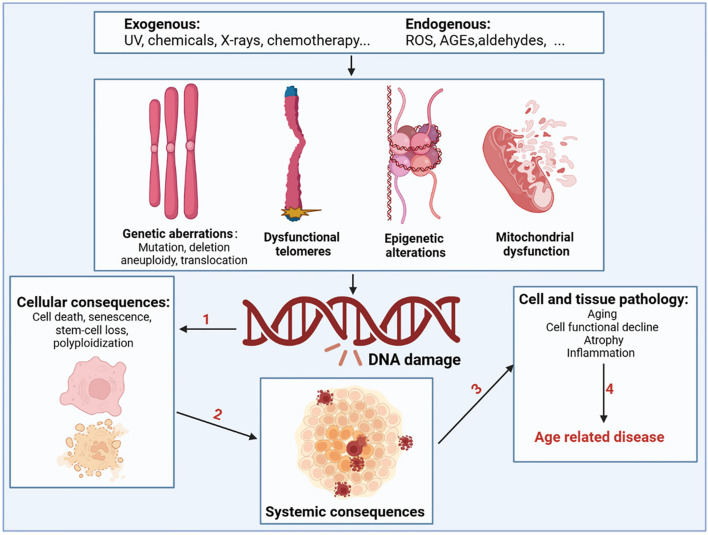
Drivers of DNA damage and the resulting systemic consequences. The nuclear and mitochondrial genomes are constantly exposed to exogenous substances (such as ultraviolet and X-rays, chemicals in food, water, and air), endogenous substances such as ROS, advanced glycation end products (AGEs), and aldehydes; this results in genetic abnormalities, including mutation, deletion, aneuploidy, translocation, dysfunctional telomeres, epigenetic alterations, and mitochondrial dysfunction. DNA damage and DNA damage response caused by the above factors can shock molecular processes and alter cell fate, such as cell death, senescence, and systemic breakdown of repair functions, eventually leading to the loss of cell and organ function and promoting the occurrence and development of age-related diseases
Fig. 3
Fig. 3
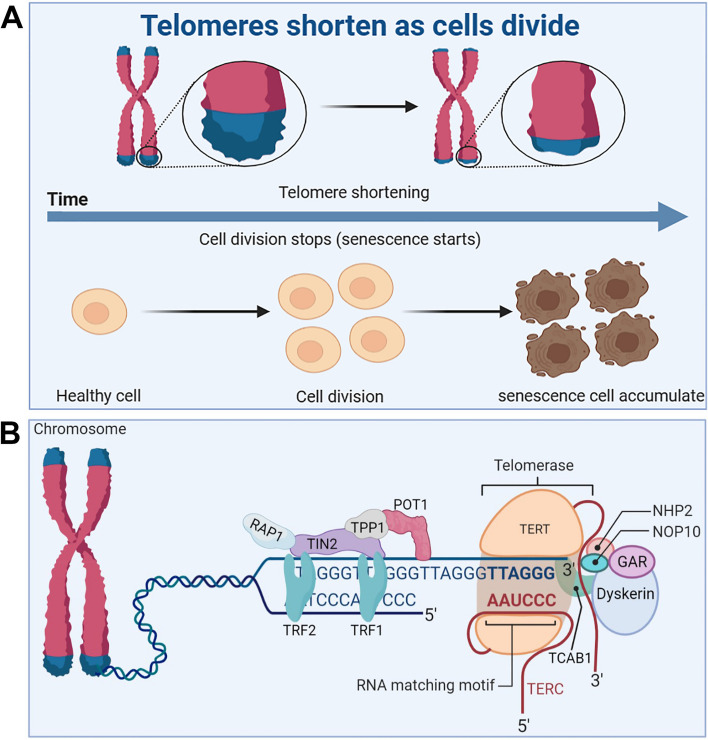
Telomere and telomerase structure, and their relationship with cell senescence. A Telomeres shorten during cell division, leading to accumulation of senescent cells. B The structure of the telomere-telomerase complex. TERT, telomerase reverse transcriptase; TERC, telomerase RNA component; NOP10, nucleolar protein family A, member 3; NHP2, nucleolar protein family A, member 2; GAR, nucleolar protein family A; TIN2, TERF1-interacting nuclear factor 2; TPP1, telomere protection protein 1; TRF1, telomeric repeat binding factor 1; TRF2, telomeric repeat binding factor 2; POT1, protection of telomeres 1; RAP1, TERF2-interacting protein. The telomere diagram is derived from “biorender”
Fig. 4
Fig. 4
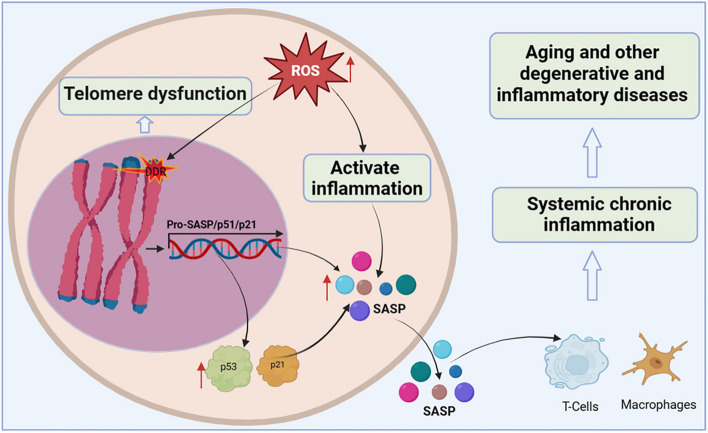
Telomere dysfunction activates DDR to drive cellular senescence. ROS induce telomere sequence damage, leading to telomere shortening and decapitation, triggering DDR, inducing the overexpression of cell cycle inhibition markers p53 and p21, and accelerating cell senescence. Senescent cells secrete SASP, which alter extracellular matrix composition, recruit and enhance T cells and macrophages, which can spread the aging phenotype to surrounding cells, thus promoting systemic chronic inflammation and inflammation-related diseases
Fig. 5
Fig. 5
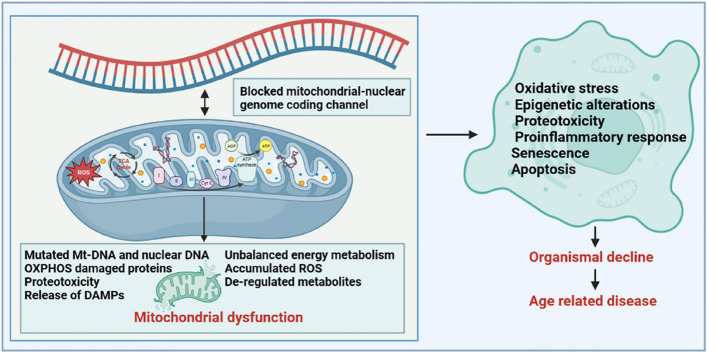
Mitochondrial dysfunction has pleiotropic effects in aging. Inducers such as the accumulation of mtDNA mutations, release of damaged toxic mitochondrial material, the production of mtROS, proteotoxicity, and deregulated metabolites (TCA intermediates, NAD+) all contribute to mitochondrial dysfunction. Alterations in mitochondrial function have widespread adverse effects on intracellular homeostasis and lead to systemic organ decline and the development of several age-related diseases through complex signalling mechanisms (involving mitogens, metabolites, etc.)
Fig. 6
Fig. 6
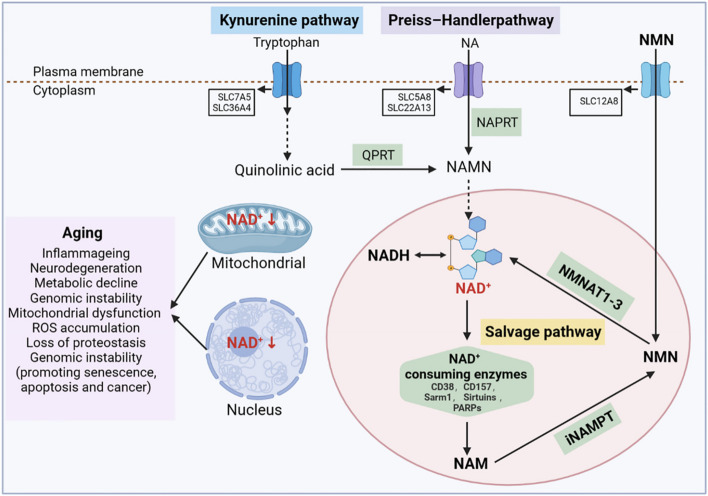
NAD+metabolism and its relationship with aging. NAD+ levels are maintained by three independent biosynthetic pathways. The kynurenine pathway uses the dietary amino acid tryptophan to produce NAD+. Tryptophan enters cells through the transporters SLC7A5 and SLC36A4. In the cell, tryptophan undergoes a series of reactions to form quinolinic acid, which is then converted by the quinolinic acid phosphoribosyl glycosyltransferase (QPRT) into nicotinamide mononucleotide (NAMN), where it converges with the Preiss-Handler pathway. In the Preiss-Handler pathway, niacin (NA) enters cells via SLC5A8 or SLC22A13 transporters, and is catalysed by the nicotinic acid phosphoribosyltransferase (NAPRT) to produce NAMN, which is then converted into NAD+ by a series of reactions. The NAD+ salvage pathway recycles the nicotinamide (NAM) generated as a by- product of the enzymatic activities of NAD+-consuming enzymes (sirtuins, poly (ADP- ribose) polymerases (PARPs) and the NAD+ glycohydrolase and cyclic ADP- ribose synthases CD38, CD157 and Sarm1). Intracellular nicotinamide phosphoribotransferase (INAMPT) circulates NAM to nicotinamide mononucleotide (NMN), a portion of which enters the cell via SLC12A8 transporter and is then converted to NAD+ by different NMNATs. Decreased levels of NAD+ in cells during senescence give rise to a range of problems, including inflammageing, neurodegeneration, genomic instability (promoting senescence, apoptosis, and cancer), mitochondrial dysfunction, ROS accumulation, and loss of proteostasis

References

    1. Colchero F, et al. The long lives of primates and the “invariant rate of ageing” hypothesis. Nat Commun. 2021;12:3666. - PMC - PubMed
    1. Giaimo S, Traulsen A. The selection force weakens with age because ageing evolves and not vice versa. Nat Commun. 2022;13:686. - PMC - PubMed
    1. Gokbilen SO, Becer E, Vatansever HS. Senescence-mediated anticancer effects of quercetin. Nutr Res. 2022;104:82–90. doi: 10.1016/j.nutres.2022.04.007. - DOI - PubMed
    1. Zhang KX, et al. The promotion of active aging through older adult education in the context of population aging. Front Public Health. 2022;10:998710. - PMC - PubMed
    1. Lehr U. Social- and behavioral-scientific gerontology; age and ageing as a social problem and individual theme. Z Gerontol Geriatr. 2005;38(3):218–218.

Publication types