Review
. 2024 May 14;29(10):2310.
doi: 10.3390/molecules29102310.

Nitrogen-Centered Radicals Derived from Azidonucleosides

Affiliations
Review

Nitrogen-Centered Radicals Derived from Azidonucleosides

Yahaira Reyes et al. Molecules. .

Abstract

Azido-modified nucleosides have been extensively explored as substrates for click chemistry and the metabolic labeling of DNA and RNA. These compounds are also of interest as precursors for further synthetic elaboration and as therapeutic agents. This review discusses the chemistry of azidonucleosides related to the generation of nitrogen-centered radicals (NCRs) from the azido groups that are selectively inserted into the nucleoside frame along with the subsequent chemistry and biological implications of NCRs. For instance, the critical role of the sulfinylimine radical generated during inhibition of ribonucleotide reductases by 2'-azido-2'-deoxy pyrimidine nucleotides as well as the NCRs generated from azidonucleosides by radiation-produced (prehydrated and aqueous) electrons are discussed. Regio and stereoselectivity of incorporation of an azido group ("radical arm") into the frame of nucleoside and selective generation of NCRs under reductive conditions, which often produce the same radical species that are observed upon ionization events due to radiation and/or other oxidative conditions that are emphasized. NCRs generated from nucleoside-modified precursors other than azidonucleosides are also discussed but only with the direct relation to the same/similar NCRs derived from azidonucleosides.

Keywords: aminyl radicals; azides; iminyl radicals; nitrogen-centered radicals; nucleosides; purines; pyrimidines; radiation; radiosensitizers; ribonucleotide reductases.


Conflict of interest statement

The authors declare no conflicts of interest. The funders had no role in the design of the study; in interpretation of data; in the writing of the manuscript; or in the decision to publish the results.

Figures
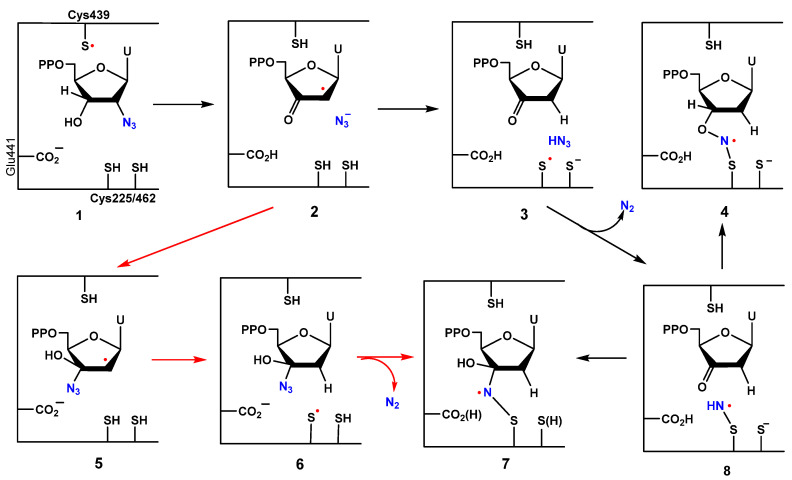
Figure 1
Figure 1
Proposed structures for the nitrogen-centered radicals (NCRs) and pathways for their generation during the inactivation of RDPR by N3UDP [57,58,59,65].
Figure 2
Figure 2
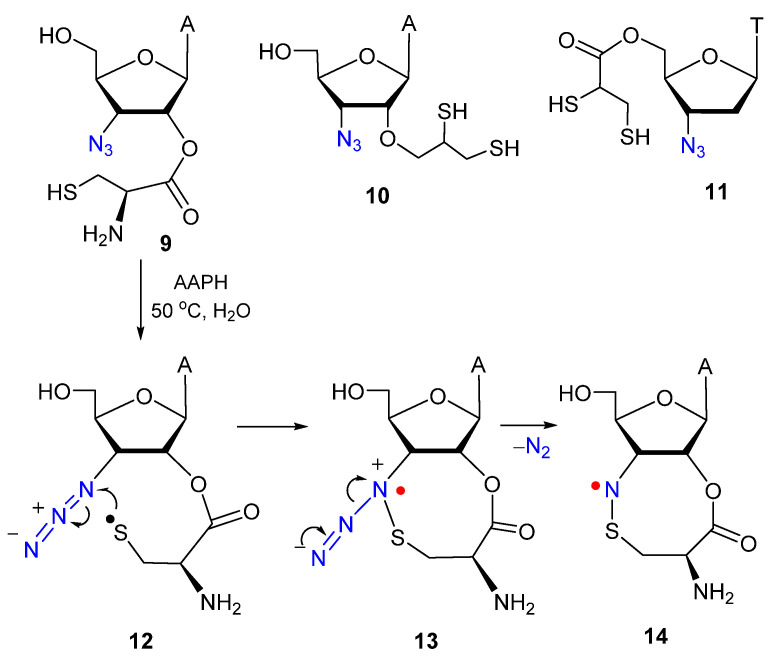
Model azidonucleosides with the cysteinate or vicinal dithiol unit attached to C2′ or C5′ to study the assumed ring closure reactions between the thiyl radical and the azido group. Plausible intramolecular interactions of the thiyl radical with an azido group at C3′ for adenosine-derived substrate 9 [71].
Figure 3
Figure 3
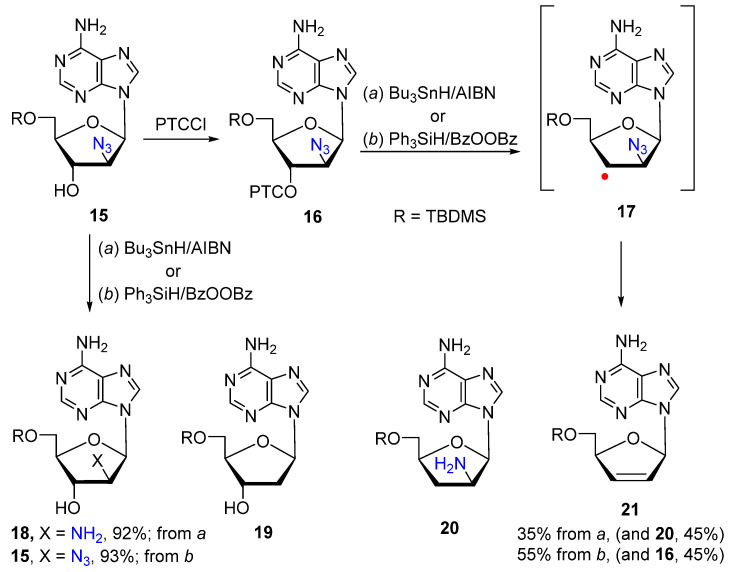
Differential interaction of azidonucleosides with tributylstannane and triphenylsilane. Reduction versus elimination of azido group from C2′ position [73].
Scheme 1
Scheme 1
Schematic representation of the steps involved in the dissociate electron attachment process involving the neutral azide molecule, RN3. The first step, attachment, leads to the formation of a transient negative ion (TNI), [(RN3]*. This is followed by dissociation [78].
Figure 4
Figure 4
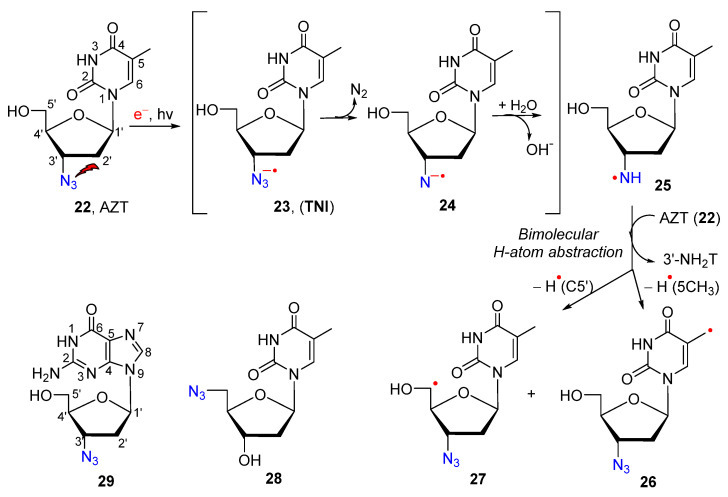
The formation and reactivity of the aminyl radical generated upon the addition of radiation-produced electrons to AZT [79].
Figure 5
Figure 5
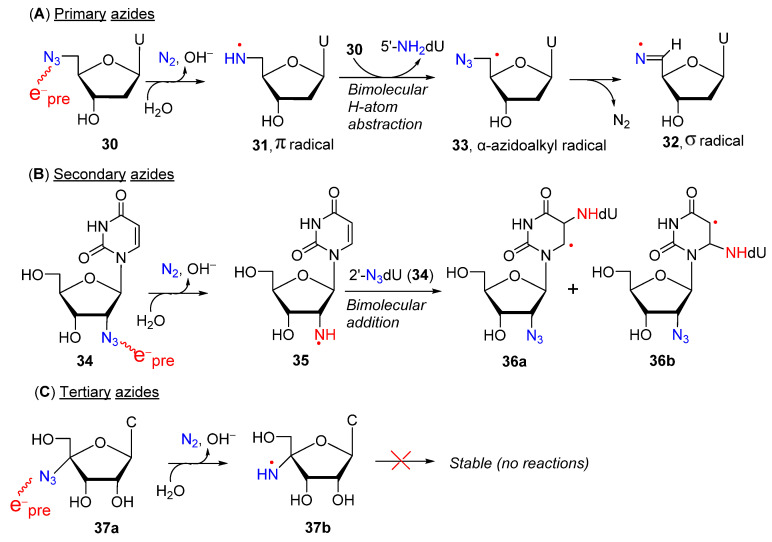
Types of reactions undergone by π-RNH· attached to a primary (path A), secondary (path B), or tertiary (path C) alkyl carbon in the ribose sugar of pyrimidine nucleosides.
Figure 6
Figure 6
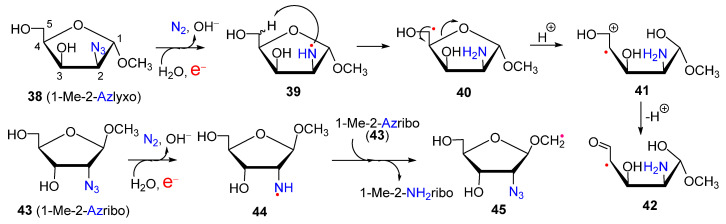
The formation of the ring-opened C4· 42 via the ring opening of a C5· intermediate in 1-Me-2-Azlyxo (38) and thermodynamically stable -OCH2· 45 with an intact ribofuranose ring in 1-Me-2-Azribo (43).
Figure 7
Figure 7
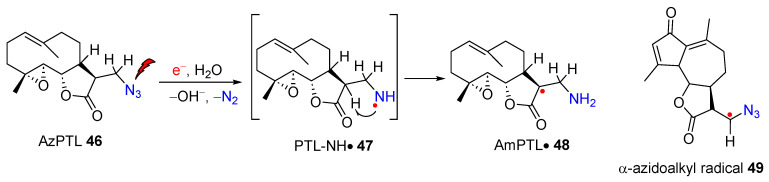
The intramolecular formation of the neutral tertiary carbon-centered radical 48 from azido-PTL 46. Structure of α-azidoalkyl radical 49 from azido-DhL.
Figure 8
Figure 8
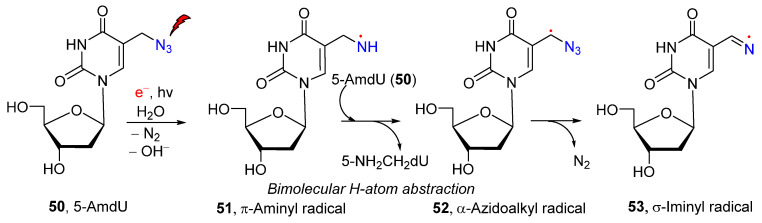
The formation of the neutral aminyl radical 51 by radiation-produced prehydrated electron attachment to 5-AmdU and its subsequent H-atom abstraction reaction with 5-AmdU to form iminyl radical 53 via the intermediary α-azidoalkyl radical 52 [88].
Figure 9
Figure 9
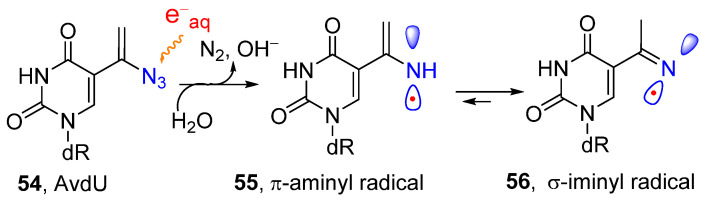
Tautomerization of π aminyl radical, generated from AvdU, to σ-iminyl radical [88].
Figure 10
Figure 10
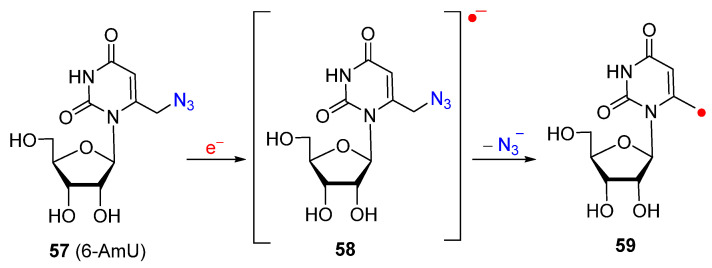
The formation of allylic radical 59 via the unexpected loss of azide as an anion (N3¯) from the azide anion radical intermediate 58 via dissociative electron attachment [76].
Figure 11
Figure 11
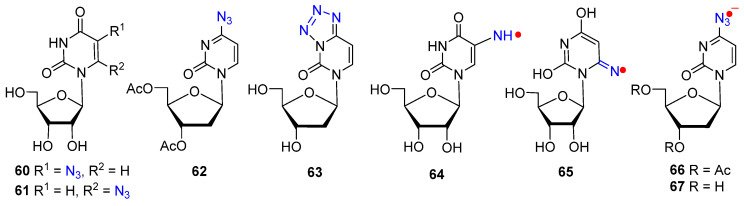
Nitrogen-centered radicals formed via dissociative electron attachment to 5-azidouridine 60, 6-azidouridine 61, and 4-azidopyrimidine analogue 62 and its cyclic tetrazolo derivative 63.
Figure 12
Figure 12
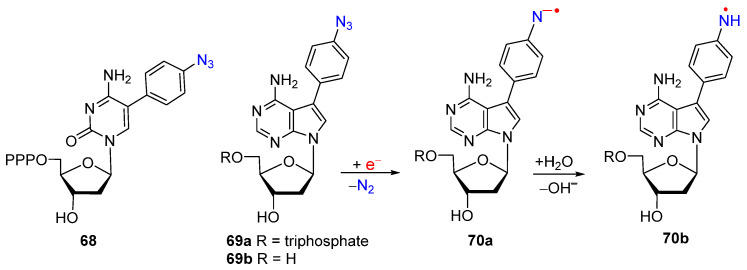
Azidophenyl-modified nucleosides and their electrochemical reduction on mercury surface to the aminyl radicals.
Figure 13
Figure 13
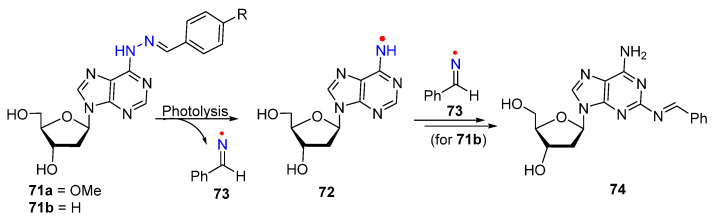
Plausible generation of dAdo-6-N-aminyl radical 72 by photolysis of dAdo-6-N-arylhydrazones 71a and 71b and its subsequent chemistry to form 2-imino-dAdo derivative 74 [99].
Figure 14
Figure 14
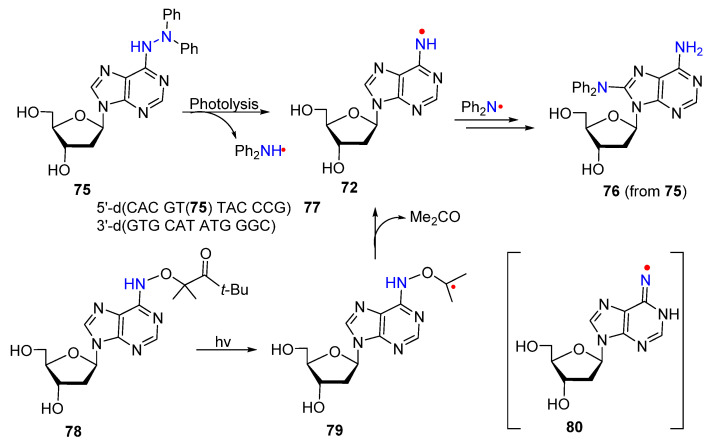
The plausible generation of dAdo-6-N-aminyl radical 72 by the photolysis of ketone 78 as well as hydrazine 75 and the subsequent chemistry to form 8-amino-dAdo derivative 76.
Figure 15
Figure 15
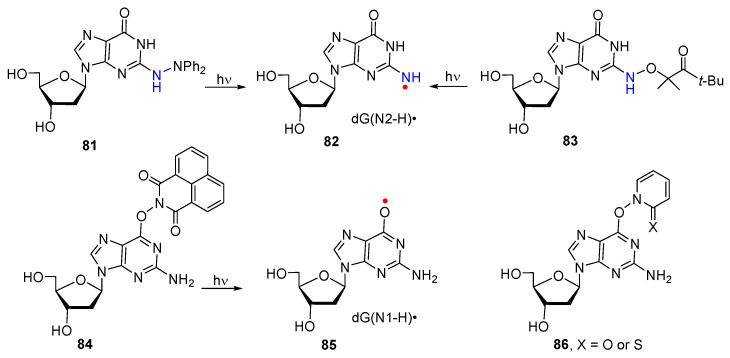
Photochemical generation of guanosyl radicals from synthetic precursors.
Figure 16
Figure 16
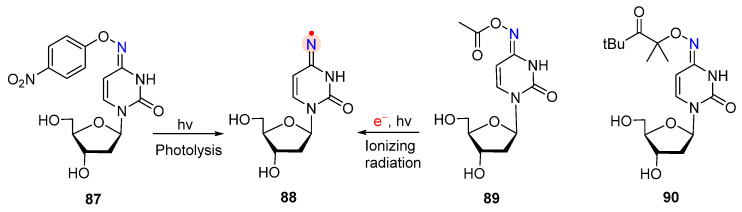
The generation of 2′-deoxycytidin-N4-yl iminyl radical 88 by photolysis and radiation-produced prehydrated electron attachment approaches.
Figure 17
Figure 17
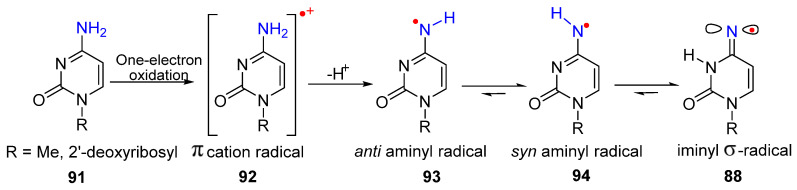
Formation of cytidine π-aminyl radicals 93 and 94 that tautomerize to σ-iminyl radical 88 upon one-electron oxidation of cytosine nucleobase [111].

References

    1. Kerru N., Gummidi L., Maddila S., Gangu K.K., Jonnalagadda S.B. A Review on Recent Advances in Nitrogen-Containing Molecules and Their Biological Applications. Molecules. 2020;25:1909. doi: 10.3390/molecules25081909. - DOI - PMC - PubMed
    1. Dedon P.C., Tannenbaum S.R. Reactive nitrogen species in the chemical biology of inflammation. Arch. Biochem. Biophys. 2004;423:12–22. doi: 10.1016/j.abb.2003.12.017. - DOI - PubMed
    1. Adams L., Franco M.C., Estevez A.G. Reactive nitrogen species in cellular signaling. Exp. Biol. Med. 2015;240:711–717. doi: 10.1177/1535370215581314. - DOI - PMC - PubMed
    1. Pratley C., Fenner S., Murphy J.A. Nitrogen-Centered Radicals in Functionalization of sp2 Systems: Generation, Reactivity, and Applications in Synthesis. Chem. Rev. 2022;122:8181–8260. doi: 10.1021/acs.chemrev.1c00831. - DOI - PubMed
    1. Jiang H., Studer A. Chemistry With N-Centered Radicals Generated by Single-Electron Transfer-Oxidation Using Photoredox Catalysis. CCS Chem. 2019;1:38–49. doi: 10.31635/ccschem.019.20180026. - DOI

LinkOut - more resources