


Four-dimensional lipidomics profiling in X-linked adrenoleukodystrophy using trapped ion mobility mass spectrometry
- PMID: 38795862
- PMCID: PMC11234049
- DOI: 10.1016/j.jlr.2024.100567
Four-dimensional lipidomics profiling in X-linked adrenoleukodystrophy using trapped ion mobility mass spectrometry
Abstract
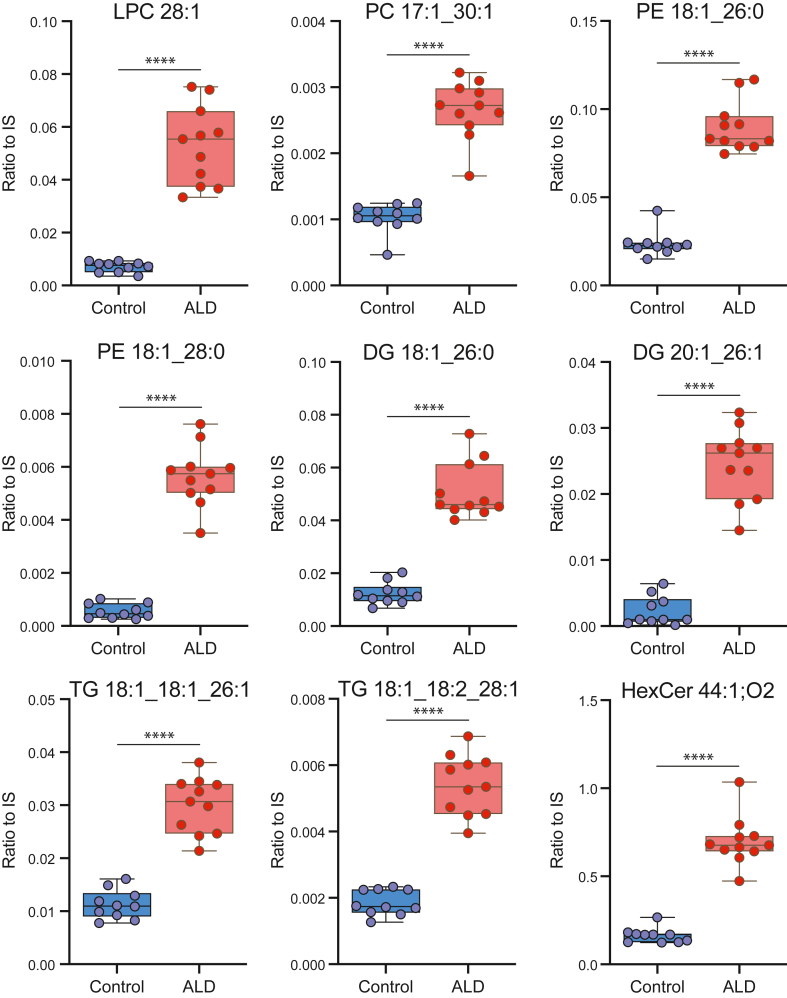
Lipids play pivotal roles in an extensive range of metabolic and physiological processes. In recent years, the convergence of trapped ion mobility spectrometry and MS has enabled 4D-lipidomics, a highly promising technology for comprehensive lipid analysis. 4D-lipidomics assesses lipid annotations across four distinct dimensions-retention time, collisional cross section, m/z (mass-to-charge ratio), and MS/MS spectra-providing a heightened level of confidence in lipid annotation. These advantages prove particularly valuable when investigating complex disorders involving lipid metabolism, such as adrenoleukodystrophy (ALD). ALD is characterized by the accumulation of very-long-chain fatty acids (VLCFAs) due to pathogenic variants in the ABCD1 gene. A comprehensive 4D-lipidomics strategy of ALD fibroblasts demonstrated significant elevations of various lipids from multiple classes. This indicates that the changes observed in ALD are not confined to a single lipid class and likely impacts a broad spectrum of lipid-mediated physiological processes. Our findings highlight the incorporation of mainly saturated and monounsaturated VLCFA variants into a range of lipid classes, encompassing phosphatidylcholines, triacylglycerols, and cholesterol esters. These include ultra-long-chain fatty acids with a length of up to thirty carbon atoms. Lipid species containing C26:0 and C26:1 were the most frequently detected VLCFA lipids in our study. Furthermore, we report a panel of 121 new candidate biomarkers in fibroblasts, exhibiting significant differentiation between controls and individuals with ALD. In summary, this study demonstrates the capabilities of a 4D-lipid profiling workflow in unraveling novel insights into the intricate lipid modifications associated with metabolic disorders like ALD.
Keywords: 4D-Lipidomics; adrenoleukodystrophy; parallel accumulation serial fragmentation; trapped ion mobility spectrometry; very-long-chain fatty acids.
Copyright © 2024 The Authors. Published by Elsevier Inc. All rights reserved.
Conflict of interest statement
Conflict of interest Sven W. Meyer is employed at Bruker Daltonics GmbH. All the other authors declarethat they have no conflict of interest with the contents of this article.
Figures
References
-
- O’Donnell V.B., Ekroos K., Liebisch G., Wakelam M. Lipidomics: current state of the art in a fast moving field. Wiley Interdiscip. Rev. Syst. Biol. Med. 2020;12:1–6. - PubMed
-
- Huynh K., Barlow C.K., Jayawardana K.S., Weir J.M., Mellett N.A., Cinel M., et al. High-Throughput plasma lipidomics: Detailed Mapping of the Associations with Cardiometabolic risk Factors. Cell Chem. Biol. 2019;26:71–84.e4. - PubMed
-
- Tu J., Zhou Z., Li T., Zhu Z.J. The emerging role of ion mobility-mass spectrometry in lipidomics to facilitate lipid separation and identification. Trac Trends Anal. Chem. 2019;116:332–339.
Publication types
MeSH terms
Substances
LinkOut - more resources
Full Text Sources
