. 2024 Jul:85:101931.
doi: 10.1016/j.molmet.2024.101931. Epub 2024 May 17.

The novel adrenergic agonist ATR-127 targets skeletal muscle and brown adipose tissue to tackle diabesity and steatohepatitis

Affiliations

The novel adrenergic agonist ATR-127 targets skeletal muscle and brown adipose tissue to tackle diabesity and steatohepatitis

Emanuela Talamonti et al. Mol Metab. 2024 Jul.

Abstract

Objective: Simultaneous activation of β2- and β3-adrenoceptors (ARs) improves whole-body metabolism via beneficial effects in skeletal muscle and brown adipose tissue (BAT). Nevertheless, high-efficacy agonists simultaneously targeting these receptors whilst limiting activation of β1-ARs - and thus inducing cardiovascular complications - are currently non-existent. Therefore, we here developed and evaluated the therapeutic potential of a novel β2-and β3-AR, named ATR-127, for the treatment of obesity and its associated metabolic perturbations in preclinical models.

Methods: In the developmental phase, we assessed the impact of ATR-127's on cAMP accumulation in relation to the non-selective β-AR agonist isoprenaline across various rodent β-AR subtypes, including neonatal rat cardiomyocytes. Following these experiments, L6 muscle cells were stimulated with ATR-127 to assess the impact on GLUT4-mediated glucose uptake and intramyocellular cAMP accumulation. Additionally, in vitro, and in vivo assessments are conducted to measure ATR-127's effects on BAT glucose uptake and thermogenesis. Finally, diet-induced obese mice were treated with 5 mg/kg ATR-127 for 21 days to investigate the effects on glucose homeostasis, body weight, fat mass, skeletal muscle glucose uptake, BAT thermogenesis and hepatic steatosis.

Results: Exposure of L6 muscle cells to ATR-127 robustly enhanced GLUT4-mediated glucose uptake despite low intramyocellular cAMP accumulation. Similarly, ATR-127 markedly increased BAT glucose uptake and thermogenesis both in vitro and in vivo. Prolonged treatment of diet-induced obese mice with ATR-127 dramatically improved glucose homeostasis, an effect accompanied by decreases in body weight and fat mass. These effects were paralleled by an enhanced skeletal muscle glucose uptake, BAT thermogenesis, and improvements in hepatic steatosis.

Conclusions: Our results demonstrate that ATR-127 is a highly effective, novel β2- and β3-ARs agonist holding great therapeutic promise for the treatment of obesity and its comorbidities, whilst potentially limiting cardiovascular complications. As such, the therapeutic effects of ATR-127 should be investigated in more detail in clinical studies.

Keywords: Hepatic steatosis; Obesity; Skeletal muscle; Type 2 diabetes; β-Adrenergic agonists.


Conflict of interest statement

Declaration of competing interest The authors declare the following financial interests/personal relationships which may be considered as potential competing interests: TB, BP and ND own stocks in Atrogi AB. ET, AK, ND, SvB, CH, MHB, AS, BP and GY are employed by Atrogi AB. VML is co-founder, CEO and shareholder of HepaPredict AB.

Figures

Figure 1
Figure 1
ATR-127, a novel adrenergic agonist, exhibits differential cAMP generation capability and minimal desensitization response. (A) The synthesis of 3-((R)-1-hydroxy-2-(((R)-pentan-2-yl)amino)ethyl)phenol (ATR-127). (a) Br2, CHCl3, reflux, 5 h; (b) diethyl phosphite, Et3N, THF, 0 °C to rt, 1 h (63% over two steps); (c) BH3·Me2S, (R)-2-methyl-CBS-oxaborolidine, PhMe, THF, 0 °C to rt, 2 h (91%, 98% ee); (d) K2CO3, MeOH, rt, 1 h (95%); (e) (R)-N-((R)-1-phenylethyl)pentan-2-amine, i-PrOH, 140 °C (sealed tube), 88 h (72% based on the amine); (f) Pd-C (10%), Et3SiH, MeOH, rt, 1 h (74%); (g) 0.5 eq H2SO4, H2O, rt, 1 h (82%). (B) Chemical structure of isoprenaline. (C–E) cAMP concentration response curves upon stimulation with ATR-127 or isoprenaline in cells expressing rodent adrenergic β receptors, (C) Rat skeletal muscle cell line expressing β2AR. (D) CHO cells expressing mouse β3AR. (E) Rat cardiomycytes expressing β1AR. (F) β2AR translocation intensity normalized to isoprenaline. (G) Characterization of transducer engagement at the β2AR by ebBRET. As depicted in the illustration, donor-tagged, pathway-selective biosensors are co-expressed with membrane-anchored acceptor and the receptor is stimulated with agonist (isoprenaline or ATR-127) to monitor pathway activation by measuring BRET. Radar plots are shown for efficacy (normalized to isoprenaline) and potency (logEC50) of the pathways engaged by the β2AR at the plasma membrane. Drugs were deemed to activate a given pathway after comparing the top and bottom parameters from non-linear regression by one-sided extra sum-of-squares F test followed by the Benjamini-Hochberg correction (P < 0.0043).
Figure 2
Figure 2
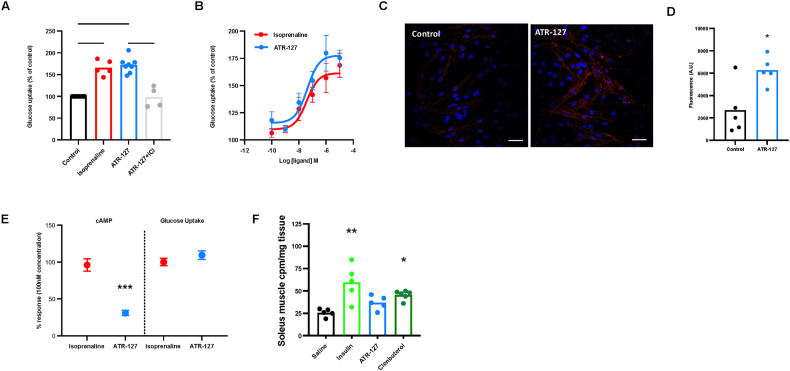
ATR-127 robustly increases skeletal muscle glucose uptake via GLUT4 translocation. (A) Glucose uptake in L6 cells upon isoprenaline (1 μM), ATR-127 (1 μM) or ATR-127 + ICI-118,551 (1 μM) incubation. (B) Dose-response curves of glucose uptake in L6 cells treated with isoprenaline and ATR-127. (C) Representative fluorescent images of Glut-4 translocation to the membranes of L6 cells upon treatment with ATR-127 (10 μM) (Red: Glut-4 protein, blue: nucleus) with scale bars (50 μm). (D) Quantification of Glut-4 translocation to the plasma membrane. (E) cAMP levels (from Figure 1C) and glucose uptake levels (from Figure 2B) at 100 nM concentration (F) In vivo glucose uptake in soleus muscle upon acute injection with saline, insulin (1 mg/kg), ATR-127 (1 mg/kg) or clenbuterol (1 mg/kg). One data point was removed in Figure 2F based on outlier test. In the event of normal distribution, data were analyzed by means of the Student's t test or one-way ANOVA followed by the Dunnett's or Sidak's multiple comparison tests. ∗p < 0.05, ∗∗∗p < 0.001, ∗∗∗∗p < 0.0001. (For interpretation of the references to color in this figure legend, the reader is referred to the Web version of this article.)
Figure 3
Figure 3
Treatment with ATR-127 enhances in vitro and in vivo BAT thermogenesis and glucose uptake (A) Accumulated heat production over time of brite adipocytes stimulated with saline, CL-316,243 (1 μM) or ATR-127 (1 μM). (B) Total accumulated heat production of brite adipocytes stimulated with saline, CL-316,243 or ATR-127. (C) Glucose uptake in ex vivo brown adipose tissue upon stimulation with ATR-127 (1 μM), NE (1 μM) and CL-316,243 (1 μM). (D) Oxygen consumption rate of human primary brown adipocytes upon stimulation with norepinephrine (10 μM) or different concentrations of ATR-127 (N = 8–14 replicates derived from 2 different patients). (E) Quantification of oxygen consumption rates calculated upon compound addition as increase over OG % response. (F) Gene expression levels of UCP1 in human BAT cells upon PBS and ATR-127 treatment (N = 3) (G) in vivo basal oxygen consumption upon acute injection of ATR-127 (5 mg/kg) in C57Bl/N6 mice. (H) in vivo average light phase energy expenditure of C57Bl/N6 mice upon acute injection with ATR-127 (5 mg/kg). (I) In vivo glucose uptake in brown adipose tissue of C57Bl/N6 mice upon acute injection with insulin (1 mg/kg), ATR-127 (1 mg/kg), or CL-316,243 (1 mg/kg). One data point was removed in Figure 3I based on outlier test. In the event of normal distribution, data were analyzed by means of the Student's t test followed by Mann Whitney test or one-way ANOVA followed by the Dunnett's or Sidak's multiple comparison tests. When the data deviates from normal distribution, it underwent analysis using the Kruskal–Wallis test, followed by Dunn's multiple comparisons.∗p < 0.05, ∗∗p < 0.01, ∗∗∗∗p < 0.0001. (h) BAT = (human) brown adipose tissue, OCR = oxygen consumption rate, OG = Oligomycin, CPD = Compound (ATR-127 or NE), NE = norepinephrine, CL = CL-316,243. (For interpretation of the references to color in this figure legend, the reader is referred to the Web version of this article.)
Figure 4
Figure 4
Prolonged ATR-127 treatment improves glucose homeostasis and reduces fat mass in diet-induced obese mice. (A) Fasting blood glucose upon 4-days of ATR-127 treatment (5 mg/kg). (B) Intraperitoneal glucose tolerance test following 4-days of ATR-127 treatment (5 mg/kg). (C) area under the curve of intraperitoneal glucose tolerance test (5 mg/kg). (D) Fasting blood glucose upon 11-days of ATR-127 treatment (5 mg/kg). (E) Intraperitoneal glucose tolerance test following 11-days of ATR-127 treatment (5 mg/kg). (F) area under the curve of intraperitoneal glucose tolerance test (5 mg/kg). (G) Percentage body weight loss upon 21 days of ATR-127 treatment (5 mg/kg). (H) Delta fat mass change. (I) Delta lean mass change. N = 8 for all experiments. In the event of normal distribution, data were analyzed by means of a Student's paired t test. ∗p < 0.05, ∗∗p < 0.01, ∗∗∗p < 0.001, ∗∗∗∗p < 0.0001. BW = body weight.
Figure 5
Figure 5
Prolonged ATR-127 treatment induces BAT browning in diet-induced obese mice. (A) Brown adipose tissue weight following 21-days of ATR-127 treatment. (B) Brown adipose tissue depots (C-H) Gene expression of Ucp1, Pgc1a, Cidea, Elovl3, Fgf21 and Dio2 normalized to the expression of TF2-beta in brown adipose tissue (N = 6–7). One data point was removed in Figure 5C,H based on outlier test. In the event of normal distribution, data were analyzed by means of a Student's paired t test. When the data deviates from normal distribution, it underwent analysis using Mann-whitney test. ∗p < 0.05, ∗∗p < 0.01, ∗∗∗∗P < 0.0001. BAT = brown adipose tissue. (For interpretation of the references to color in this figure legend, the reader is referred to the Web version of this article.)
Figure 6
Figure 6
ATR-127 treatment for 21 days reduces hepatic steatosis in diet-induced obese mice (A) Liver morphology. (B) Liver weight. (C) Hepatic lipid staining with BODIPY (green), (scale bar = 50 μm). (D–H) Hepatic gene expression of Scd1, Atgl, Cd36, Mcp1, and F4/80 normalized to TF2β expression (N = 7). One data point was removed in Figure 5G based on outlier test. In the event of normal distribution, data were analyzed by means of a Student's paired t test. A significant difference was considered at ∗p < 0.05, ∗∗p < 0.01. (For interpretation of the references to color in this figure legend, the reader is referred to the Web version of this article.)
Figure 7
Figure 7
Effects of prolonged treatment with ATR-127 on mouse heart weight and ex vivo in human heart strips. Diet-induced obesity was developed in C57Bl/6N mice maintained at 30 °C and on HFD for 4 months; DIO mice were treated daily with 5 mg/kg ATR-127 for 3 weeks (n = 8). (A) heart weight. (B) Mean cumulative concentration-response curves to Salbutamol and ATR-127 in 5 electrically driven human right atrial appendage trabeculae from 4 patients. Inotropic responses are expressed as a percentage of the maximum response to (−)-isoprenaline. Each data point represents mean ± SEM.

References

    1. Obesity: Preventing and Managing the Global Epidemic. reportReport of a WHO consultation - PubMed Available online: https://pubmed.ncbi.nlm.nih.gov/11234459/(accessed on 12 March 2023).
    1. Goossens G.H. The role of adipose tissue dysfunction in the pathogenesis of obesity-related insulin resistance. Physiol Behav. 2008;94:206–218. doi: 10.1016/J.PHYSBEH.2007.10.010. - DOI - PubMed
    1. Gastaldelli A., Cusi K., Pettiti M., Hardies J., Miyazaki Y., Berria R., et al. Relationship between hepatic/visceral fat and hepatic insulin resistance in nondiabetic and type 2 diabetic subjects. Gastroenterology. 2007;133:496–506. doi: 10.1053/J.GASTRO.2007.04.068. - DOI - PubMed
    1. Burgess E., Hassmén P., Welvaert M., Pumpa K.L. Behavioural treatment strategies improve adherence to lifestyle intervention programmes in adults with obesity: a systematic review and meta-analysis. Clin Obes. 2017;7:105–114. doi: 10.1111/COB.12180. - DOI - PubMed
    1. Buse J.B., Wexler D.J., Tsapas A., Rossing P., Mingrone G., Mathieu C., et al. 2019 update to: management of hyperglycemia in type 2 diabetes, 2018. A consensus report by the American diabetes association (ADA) and the European association for the study of diabetes (EASD) Diabetes Care. 2020;43:487–493. doi: 10.2337/DCI19-0066. - DOI - PMC - PubMed

Substances