This is a preprint.
Higher prevalence of kidney function impairment among older people living with HIV in Uganda
- PMID: 38798422
- PMCID: PMC11118683
- DOI: 10.21203/rs.3.rs-4364155/v1
Higher prevalence of kidney function impairment among older people living with HIV in Uganda
Update in
-
Higher prevalence of kidney function impairment among older people living with HIV in Uganda.BMC Nephrol. 2024 Sep 27;25(1):321. doi: 10.1186/s12882-024-03761-1. BMC Nephrol. 2024. PMID: 39334034 Free PMC article.
Abstract
Background: People living with HIV (PLWH) are at risk of kidney function impairment due to HIV-related inflammation, antiretroviral therapy (ART), diabetes mellitus, and hypertension. Older persons may experience a higher burden of chronic kidney disease (CKD) as kidney function declines with increasing age. There is a paucity of data comparing the prevalence of kidney function impairment in older PLWH to that in HIV-uninfected people in sub-Saharan Africa.
Methods: We conducted a cross-sectional study among people aged ≥ 60 years living with and without HIV in Kampala, Uganda who were matched 1:1 by community location. We collected data on sociodemographics, comorbidities, and HIV-related clinical characteristics. We defined kidney function impairment as an estimated glomerular filtration rate(eGFR) < 60mls/min/1.73m2 with or without proteinuria. We constructed multivariable logistic regression models to study associations between participant characteristics and kidney function impairment.
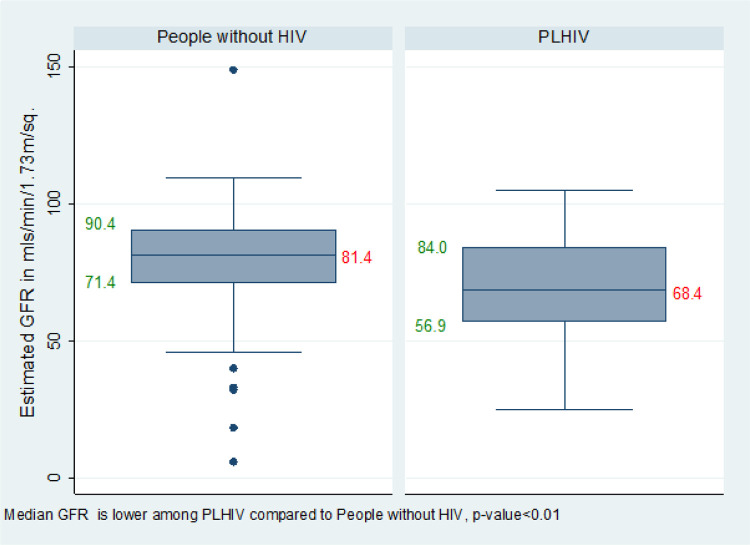
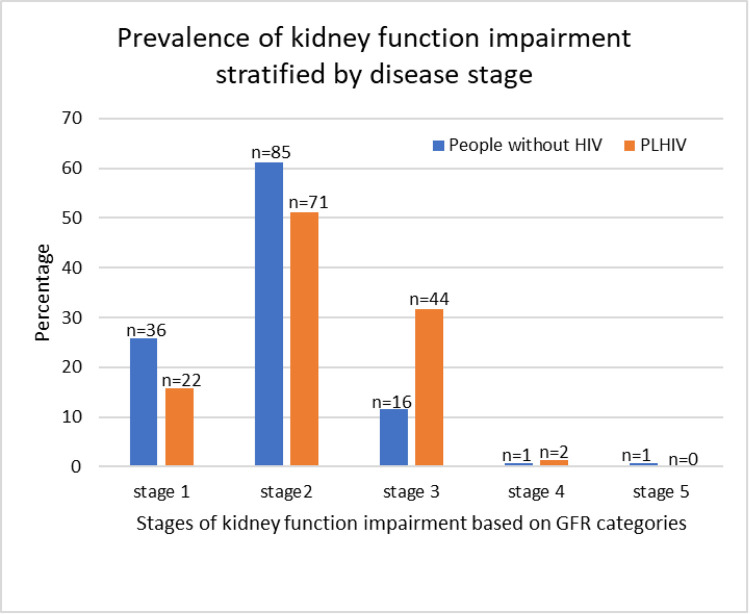
Results: We enrolled 278 people (median age 66 years); 50% were PLWH, and 51.8% were female. Overall, the prevalence of kidney function impairment was 23.0% (95% CI:18.4%-28.4%); 33.1% (95% CI: 25.7%-41.4%) versus 12.9% (95% CI: 8.3%-19.7%) among people living with and without HIV (p-value < 0.01). The prevalence of proteinuria among PLWH versus people without HIV was 43.9% (95% CI:35.8%-52.3%) versus 19.4% (95% CI:13.6%-26.9%) p-value < 0.01. Living with HIV (OR = 3.89(95% CI: 2.04-7.41), p-value < 0.01), older age (OR = 1.13, (95% CI:1.07-1.20), p-value < 0.01), female sex (OR = 1.95, (95% CI:1.06-3.62), p-value = 0.03) and a prior diagnosis of hypertension (OR = 2.19(95% CI:1.02-4.67), p-value = 0.04) were significantly associated with kidney function impairment.
Conclusions: HIV infection is strongly associated with kidney function impairment among older PLWH. Prioritizing routine measurements of kidney function and proteinuria in older PLWH will enable early detection and institution of measures to reduce the progression of kidney disease.
Keywords: Older persons; kidney function impairment; sub-Saharan Africa.
Conflict of interest statement
Competing interests The authors declare that they have no competing interests.
Figures
References
-
- UNAIDS, The path that ends AIDS: UNAIDS Global AIDS Update 2023. Geneva: Joint United Nations Programme on HIV/AIDS; 2023. Licence: CC BY-NC-SA 3.0 IGO. 2023.
-
- Haregu T.N., et al. , Epidemiology of comorbidity of HIV/AIDS and non-communicable diseases in developing countries: a systematic review. J Glob Health Care Syst, 2012. 2(1): p. 1–12.
-
- Hirschhorn L.R., et al. , Cancer and the ‘other’noncommunicable chronic diseases in older people living with HIV/AIDS in resource-limited settings: a challenge to success. Aids, 2012. 26: p. S65–S75. - PubMed
Publication types
Grants and funding
LinkOut - more resources
Full Text Sources
Research Materials
Miscellaneous