


Hurricane Harvey and the risk of spontaneous preterm and early-term birth
- PMID: 38799265
- PMCID: PMC11115986
- DOI: 10.1097/EE9.0000000000000312
Hurricane Harvey and the risk of spontaneous preterm and early-term birth
Abstract
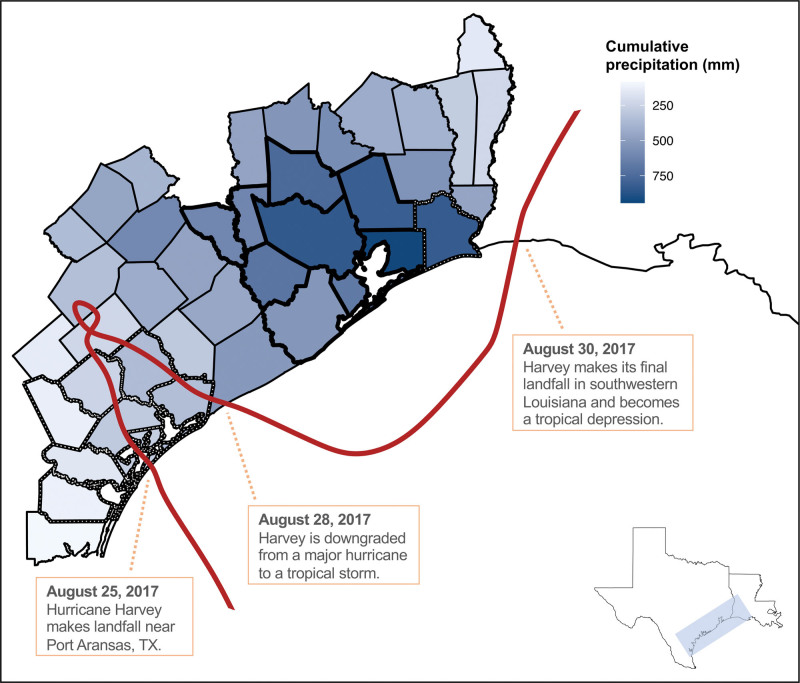
Background: Hurricane Harvey made landfall in August 2017 and resulted in catastrophic flooding in Houston, Texas. Prior studies of hurricanes and preterm birth have found conflicting results. We tested the hypotheses that exposure to Hurricane Harvey was associated with a higher risk of spontaneous pre- and early-term birth and assessed vulnerable subpopulations.
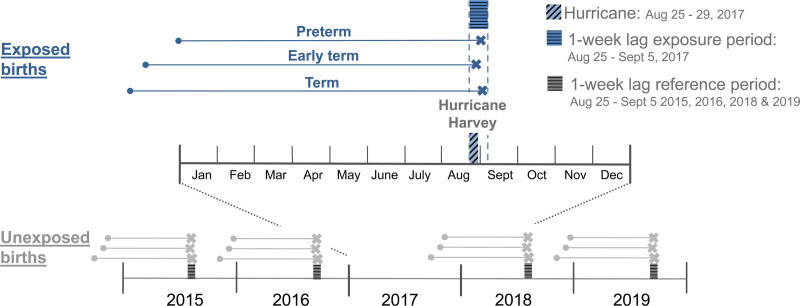
Methods: We conducted a retrospective study of singleton births using administrative birth records in the nine-county greater Houston area from 2015 to 2019. We estimated the likelihood of pre- and early-term births using logistic regression, comparing births occurring during or within 1, 2, or 4 weeks of Hurricane Harvey to unexposed reference periods encompassing the same dates 2 years prior and after. Stratified models assessed effect modification by degree of flooding, birth parent age, high- vs. low-risk pregnancy, race/ethnicity, and prenatal care.
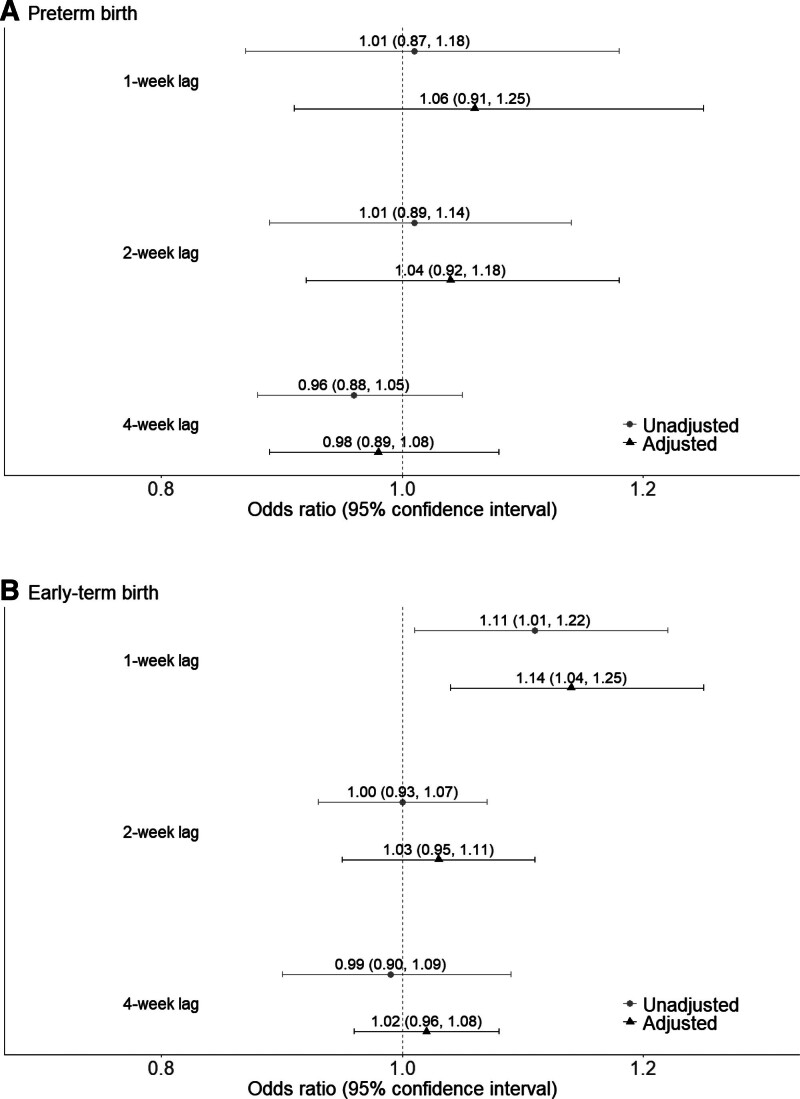
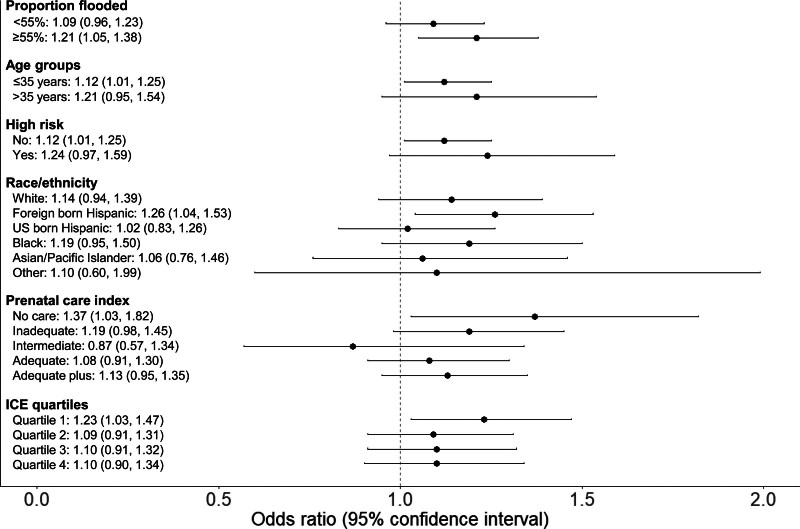
Results: Among 15,564 births, we found no association between exposure to Hurricane Harvey and spontaneous preterm birth within 1 week adjusted (odds ratio [OR], 1.06; 95% confidence interval [CI] = 0.91, 1.25) but a 14% higher odds of spontaneous early-term birth (OR, 1.14; 95% CI = 1.04, 1.25). The odds of early-term birth were even higher in neighborhoods with severe flooding (OR, 1.21; 95% CI = 1.05, 1.38), segregated neighborhoods (OR, 1.23; 95% CI = 1.03, 1.47), and among foreign-born Hispanics (OR, 1.21; 95% CI = 1.04, 1.53) and pregnant people receiving no prenatal care (OR, 1.37; 95% CI = 1.03, 1.82). Effect estimates were attenuated or null when considering 2-week or 4-week lags to define exposure.
Conclusions: Hurricane Harvey was associated with higher odds of spontaneous early-term birth up to 1 week later, especially among socially marginalized populations.
Copyright © 2024 The Authors. Published by Wolters Kluwer Health, Inc. on behalf of The Environmental Epidemiology. All rights reserved.
Conflict of interest statement
The authors declare that they have no conflicts of interest with regard to the content of this report.
Figures
References
-
- Wuebbles DJ, Fahey DW, Hibbard KA. Climate science special report: fourth national climate assessment, volume I; 2017.
-
- Pant S, Cha EJ. Potential changes in hurricane risk profile across the United States coastal regions under climate change scenarios. Struct Saf. 2019;80:56–65.
-
- First Street Foundation. The 7th National Risk Assessment: Worsening Winds; 2023.
-
- Wang SS, Zhao L, Yoon J-H, Klotzbach P, Gillies RR. Quantitative attribution of climate effects on Hurricane Harvey’s extreme rainfall in Texas. Environ Res Lett. 2018;13:054014.