


Optimal use of antithrombotic agents in recent small subcortical strokes accompanied by atrial fibrillation
- PMID: 38804237
- PMCID: PMC11569447
- DOI: 10.1177/23969873241253958
Optimal use of antithrombotic agents in recent small subcortical strokes accompanied by atrial fibrillation
Abstract
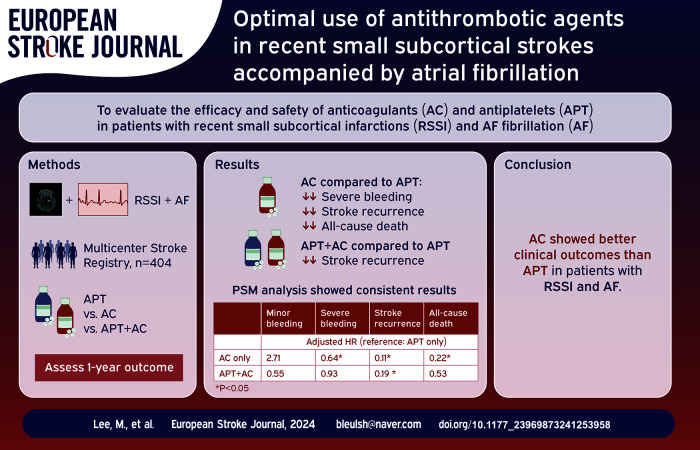
Background: This study aimed to evaluate the efficacy and safety of anticoagulants (AC) and antiplatelets (APT) in patients with recent small subcortical infarctions (RSSI) and atrial fibrillation (AF).
Methods: We utilized a prospective multicenter stroke registry database to identify patients with RSSI with a concurrent diagnosis of AF. Propensity score matching analysis was used to balance baseline differences among the AC-only, APT-only, and their combination groups. The main outcomes of interest were time to occurrence of minor and major bleeding, stroke recurrence, and all-cause mortality. Adjusted hazard ratios (aHRs) and 95% confidence intervals (CIs) for each outcome were calculated using the multivariable Cox proportional hazard regression analysis.
Results: Of the 404 eligible patients, 28.2% received APT only, 53.0% received AC only, and 18.9% received a combination of both. Notable differences were observed between these groups in terms of the 1-year stroke recurrence (APT, 32.5%; AC, 5.6%; APT + AC, 9.2%) and all-cause mortality (APT, 21.9%; AC, 6.1%; APT + AC, 14.5%), whereas the rates of bleeding events were comparable. The multivariable analysis indicated a significant association of AC alone with reduced risks of severe bleeding, stroke recurrence, and all-cause mortality compared with APT alone (aHR 0.64, 95% CI 0.41-0.98; aHR 0.11, 95% CI 0.06-0.22; aHR 0.22, 95% CI 0.11-0.44, respectively). The combination group showed a reduced risk of stroke recurrence compared to APT alone (aHR 0.19, 95% CI 0.08-0.46). These findings remained consistent with the propensity score-matched analysis.
Conclusion: AC showed better clinical outcomes than APT in patients with RSSI and AF. Additionally, combination therapy with AC and APT was associated with a lower risk of stroke recurrence than APT alone.
Keywords: Stroke; anticoagulant; antiplatelet; atrial fibrillation; subcortical infarction.
Conflict of interest statement
Declaration of conflicting interestsThe author(s) declared no potential conflicts of interest with respect to the research, authorship, and/or publication of this article.
Figures


References
-
- Secondary prevention in non-rheumatic atrial fibrillation after transient ischaemic attack or minor stroke. EAFT (European Atrial Fibrillation Trial) Study Group. Lancet 1993; 342: 1255–1262. https://www.thelancet.com/journals/lancet/article/PII0140-6736(93)92358-... - PubMed
-
- Kleindorfer DO, Towfighi A, Chaturvedi S, et al. 2021 Guideline for the prevention of stroke in patients with stroke and transient ischemic attack: a guideline from the American Heart Association/American Stroke Association. Stroke 2021; 52: e364–e467. - PubMed
-
- Evans A, Perez I, Yu G, et al. Secondary stroke prevention in atrial fibrillation: lessons from clinical practice. Stroke 2000; 31: 2106–2111. - PubMed
-
- Miller VT, Pearce LA, Feinberg WM, et al. Differential effect of aspirin versus warfarin on clinical stroke types in patients with atrial fibrillation. Stroke prevention in atrial fibrillation investigators. Neurology 1996; 46: 238–240. - PubMed
Publication types
MeSH terms
Substances
LinkOut - more resources
Full Text Sources
Medical
