


Chronotropic Incompetence Among People With HIV Improves With Exercise Training in the Exercise for Healthy Aging Study
- PMID: 38805178
- PMCID: PMC11481357
- DOI: 10.1093/infdis/jiae284
Chronotropic Incompetence Among People With HIV Improves With Exercise Training in the Exercise for Healthy Aging Study
Abstract
Background: People with HIV (PWH) have lower exercise capacity than peers without HIV, which may be explained by chronotropic incompetence, the inability to increase heart rate during exercise.
Methods: The Exercise for Healthy Aging Study included adults aged 50 to 75 years with and without HIV. Participants completed 12 weeks of moderate-intensity exercise, before randomization to moderate or high intensity for 12 additional weeks. We compared adjusted heart rate reserve (AHRR; chronotropic incompetence <80%) on cardiopulmonary exercise testing by HIV serostatus and change from baseline to 12 and 24 weeks using mixed effects models.
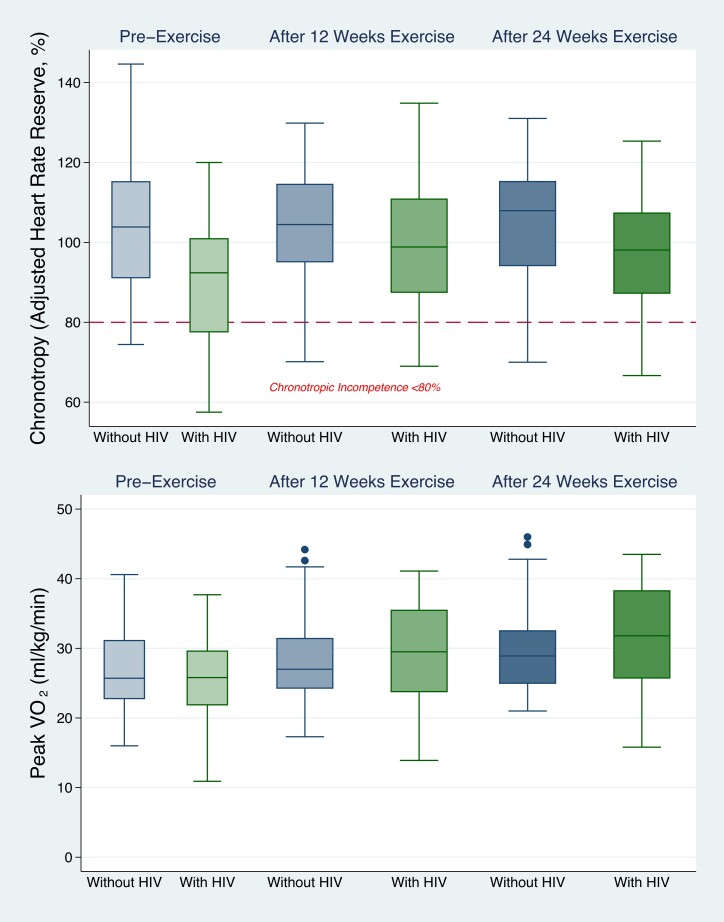
Results: Among 32 PWH and 37 controls (median age, 56 years; 7% female), 28% of PWH vs 11% of controls had chronotropic incompetence at baseline (P = .067). AHRR was lower among PWH (91% vs 101%; difference, 10%; 95% CI, 1.9%-18.9%; P = .02). At week 12, AHRR normalized among PWH (+8%; 95% CI, 4%-11%; P < .001) and was sustained at week 24 (+5%; 95% CI, 1%-9%; P = .008) versus no change among controls (95% CI, -4% to 4%; P = .95; interaction P = .004). After 24 weeks of exercise, 15% of PWH and 10% of controls had chronotropic incompetence (P = .70).
Conclusions: Chronotropic incompetence contributes to reduced exercise capacity among PWH and improves with exercise training.
Keywords: HIV; adjusted heart rate reserve/chronotropic index; cardiorespiratory fitness; chronotropic incompetence; exercise training.
© The Author(s) 2024. Published by Oxford University Press on behalf of Infectious Diseases Society of America. All rights reserved. For commercial re-use, please contact reprints@oup.com for reprints and translation rights for reprints. All other permissions can be obtained through our RightsLink service via the Permissions link on the article page on our site—for further information please contact journals.permissions@oup.com.
Conflict of interest statement
Potential conflicts of interest. All authors: No reported conflicts. All authors have submitted the ICMJE Form for Disclosure of Potential Conflicts of Interest. Conflicts that the editors consider relevant to the content of the manuscript have been disclosed.
Figures

Update of
-
Chronotropic Incompetence among People with HIV Improves with Exercise Training in the Exercise for Healthy Aging Study.medRxiv [Preprint]. 2023 Nov 10:2023.11.10.23298367. doi: 10.1101/2023.11.10.23298367. medRxiv. 2023. Update in: J Infect Dis. 2024 Oct 16;230(4):919-927. doi: 10.1093/infdis/jiae284. PMID: 37986954 Free PMC article. Updated. Preprint.
References
-
- Pothoff G, Wassermann K, Ostmann H. Impairment of exercise capacity in various groups of HIV-infected patients. Respiration 1994; 61:80–5. - PubMed
-
- Oursler KK, Sorkin JD, Smith BA, Katzel LI. Reduced aerobic capacity and physical functioning in older HIV-infected men. AIDS Res Hum Retroviruses 2006; 22:1113–21. - PubMed
-
- Duong M, Dumas JP, Buisson M, et al. Limitation of exercise capacity in nucleoside-treated HIV-infected patients with hyperlactataemia. HIV Med 2007; 8:105–11. - PubMed
