Clinical Trial
. 2024 Aug 10;42(23):2790-2799.
doi: 10.1200/JCO.23.01462. Epub 2024 May 28.

Patient-Reported Outcomes From the Phase III HIMALAYA Study of Tremelimumab Plus Durvalumab in Unresectable Hepatocellular Carcinoma

Affiliations
Clinical Trial

Patient-Reported Outcomes From the Phase III HIMALAYA Study of Tremelimumab Plus Durvalumab in Unresectable Hepatocellular Carcinoma

Bruno Sangro et al. J Clin Oncol. .

Abstract

Purpose: In the phase III HIMALAYA study (ClinicalTrials.gov identifier: NCT03298451) in unresectable hepatocellular carcinoma (uHCC), the Single Tremelimumab Regular Interval Durvalumab (STRIDE) regimen significantly improved overall survival versus sorafenib, and durvalumab monotherapy was noninferior to sorafenib. Patient-reported outcomes (PROs), a secondary outcome from HIMALAYA, are reported here.

Methods: Participants were randomly assigned to receive STRIDE, durvalumab, or sorafenib. PROs were assessed (preplanned secondary outcome) using the European Organization for Research and Treatment of Cancer 30-item Quality of Life Questionnaire and the 18-item HCC module. Time to deterioration (TTD), change from baseline and improvement rate in global health status/quality of life (GHS/QoL), functioning, and disease-related symptoms were analyzed.

Results: In total, 1,171 participants were randomly assigned to STRIDE (n = 393), durvalumab (n = 389), or sorafenib (n = 389) and were evaluable for PRO assessments. Across treatment arms, compliance rates for PROs were >77% at baseline and >70% overall. Baseline scores were comparable across treatment arms. TTD in GHS/QoL, physical functioning, fatigue, appetite loss, and abdominal pain was numerically longer for both STRIDE and durvalumab versus sorafenib. Clinically meaningful deterioration in PROs was not observed in any treatment arm. However, TTD in nausea and abdominal swelling was numerically longer for STRIDE versus sorafenib, and the likelihood of clinically meaningful improvement in GHS/QoL, role, emotional and social functioning, and disease-related symptoms was greater with STRIDE and durvalumab versus sorafenib. PROs with STRIDE and durvalumab were generally similar.

Conclusion: Compared with sorafenib, STRIDE and durvalumab were associated with clinically meaningful, patient-centered GHS/QoL, functioning, and symptom benefits in people with uHCC. These findings support the benefits of the STRIDE regimen compared with sorafenib for a diverse population reflective of the global uHCC population.


Conflict of interest statement

The following represents disclosure information provided by authors of this manuscript. All relationships are considered compensated unless otherwise noted. Relationships are self-held unless noted. I = Immediate Family Member, Inst = My Institution. Relationships may not relate to the subject matter of this manuscript. For more information about ASCO's conflict of interest policy, please refer to www.asco.org/rwc or ascopubs.org/jco/authors/author-center.

Open Payments is a public database containing information reported by companies about payments made to US-licensed physicians (Open Payments).

Bruno Sangro

Consulting or Advisory Role: Bristol Myers Squibb, AstraZeneca, Bayer, Sirtex Medical, Roche/Genentech, Eisai, Incyte, Boston Scientific, Sanofi Pasteur

Speakers' Bureau: AstraZeneca, Eisai, Incyte, Roche

Research Funding: Bristol Myers Squibb (Inst), Roche (Inst)

Travel, Accommodations, Expenses: AstraZeneca, Bristol Myers Squibb, Sirtex Medical, Eisai, Roche

Peter R. Galle

Honoraria: Bristol-Myers Squibb, Bayer Schering Pharma, Sirtex Medical, Roche/Genentech, Ipsen, Adaptimmune, MSD, AstraZeneca/MedImmune

Consulting or Advisory Role: Bayer Schering Pharma, Sirtex Medical, Lilly, Bristol-Myers Squibb, MSD, Roche/Genentech, Adaptimmune, Boston Scientific

Speakers' Bureau: Bayer Schering Pharma, Lilly, Roche, Ipsen

Research Funding: Roche/Genentech

Travel, Accommodations, Expenses: Bayer Schering Pharma, Lilly, Sirtex Medical, AstraZeneca

Robin Kate Kelley

Consulting or Advisory Role: Agios (Inst), AstraZeneca (Inst), Merck (Inst), Kinnate Biopharma, Exelixis/Ipsen (Inst), Regeneron, Tyra Biosciences, Compass Therapeutics, Elevar Therapeutics, J-Pharma, Moderna Therapeutics

Research Funding: Lilly (Inst), Exelixis (Inst), Novartis (Inst), Bristol-Myers Squibb (Inst), MedImmune (Inst), Merck Sharp & Dohme (Inst), Agios (Inst), AstraZeneca (Inst), Adaptimmune (Inst), Taiho Pharmaceutical (Inst), Bayer (Inst), QED Therapeutics (Inst), EMD Serono (Inst), Partner Therapeutics (Inst), Genentech/Roche (Inst), Surface Oncology (Inst), Relay Therapeutics (Inst), Loxo/Lilly (Inst), Servier (Inst), Compass Therapeutics (Inst), Tyra Biosciences (Inst)

Travel, Accommodations, Expenses: AstraZeneca, Merck

Chaiyut Charoentum

Research Funding: AstraZeneca (Inst), Roche/Genentech (Inst), Novartis (Inst), MSD Oncology (Inst)

Enrico N. De Toni

Employment: Boehringer Ingelheim

Honoraria: AstraZeneca, Bayer, Bristol-Myers Squibb, Eisai, Lilly, Pfizer, Ipsen, Terumo, Roche

Consulting or Advisory Role: AstraZeneca, Bayer, Bristol-Myers Squibb, Eisai, Lilly, Pfizer, Ipsen, Terumo, Roche

Research Funding: AstraZeneca, Bristol-Myer Squibb, Bayer, Lilly, Ipsen, Roche

Travel, Accommodations, Expenses: AstraZeneca, Bristol-Myers Squibb, Bayer, Celsion, Roche, Ipsen

Jeong Heo

Consulting or Advisory Role: AstraZeneca/MedImmune

Speakers' Bureau: Roche, AstraZeneca/MedImmune

Ann-Lii Cheng

Honoraria: Bayer Yakuhin, AstraZeneca, Eisai, Genentech/Roche

Consulting or Advisory Role: Bristol-Myers Squibb, Bayer Schering Pharma, Eisai, Ono Pharmaceutical, AstraZeneca, Genentech/Roche, MSD, BeiGene, IQVIA, Ipsen, Roche, Omega Therapeutics, Inc

Andrea Wilson Woods

Employment: Blue Faery: The Adrienne Wilson Liver Cancer Association

Honoraria: HCC TAG, American Institute Continuing Medical Education

Consulting or Advisory Role: Eisai (Inst), Humanise Health, AstraZeneca

Charu Gupta

Employment: AstraZeneca/MedImmune

Stock and Other Ownership Interests: AstraZeneca/MedImmune

Jayne Abraham

Employment: UCB

Stock and Other Ownership Interests: UCB

Carrie L. McCoy

Employment: AstraZeneca/MedImmune

Stock and Other Ownership Interests: AstraZeneca/MedImmune

Nikunj Patel

Employment: AstraZeneca

Stock and Other Ownership Interests: AstraZeneca

Alejandra Negro

Employment: AstraZeneca

Stock and Other Ownership Interests: AstraZeneca

Arndt Vogel

Honoraria: Roche, Amgen, Lilly, Bristol-Myers Squibb, MSD, Pierre Fabre, Ipsen, Janssen, Incyte, AstraZeneca/MedImmune, Sirtex Medical, Daichi-Sankyo, Terumo, Taiho Oncology, Eisai, BeiGene, Boehringer Pharma GmbH, GlaxoSmithKline, Boston Scientific, Servier

Consulting or Advisory Role: Novartis, Lilly, Roche, Amgen, Baxalta, AstraZeneca, Eisai, BTG, Ipsen, Pierre Fabre, Terumo, Daichi-Sankyo, Sirtex Medical, Boehringer Pharma GmbH, Incyte, Taiho Oncology

Research Funding: Novartis

Travel, Accommodations, Expenses: Roche, Ipsen, AstraZeneca, MSD, Lilly

Ghassan K. Abou-Alfa

Consulting or Advisory Role: Eisai, Ipsen, Merck Serono, AstraZeneca, Yiviva, Roche/Genentech, Autem Medical, Exelixis, QED Therapeutics, Boehringer Ingelheim, Novartis, Berry Genomics, BioNtech, Bristol-Myers Squibb/Medarex, Merus NV, Neogene Therapeutics, Tempus, Vector Health, Servier, J-Pharma, AbbVie

Research Funding: AstraZeneca (Inst), Bristol-Myers Squibb (Inst), Puma Biotechnology (Inst), QED Therapeutics (Inst), BioNtech (Inst), Genentech/Roche (Inst), Helsinn Healthcare (Inst), Yiviva (Inst), Elicio Therapeutics (Inst), Agenus (Inst), Parker Institute for Cancer Immunotherapy (Inst), Pertzye (Inst), Arcus Ventures (Inst)

No other potential conflicts of interest were reported.

Figures
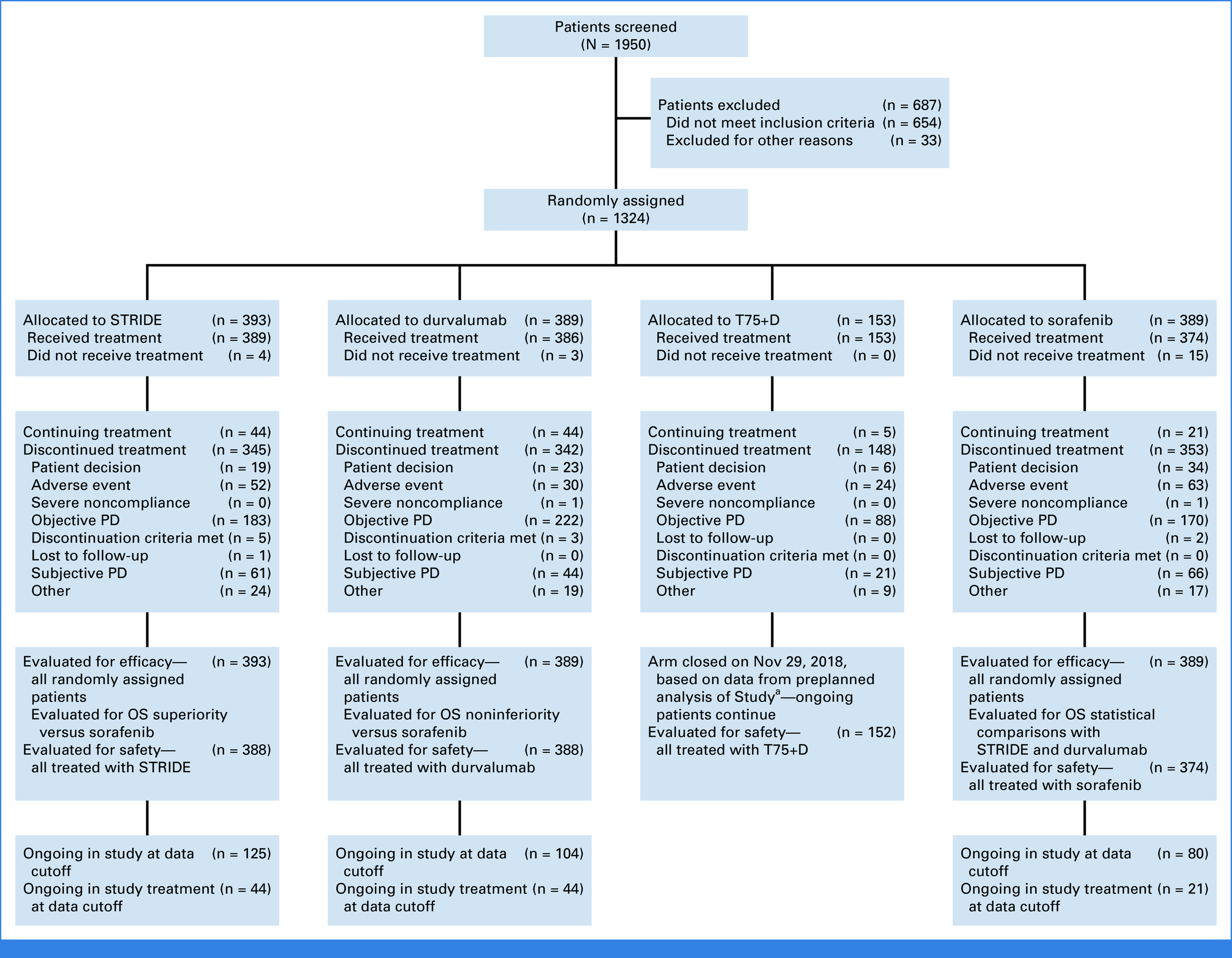
FIG 1.
FIG 1.
CONSORT diagram. aA preplanned analysis of Study 22 demonstrated that T75+D did not meaningfully differentiate from durvalumab monotherapy in terms of efficacy, and toxicity was slightly increased. Thus, enrollment to T75+D in HIMALAYA was closed on Nov 29, 2018. OS, overall survival; PD, progressive disease; STRIDE, Single Tremelimumab Regular Interval Durvalumab; T75+D, tremelimumab 75 mg once every 4 weeks for four doses plus durvalumab 1,500 mg once every 4 weeks.
FIG 2.
FIG 2.
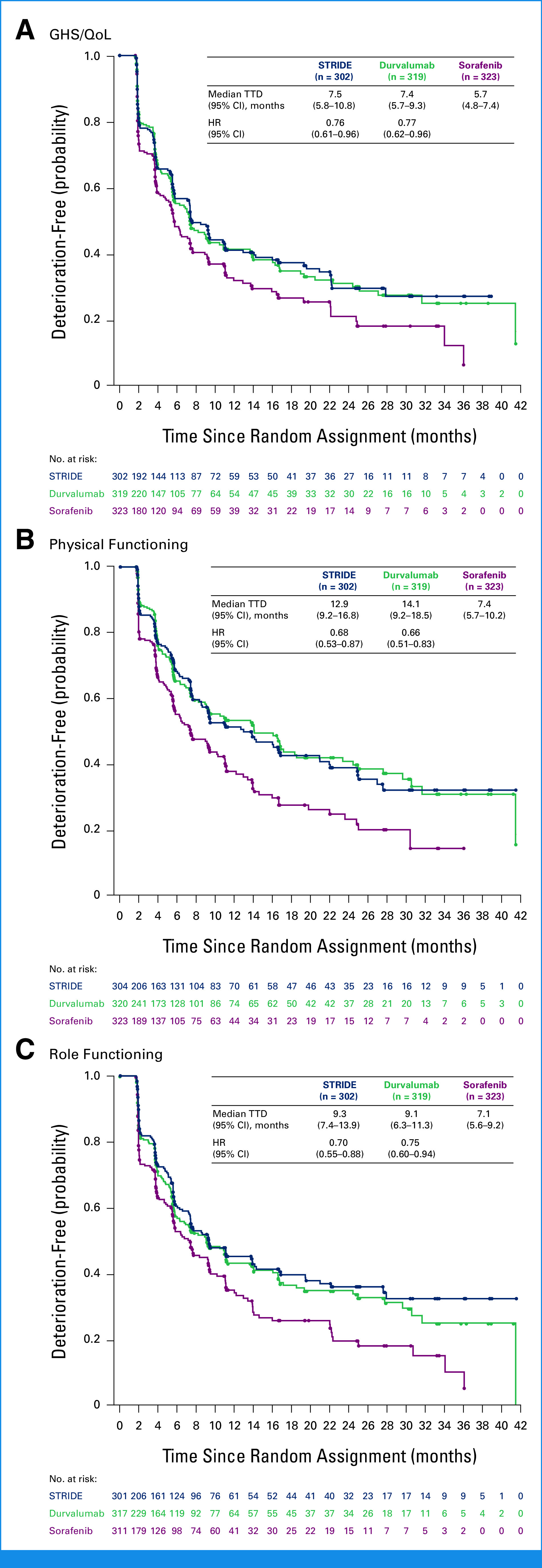
TTD in (A) GHS/QoL, (B) physical functioning, and (C) role functioning. HRs were calculated versus sorafenib. GHS, global health status; HR, hazard ratio; QoL, quality of life; STRIDE, Single Tremelimumab Regular Interval Durvalumab; TTD, time to deterioration.
FIG 3.
FIG 3.
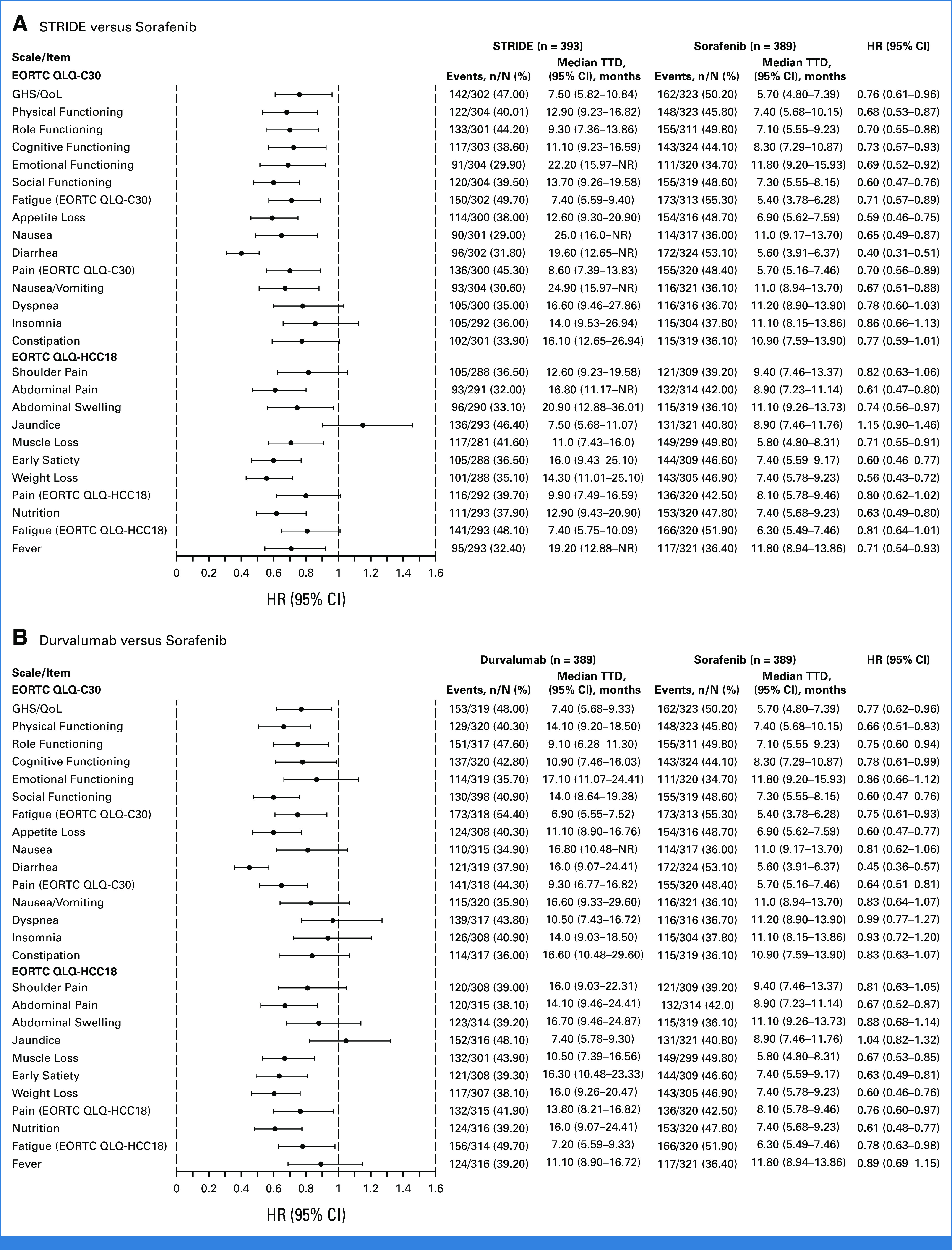
TTD in PROs with (A) STRIDE versus sorafenib and (B) durvalumab versus sorafenib. EORTC, European Organization for Research and Treatment of Cancer; GHS, global health status; HCC, hepatocellular carcinoma; HR, hazard ratio; NR, not reached; PRO, patient-reported outcome; QLQ-C30, 30-item Quality of Life Questionnaire; QLQ-HCC18, 18-item HCC Health-Related Quality of Life Questionnaire; QoL, quality of life; STRIDE, Single Tremelimumab Regular Interval Durvalumab; TTD, time to deterioration.
FIG 4.
FIG 4.
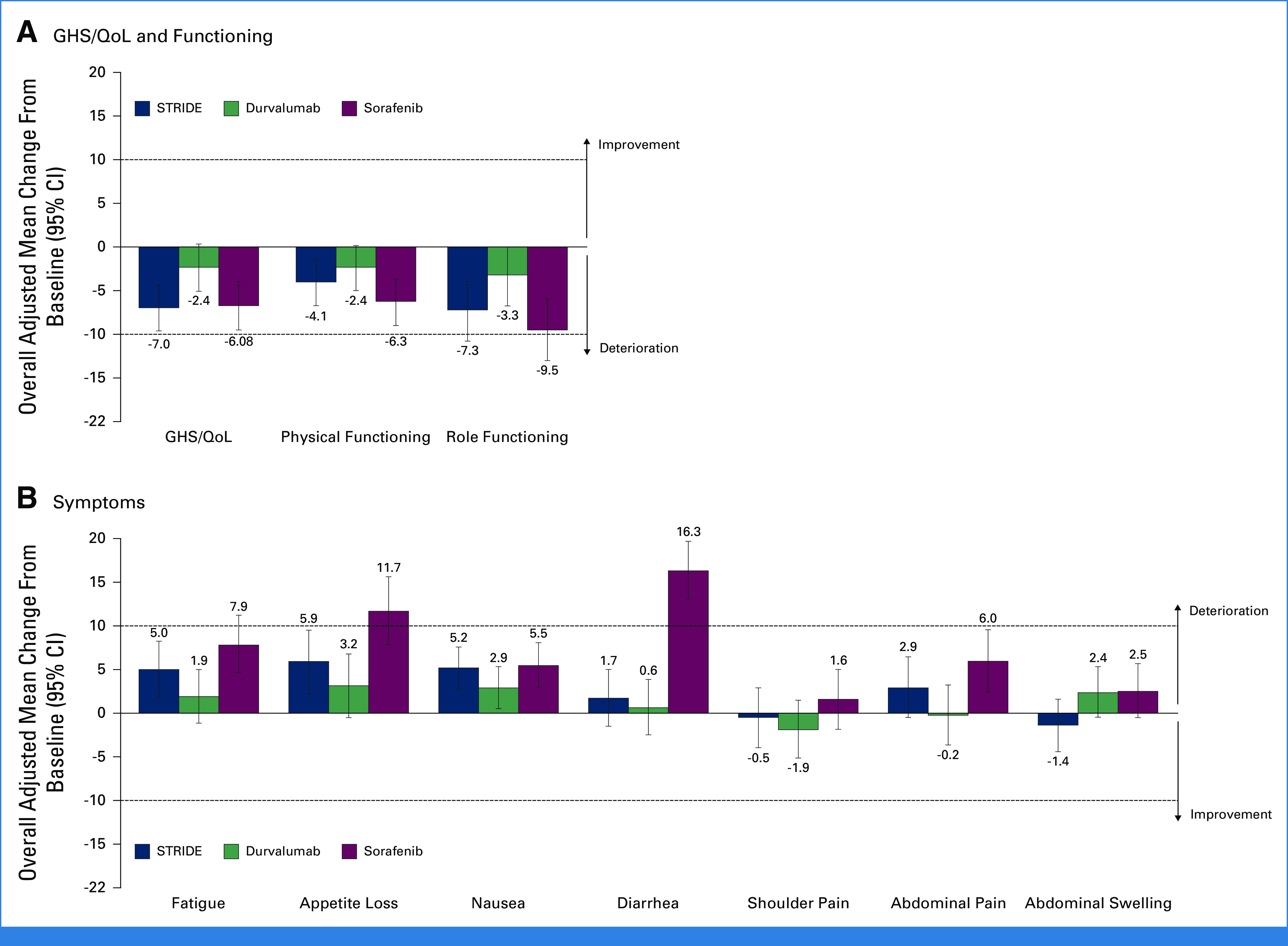
Adjusted mean change from baseline over 24 weeks in (A) GHS/QoL and functioning and (B) symptoms. Adjusted mean change from baseline was calculated using an MMRM analysis, including treatment, visit, and treatment-by-visit interaction as explanatory variables and the baseline score as a covariate. Data reported are the adjusted mean change from baseline averaged over 24 weeks. Error bars represent the 95% CIs. Dotted lines represent the threshold for clinically meaningful change: an absolute change in the score of ≥10 points from the baseline score. Change from baseline in jaundice was not calculated. GHS, global health status; MMRM, mixed-effect model repeated measures; QoL, quality of life; STRIDE, Single Tremelimumab Regular Interval Durvalumab.
FIG A1.
FIG A1.
TTD in (A) cognitive functioning, (B) emotional functioning, and (C) social functioning. HRs were calculated versus sorafenib. HR, hazard ratio; NR, not reached; STRIDE, Single Tremelimumab Regular Interval Durvalumab; TTD, time to deterioration.
FIG A2.
FIG A2.
Adjusted mean change from baseline over 24 weeks in EORTC QLQ-C30 functioning domains. Adjusted mean change from baseline was calculated using an MMRM analysis including treatment, visit, and treatment-by-visit interaction as explanatory variables and the baseline score as a covariate. Data reported are the adjusted mean change from baseline averaged over 24 weeks. Error bars represent the 95% CIs. Dotted lines represent the threshold for clinically meaningful change (an absolute change ≥10 points from baseline). EORTC, European Organization for Research and Treatment of Cancer; MMRM, mixed-effect model repeated measures; QLQ-C30, 30-item Quality of Life Questionnaire; STRIDE, Single Tremelimumab Regular Interval Durvalumab.
FIG A3.
FIG A3.
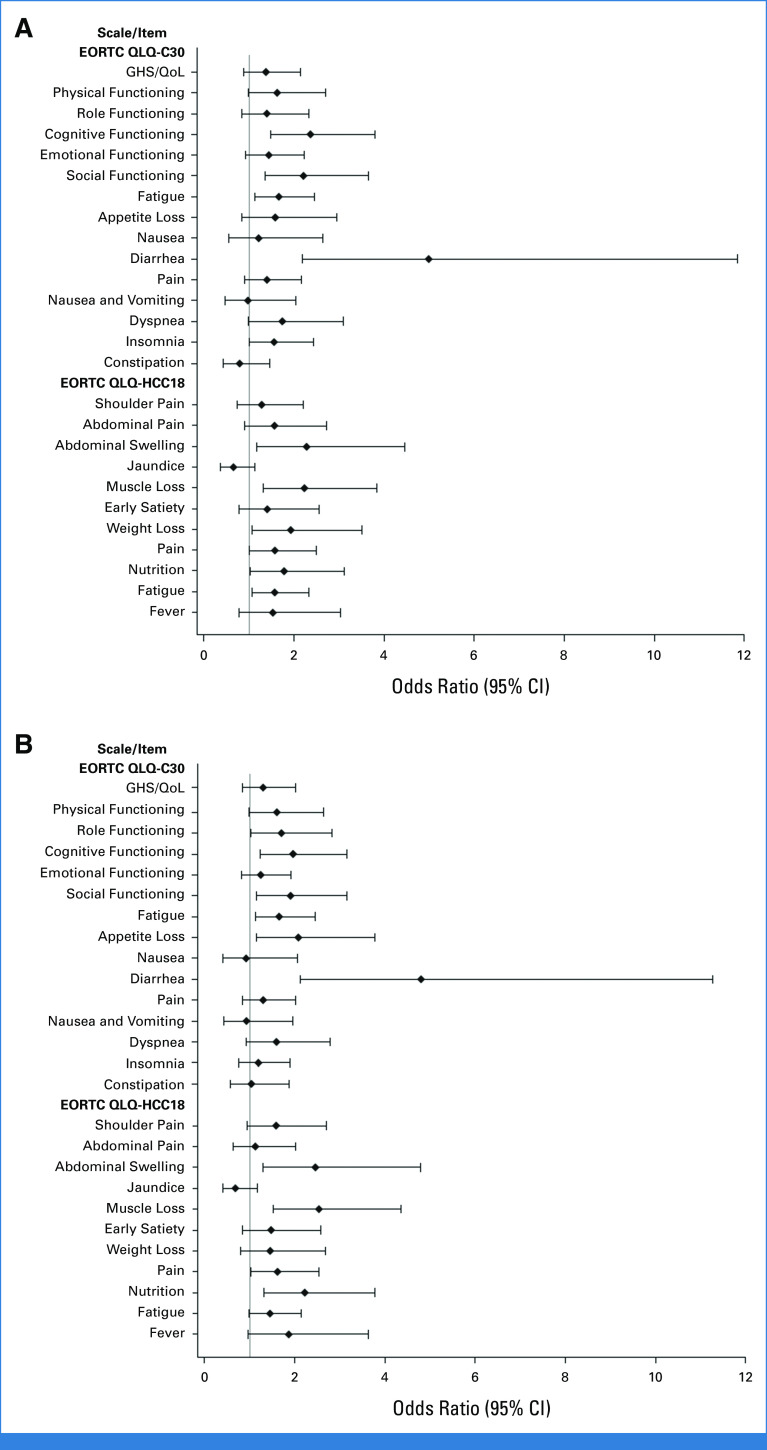
Improvement rate (best overall response of improveda) in PROs assessed with (A) STRIDE versus sorafenib and (B) durvalumab versus sorafenib. The analysis was performed using a logistic regression model adjusted for treatment with factors for etiology of liver disease, ECOG, and macrovascular invasion. An odds ratio >1 favors the STRIDE regimen or durvalumab versus sorafenib. For the GHS/QoL and function improvement rate, the set for the analysis includes a subset of the FAS who have a baseline GHS/QoL or function score ≤90. For the symptom improvement rate, the set for the analysis includes a subset of the FAS who have baseline symptom scores of ≥10. aTwo consecutive visit responses of improvement ≥21 days apart or one visit response of improvement and no further assessments and no death within two visits. ECOG, Eastern Cooperative Oncology Group; EORTC, European Organization for Research and Treatment of Cancer; FAS, full analysis set; GHS, global health status; HCC, hepatocellular carcinoma; PRO, patient-reported outcome; QLQ-C30, 30-item Quality of Life Questionnaire; QLQ-HCC18, 18-item HCC Health-Related Quality of Life Questionnaire; QoL, quality of life; STRIDE, Single Tremelimumab Regular Interval Durvalumab.

References

    1. Sung H, Ferlay J, Siegel RL, et al. : Global cancer statistics 2020: GLOBOCAN estimates of incidence and mortality worldwide for 36 cancers in 185 countries. CA Cancer J Clin 71:209-249, 2021 - PubMed
    1. Ferlay J, Ervik M, Lam F, et al. : Global Cancer Observatory: Cancer Today: Liver Factsheet. Lyon, France, International Agency for Research on Cancer, 2020
    1. Park J-W, Chen M, Colombo M, et al. : Global patterns of hepatocellular carcinoma management from diagnosis to death: The BRIDGE study. Liver Int 35:2155-2166, 2015 - PMC - PubMed
    1. Bray F, Ferlay J, Soerjomataram I, et al. : Global cancer statistics 2018: GLOBOCAN estimates of incidence and mortality worldwide for 36 cancers in 185 countries. CA Cancer J Clin 68:394-424, 2018 - PubMed
    1. Llovet JM, Kelley RK, Villanueva A, et al. : Hepatocellular carcinoma. Nat Rev Dis Primers 7:6, 2021 - PubMed

Publication types

MeSH terms

Associated data