


Association between atherosclerotic cardiovascular disease score and skin carotenoid levels estimated via refraction spectroscopy in the Japanese population: a cross-sectional study
- PMID: 38806551
- PMCID: PMC11133310
- DOI: 10.1038/s41598-024-62772-y
Association between atherosclerotic cardiovascular disease score and skin carotenoid levels estimated via refraction spectroscopy in the Japanese population: a cross-sectional study
Abstract
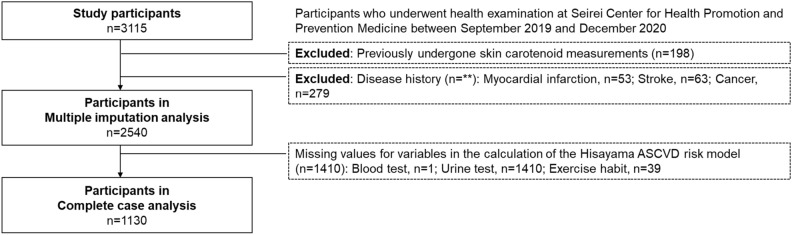
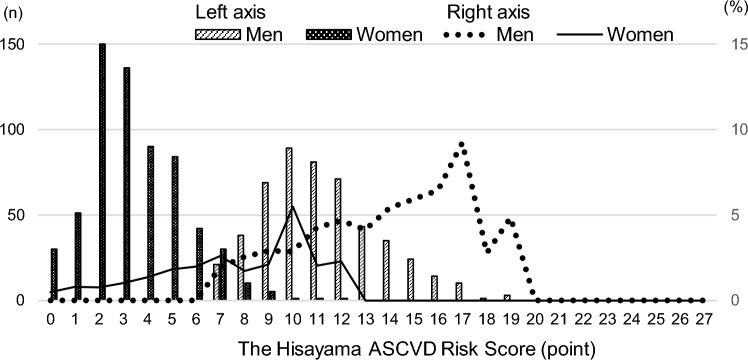
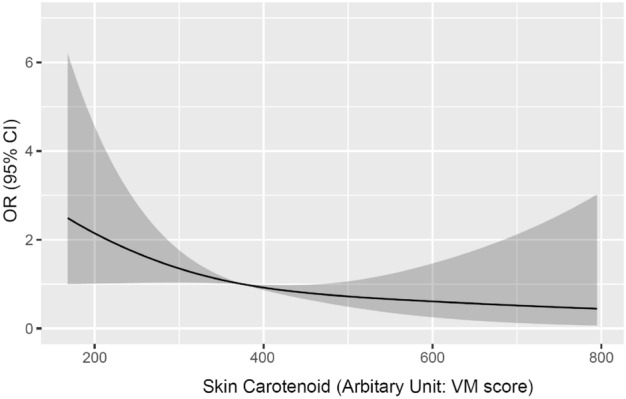
Carotenoids play a role in preventing and impeding the progression of atherosclerotic cardiovascular diseases (ASCVDs) through their anti-oxidative effects. This study evaluated associations between ASCVD risk and skin carotenoid (SC) levels, reflecting dietary carotenoid intake. Participants' ASCVD risk was assessed using the Hisayama ASCVD risk prediction model, and SC levels were measured through a reflection spectroscope (Veggie Meter). The associations between high ASCVD risk and SC levels were analyzed using logistic regression analysis and a restricted cubic spline (RCS) model. A total of 1130 men and women (mean age: 56 years) from participants who underwent a health examination in Seirei Center for Health Promotion and Prevention Medicine in 2019 and 2022 were analyzed. Of these, 4.6% had moderate or high ASCVD risk. Mean SC values were 236, 315, 376, 447, and 606 in quintile Q1 to Q5, respectively. The adjusted odds ratios (95% confidence intervals) of SC quintile for moderate- or high-risk ASCVD was 0.24 (0.12-0.51) in Q5 (495 ≤), 0.42 (0.23-0.77) in Q4, 0.50 (0.29-0.88) in Q3, and 0.68 (0.41-1.12) in Q2 compared to Q1 (< 281). High SC values continuously showed non-linear inverse association with moderate- or high-risk for ASCVD in Japanese adults. Non-invasive SC measurements may be a good indicator for recommending carotenoids to prevent cardiovascular disease.
Keywords: Cardiovascular disease risk; Health examination participants; Japanese; Logistic regression analysis; Skin carotenoids; Veggie meter.
© 2024. The Author(s).
Conflict of interest statement
The authors declare no competing interests.
Figures
Similar articles
-
Skin Carotenoid Scores Assessed with Reflection Spectroscopy Are Associated with Self-Reported Fruit and Vegetable Intake Among Latino Early Adolescents.J Acad Nutr Diet. 2021 Aug;121(8):1507-1514. doi: 10.1016/j.jand.2021.02.019. Epub 2021 Apr 2. J Acad Nutr Diet. 2021. PMID: 33820748
-
Use of the Veggie Meter® as a tool to objectively approximate fruit and vegetable intake among youth for evaluation of preschool and school-based interventions.J Hum Nutr Diet. 2020 Dec;33(6):869-875. doi: 10.1111/jhn.12755. Epub 2020 Apr 12. J Hum Nutr Diet. 2020. PMID: 32281191 Free PMC article.
-
Skin carotenoid scores and metabolic syndrome in a general Japanese population: the Hisayama study.Int J Obes (Lond). 2024 Oct;48(10):1465-1471. doi: 10.1038/s41366-024-01575-7. Epub 2024 Jul 9. Int J Obes (Lond). 2024. PMID: 38982187 Free PMC article.
-
Use of Preventive Cardiovascular Health Care Among Asian American Individuals: A National Health Interview Survey Study.Curr Probl Cardiol. 2023 Aug;48(8):101241. doi: 10.1016/j.cpcardiol.2022.101241. Epub 2022 May 2. Curr Probl Cardiol. 2023. PMID: 35513186 Review.
-
Measurement of skin carotenoids and their association with diseases: a narrative review.Biochim Biophys Acta Mol Cell Biol Lipids. 2025 Jun;1870(5):159612. doi: 10.1016/j.bbalip.2025.159612. Epub 2025 Apr 19. Biochim Biophys Acta Mol Cell Biol Lipids. 2025. PMID: 40258439 Review.
Cited by
-
Validation of a Food Frequency Questionnaire: VioScreen-Allergy.Nutrients. 2024 Nov 2;16(21):3772. doi: 10.3390/nu16213772. Nutrients. 2024. PMID: 39519605 Free PMC article.
-
Inverse Relationship Between Serum Carotenoid Levels and Cardiovascular-Kidney-Metabolic Syndrome Among the General Adult Population.J Diabetes. 2025 Feb;17(2):e70046. doi: 10.1111/1753-0407.70046. J Diabetes. 2025. PMID: 39887849 Free PMC article.
References
MeSH terms
Substances
Grants and funding
- 23K09691/the Ministry of Education, Culture, Sports, Science and Technology of Japan
- 23K12695/the Ministry of Education, Culture, Sports, Science and Technology of Japan
- 23K02694/the Ministry of Education, Culture, Sports, Science and Technology of Japan
- 19H01114, 18KK0253/the Ministry of Education, Culture, Sports, Science and Technology of Japan
- 20K09784/Japan Agency for Medical Research and Development
LinkOut - more resources
Full Text Sources
Medical
