


Density-mediated foraging behavioral responses of Rhyzopertha dominica (Coleoptera: Bostrichidae) and Tribolium castaneum (Coleoptera: Tenebrionidae)
- PMID: 38806558
- PMCID: PMC11133452
- DOI: 10.1038/s41598-024-62277-8
Density-mediated foraging behavioral responses of Rhyzopertha dominica (Coleoptera: Bostrichidae) and Tribolium castaneum (Coleoptera: Tenebrionidae)
Abstract
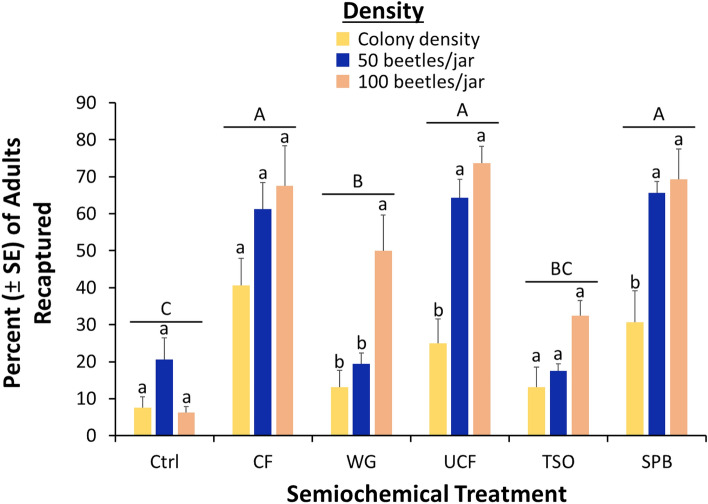
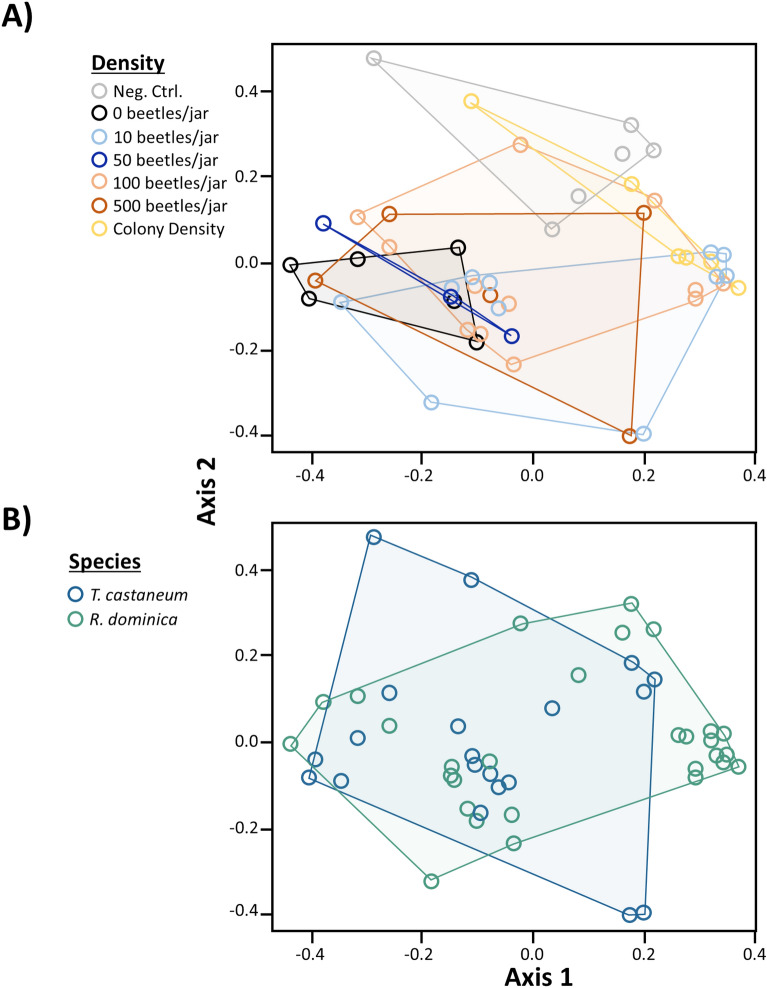
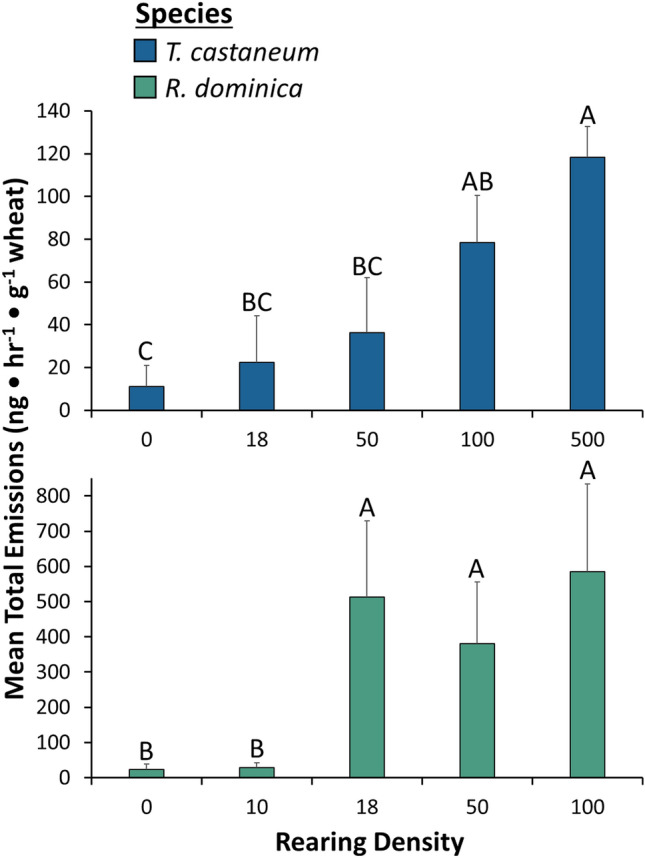
Tribolium castaneum and Rhyzopertha dominica are cosmopolitan, destructive postharvest pests. Although research has investigated how high densities of T. castaneum affect attraction to the aggregation pheromone by conspecifics, research into the behavioral response of both species to food cues after high density exposure has been lacking despite its importance to foraging ecology. Our goal was to manipulate and observe the effects of crowding on the behavioral response of both species to common food and pheromonal stimuli and to determine how the headspace emission patterns from grain differed under increasing densities. Densities of colonies for both species was altered (10-500 adults) on a fixed quantity of food (10 g of flour or whole wheat), then the behavioral response to common food and pheromonal cues was evaluated in a wind tunnel and release-recapture experiment, while volatiles were examined through gas chromatography coupled with mass spectrometry. Importantly, at least for T. castaneum, crowded conditions attenuate attraction to food-based stimuli, but not pheromonal stimuli. Crowding seemed to have no effect on R. dominica attraction to food and pheromonal stimuli in the wind tunnel, but exposure to high density cues did elicit 2.1-3.8-fold higher captures in traps. The relative composition and abundance of headspace volatiles emitted varied significantly with different densities of beetles and was also species-specific. Overall, our results have implications for expanding our understanding of the foraging ecology of two economically important pests.
Keywords: Integrated pest management; Lesser grain borer; Red flour beetle; Semiochemicals; Stored products; Taxis.
© 2024. This is a U.S. Government work and not under copyright protection in the US; foreign copyright protection may apply.
Conflict of interest statement
The authors declare no competing interests.
Figures
References
-
- Getz WM. A hypothesis regarding the abruptness of density dependence and the growth rate of populations. Ecology. 1996;77:2014–2026. doi: 10.2307/2265697. - DOI
-
- Lauer MJ, James AS, Krupa J. Male density, female density and inter-sexual conflict in a stream-dwelling insect. Anim. Behav. 1996;52:929–939. doi: 10.1006/anbe.1996.0241. - DOI
-
- Gunton RM, Pöyry J. Scale-specific spatial density dependence in parasitoids: A multi-factor meta-analysis. Funct. Ecol. 2016;30:1501–1510. doi: 10.1111/1365-2435.12627. - DOI
-
- Thierry M, Hrček J, Lewis OT. Mechanisms structuring host–parasitoid networks in a global warming context: A review. Ecol. Entomol. 2019;44:581–592. doi: 10.1111/een.12750. - DOI
MeSH terms
Substances
Supplementary concepts
Grants and funding
LinkOut - more resources
Full Text Sources
