


Membranous urethral length is the single independent predictor of urinary continence recovery at 12 months following Retzius-sparing robot-assisted radical prostatectomy
- PMID: 38809307
- PMCID: PMC11136784
- DOI: 10.1007/s11701-024-01986-8
Membranous urethral length is the single independent predictor of urinary continence recovery at 12 months following Retzius-sparing robot-assisted radical prostatectomy
Abstract
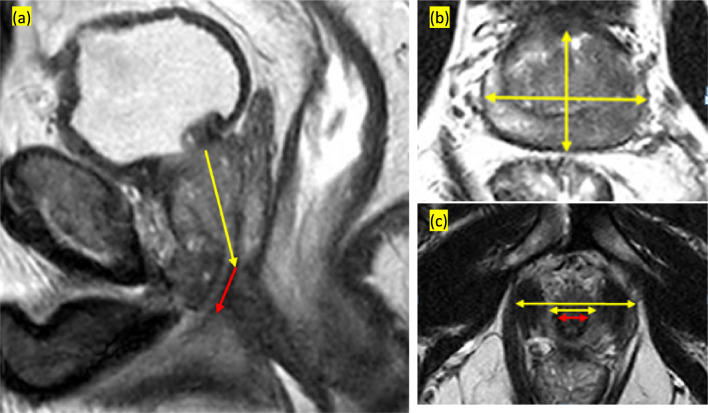
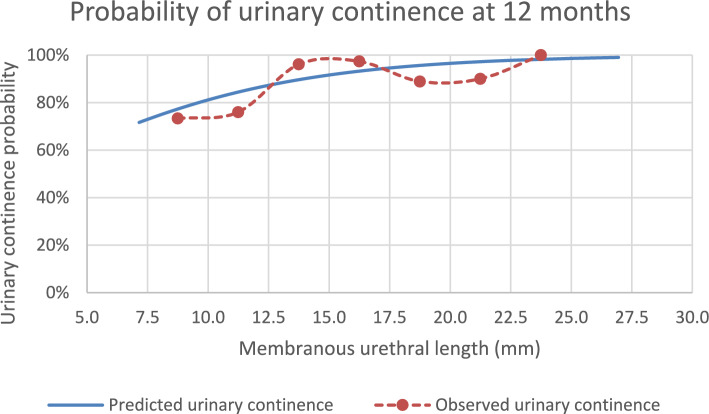
The influence of anatomical parameters on urinary continence (UC) after Retzius-sparing robot-assisted radical prostatectomy (RS-RARP) remains uncharted. Our objective was to evaluate their association with UC at 3, 6 and 12 months post-operatively. Data from patients who underwent RS-RARP were prospectively collected. Continence was defined as no pad use. Anatomic variables were measured on preoperative magnetic resonance imaging (MRI). Regression analyses were performed to identify predictors of UC at each time point. We included 158 patients with a median age of 60 years, most of whom had a localized tumor (≤ cT2). On multivariate analyses, at 3 months post-surgery, urinary incontinence (UI) rises with age, odds ratio (OR) 1.07 [95% confidence interval (CI) 1.004-1.142] and with prostate volume (PV), OR 1.029 (95% CI 1.006-1.052); it reduces with longer membranous urethral length (MUL), OR 0.875 (95% CI 0.780-0.983) and with higher membranous urethral volume (MUV), OR 0.299 (95% CI 0.121-0.737). At 6 months, UI rises with PV, OR 1.033 (95% CI 1.011-1.056) and decreases with MUV, OR 0.1504 (95% CI 0.050-0.444). Significantly, at 12 months post-surgery, the only predictor of UI is MUL, OR 0.830 (95% CI 0.706-0.975), establishing a threshold associated with a risk of UI of 5% (MUL > 15 mm) in opposition to a risk of 25% (MUL < 10 mm). This single institutional study requires external validation. To our knowledge, this is the first prospective cohort study supporting MUL as the single independent predictor of UC at 12 months post-surgery. By establishing MUL thresholds, we enable precise patient counseling.
Keywords: Magnetic resonance imaging; Prognostic tool; Prostate cancer; Retzius-sparing robot-assisted radical prostatectomy; Urinary incontinence.
© 2024. The Author(s).
Conflict of interest statement
The authors declare no competing interests.
The author declares that have no conflict of interest.
Figures
References
-
- Mottet N, van den Bergh RCN, Briers E, Van den Broeck T, Cumberbatch MG, De Santis M et al (2021) EAU-EANM-ESTRO-ESUR-SIOG guidelines on prostate cancer—2020 update. Part 1: screening, diagnosis, and local treatment with curative intent. Eur Urol 79:243–262. 10.1016/j.eururo.2020.09.042 - PubMed
-
- Fanshawe JB, Wai-Shun Chan V, Asif A, Ng A, Van Hemelrijck M, Cathcart P et al (2023) Decision regret in patients with localised prostate cancer: a systematic review and meta-analysis. Eur Urol Oncol. 10.1016/j.euo.2023.02.005 - PubMed
-
- Ficarra V, Novara G, Rosen RC, Artibani W, Carroll PR, Costello A et al (2012) Systematic review and meta-analysis of studies reporting urinary continence recovery after robot-assisted radical prostatectomy. Eur Urol 62:405–417. 10.1016/j.eururo.2012.05.045 - PubMed
MeSH terms
LinkOut - more resources
Full Text Sources
Medical
