


Antibiotic-altered gut microbiota explain host memory plasticity and disrupt pace-of-life covariation for an aquatic snail
- PMID: 38811063
- PMCID: PMC11136587
- DOI: 10.1093/ismejo/wrae078
Antibiotic-altered gut microbiota explain host memory plasticity and disrupt pace-of-life covariation for an aquatic snail
Abstract
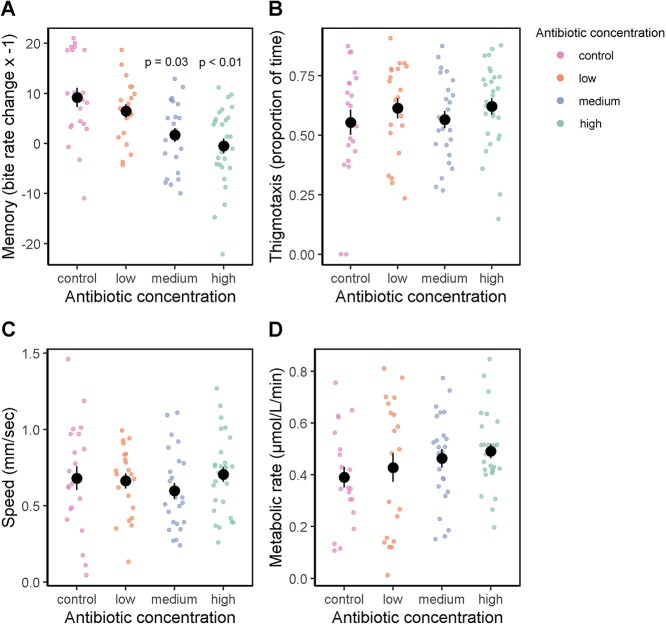
There is mounting evidence that intestinal microbiota communities and their genes (the gut microbiome) influence how animals behave and interact with their environment, driving individual variation. Individual covariation in behavioural, physiological, and cognitive traits among individuals along a fast-slow continuum is thought to arise because these traits are linked as part of an adaptive pace-of-life strategy. Yet paradoxically, trait intercorrelation is absent or disrupted in some populations but not others. Here, we provide experimental evidence from aquatic pond snails (Lymnaea stagnalis) that environmental stressors and the gut microbiota explain host phenotypic plasticity and disrupted covariation among traits. Antibiotic exposure at varying levels of ecologically relevant concentrations had multiple effects starting with gut microbiota diversity, differential abundance, and inferred function. Memory declined in line with antibiotic concentrations that caused the most profound gut microbiota disruption, and although pace-of-life traits remained rigid, their covariation did not. Moreover, inferred microbial metabolic pathways with biologically relevant host functions explained individual and treatment variation in phenotypes. Together, our results point to the gut microbiome as a proximate mechanism influencing the emergence and maintenance of phenotypic variation within populations and highlights the need to decipher whether the gut microbiome's sensitivity to environmental pollution facilitates adaptive or maladaptive phenotypic plasticity.
Keywords: Lymnaea stagnalis; antibiotic pollution; behavioural plasticity; cognition; gut microbiota; memory; microbiome–gut–brain axis; pace-of-life; personality; syndromes.
© The Author(s) 2024. Published by Oxford University Press on behalf of the International Society for Microbial Ecology.
Conflict of interest statement
None declared.
Figures



References
MeSH terms
Substances
Grants and funding
LinkOut - more resources
Full Text Sources
Medical
Research Materials
