. 2024 May 29;24(1):592.
doi: 10.1186/s12909-024-05557-1.

A systematic review of shared decision making training programs for general practitioners

Affiliations

A systematic review of shared decision making training programs for general practitioners

Jasmien Jaeken et al. BMC Med Educ. .

Abstract

Background: Shared decision making (SDM) has been presented as the preferred approach for decisions where there is more than one acceptable option and has been identified a priority feature of high-quality patient-centered care. Considering the foundation of trust between general practitioners (GPs) and patients and the variety of diseases in primary care, the primary care context can be viewed as roots of SDM. GPs are requesting training programs to improve their SDM skills leading to a more patient-centered care approach. Because of the high number of training programs available, it is important to overview these training interventions specifically for primary care and to explore how these training programs are evaluated.

Methods: This review was reported in accordance with the PRISMA guideline. Eight different databases were used in December 2022 and updated in September 2023. Risk of bias was assessed using ICROMS. Training effectiveness was analyzed using the Kirkpatrick evaluation model and categorized according to training format (online, live or blended learning).

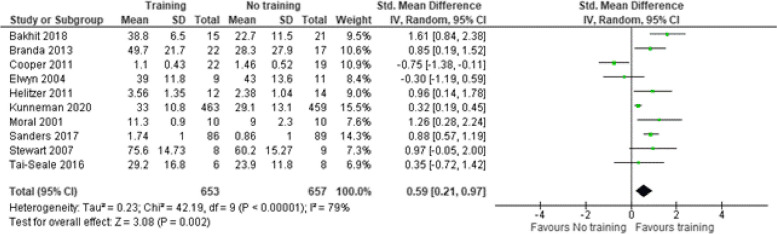
Results: We identified 29 different SDM training programs for GPs. SDM training has a moderate impact on patient (SMD 0.53 95% CI 0.15-0.90) and observer reported SDM skills (SMD 0.59 95%CI 0.21-0.97). For blended training programs, we found a high impact for quality of life (SMD 1.20 95% CI -0.38-2.78) and patient reported SDM skills (SMD 2.89 95%CI -0.55-6.32).

Conclusion: SDM training improves patient and observer reported SDM skills in GPs. Blended learning as learning format for SDM appears to show better effects on learning outcomes than online or live learning formats. This suggests that teaching facilities designing SDM training may want to prioritize blended learning formats. More homogeneity in SDM measurement scales and evaluation approaches and direct comparisons of different types of educational formats are needed to develop the most appropriate and effective SDM training format.

Trial registration: PROSPERO: A systematic review of shared-decision making training programs in a primary care setting. PROSPERO 2023 CRD42023393385 Available from: https://www.crd.york.ac.uk/prospero/display_record.php?ID=CRD42023393385 .

Keywords: Decision making; Educational intervention; General practitioner; Shared decision making.


Conflict of interest statement

The authors declare no competing interests.

Figures
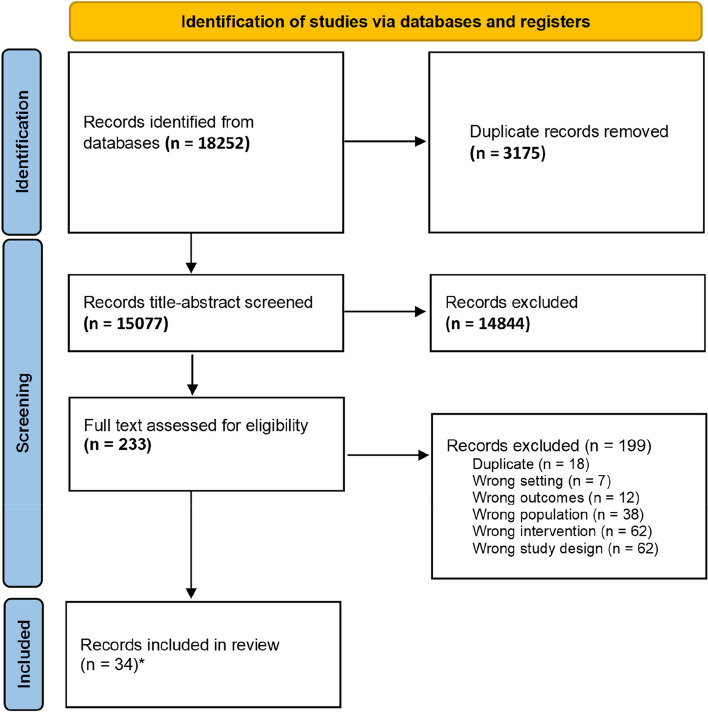
Fig. 1
Fig. 1
PRISMA flowchart. *34 records representing 29 studies
Fig. 2
Fig. 2
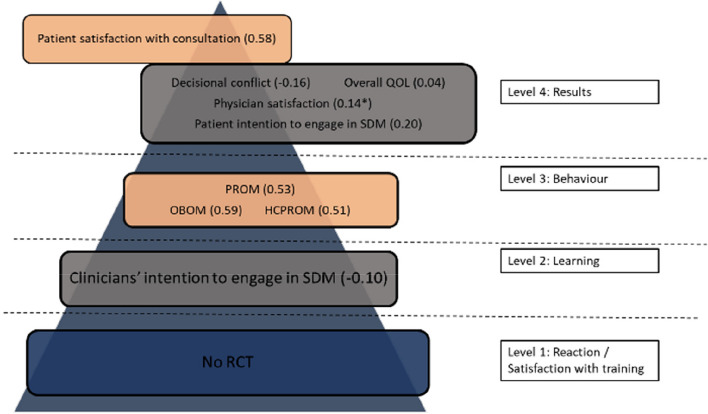
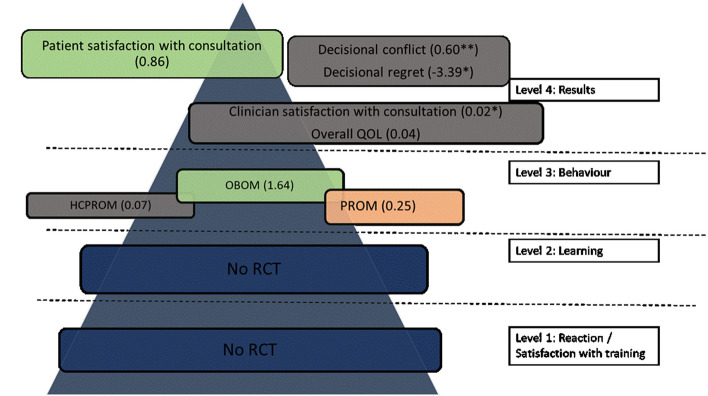
Outcome measures of all SDM training programs (online + live + blended) categorized by Kirkpatrick level. Numbers in brackets are standardized mean difference, numbers with * indicate a risk difference. Color legend: blue = no studies. Grey = small effect size (Cohen’s d < 0.2). Orange = medium effect size (Cohen’s d 0.2–0.5). Green: large effect size (Cohen’s d > 0.8). RCT = randomized controlled trial. SDM = Shared Decision making. PROM = patient reported outcome measure. OBOM = observer reported outcome measure. HCPROM = healthcare professional reported outcome measure. QOL = quality of life
Fig. 3
Fig. 3
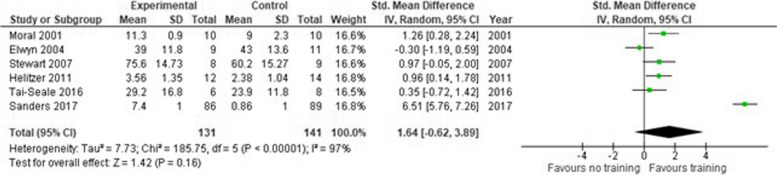
Shared decision making skills – Observer reported scales. SD = standard deviation. Std. mean difference = standardized mean difference. IV = inverse variance. 95% CI = 95% confidence interval
Fig. 4
Fig. 4
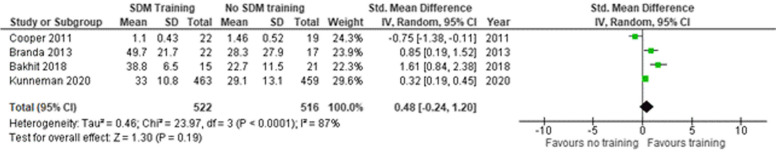
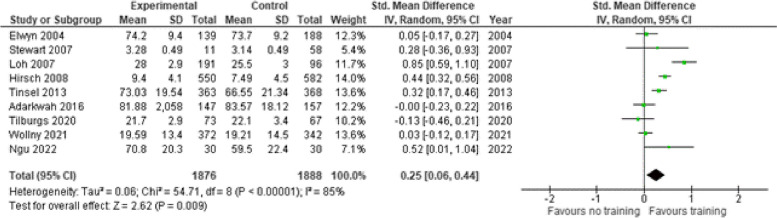
Shared decision making skills – Patient reported scales. SD = standard deviation. Std. mean difference = standardized mean difference. IV = inverse variance. 95% CI = 95% confidence interval
Fig. 5
Fig. 5
Shared decision making skills – Healthcare professional reported scales. SD = standard deviation. Std. mean difference = standardized mean difference. IV = inverse variance. 95% CI = 95% confidence interval
Fig. 6
Fig. 6
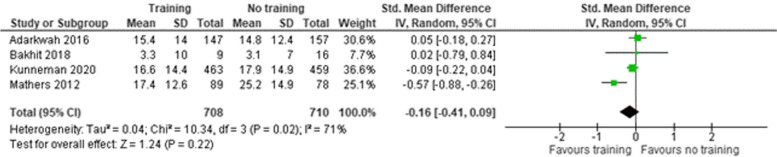
Decisional conflict. SD = standard deviation. Std. mean difference = standardized mean difference. IV = inverse variance. 95% CI = 95% confidence interval
Fig. 7
Fig. 7
Outcome measures of online training programs based on Kirkpatrick level. Numbers in brackets are standardized mean difference, numbers with * indicate a risk difference. Color legend: blue = no studies. Grey = small effect size (Cohen’s d < 0.2). Orange = medium effect size (Cohen’s d 0.2–0.5). Green: large effect size (Cohen’s d > 0.8). RCT = randomized controlled trial. SDM = Shared Decision making. PROM = patient reported outcome measure. OBOM = observer reported outcome measure. HCPROM = healthcare professional reported outcome measure. QOL = quality of life
Fig. 8
Fig. 8
Shared decision making skills – Patient reported scales. SD = standard deviation. Std. mean difference = standardized mean difference. IV = inverse variance. 95% CI = 95% confidence interval
Fig. 9
Fig. 9
Shared decision making skills – Observer reported scales. SD = standard deviation. Std. mean difference = standardized mean difference. IV = inverse variance. 95% CI = 95% confidence interval
Fig. 10
Fig. 10
Decisional conflict. SD = standard deviation. Std. mean difference = standardized mean difference. IV = inverse variance. 95% CI = 95% confidence interval
Fig. 11
Fig. 11
Outcome measures of live training programs based on Kirkpatrick level. Numbers in brackets are standardized mean difference. Numbers with * indicate a risk difference. Numbers with ** indicate the mean difference. Color legend: blue = no studies. Grey = small effect size (Cohen’s d < 0.2). Orange = medium effect size (Cohen’s d 0.2–0.5). Green: large effect size. RCT = randomized controlled trial. SDM = Shared Decision making. PROM = patient reported outcome measure. OBOM = observer reported outcome measure. HCPROM = healthcare professional reported outcome measure. QOL = quality of life. (Cohen’s d > 0.8)
Fig. 12
Fig. 12
Shared decision making skills – Patient reported scales. SD = standard deviation. Std. mean difference = standardized mean difference. IV = inverse variance. 95% CI = 95% confidence interval
Fig. 13
Fig. 13
Shared decision making skills – Observer reported scales. SD = standard deviation. Std. mean difference = standardized mean difference. IV = inverse variance. 95% CI = 95% confidence interval
Fig. 14
Fig. 14
Patient satisfaction with consultation. SD = standard deviation. Std. mean difference = standardized mean difference. IV = inverse variance. 95% CI = 95% confidence interval
Fig. 15
Fig. 15
Outcome measures of blended training programs based on Kirkpatrick level. Numbers in brackets are standardized mean difference, numbers with * indicate a risk difference. Color legend: blue = no studies. Grey = small effect size (Cohen’s d < 0.2). Orange = medium effect size (Cohen’s d 0.2–0.5). Green: large effect size (Cohen’s d > 0.8). RCT = randomized controlled trial. SDM = Shared Decision making. PROM = patient reported outcome measure. OBOM = observer reported outcome measure. HCPROM = healthcare professional reported outcome measure. QOL = quality of life. (Cohen’s d > 0.8)
Fig. 16
Fig. 16
Shared decision making skills –Patient reported scales. SD = standard deviation. Std. mean difference = standardized mean difference. IV = inverse variance. 95% CI = 95% confidence interval

References

    1. Levinson W, Kao A, Kuby A, Thisted RA. Not all patients want to participate in decision making. A national study of public preferences. J Gen Intern Med. 2005;20(6):531–5. 10.1111/j.1525-1497.2005.04101.x. - PMC - PubMed
    1. Kramer P, Damhuis E, Verhue D. Samen Beslissen: Doelgroepenonderzoek onder zorgverleners en zorggebruikers. Campagne Samen Beslissen in de Zorg. Programma Uitkomstgerichte Zorg. The Netherlands: KANTAR; 2022. p. 5–79. https://demedischspecialist.nl/sites/default/files/2022-10/rapport_campa....
    1. Gattellari M, Butow PN, Tattersall MH. Sharing decisions in cancer care. Soc Sci Med. 2001;52(12):1865–1878. doi: 10.1016/S0277-9536(00)00303-8. - DOI - PubMed
    1. Force UPST. Collaboration and Shared decision-making between patients and clinicians in preventive health care decisions and US preventive services task force recommendations. JAMA. 2022;327(12):1171–1176. doi: 10.1001/jama.2022.3267. - DOI - PubMed
    1. Elwyn G, Edwards A, Kinnersley P, Grol R. Shared decision making and the concept of equipoise: the competences of involving patients in healthcare choices. Br J Gen Pract. 2000;50(460):892–899. - PMC - PubMed

Publication types

MeSH terms

LinkOut - more resources