Case Reports
. 2024 May 21:27:101401.
doi: 10.1016/j.artd.2024.101401. eCollection 2024 Jun.

Bilateral Acrylic Hip Mold Arthroplasty in a Child With a Revision 60 years After Implantation: Clinical Case and Chemical Analysis of Endoprosthetic Material

Affiliations
Case Reports

Bilateral Acrylic Hip Mold Arthroplasty in a Child With a Revision 60 years After Implantation: Clinical Case and Chemical Analysis of Endoprosthetic Material

Samo Roškar et al. Arthroplast Today. .

Abstract

A 68-year-old man was referred due to bilateral hip pain and gradual deterioration of walking. He had mold arthroplasties on both hips at the age of 7 years and has been functioning well for more than 5 decades. However, the original data on operative report and the prostheses were missing. The radiological examination revealed bilateral broken prosthetic material. Thus, stage bilateral revision total hip arthroplasty was performed. A detailed chemical analysis of retrieved mold arthroplasty implants proved that the acrylic material was noted to be the same composition with the difference in appearance likely being related to different thermal treatments originally applied to the implants. As presented in our clinical case, even obsolete implants may have good survivorship. According to the case presented, total hip arthroplasty could be considered an effective option with the desired functional outcome when conservative and joint-preserving measures are exhausted.


Figures

Figure 1
Figure 1
Preoperative planning data from 1961.
Figure 2
Figure 2
An X-ray image of bilateral mold arthroplasties recorded in May 2020 before the revision operation.
Figure 3
Figure 3
X-ray image after definitive revision THA treatments of both hips at follow-up in April 2022.
Figure 4
Figure 4
The explanted mold arthroplasties with glass-like appearance: (a) right hip operated in May 2020 and (b) left hip operated in January 2022.
Figure 5
Figure 5
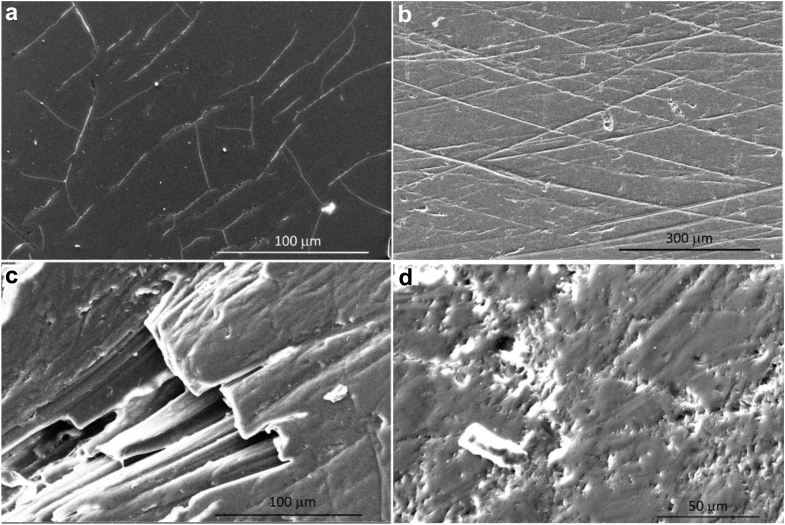
Scanning electron images (SEM) of the interior of the concave parts of the mold arthroplasty in Figure 4a show (a, b) longitudinal marks), (c) scratches and (d) pits.
Figure 6
Figure 6
Fourier-transform infrared spectra (FTIR) of the interior of the concave parts of the mold arthroplasties in Figure 4a. The chemical structure of poly(methyl methacrylate) (PMMA) is given in inset.
Figure 7
Figure 7
Proton nuclear magnetic resonance (1H NMR) spectra of the concave parts of the mold arthroplasties.
Figure 8
Figure 8
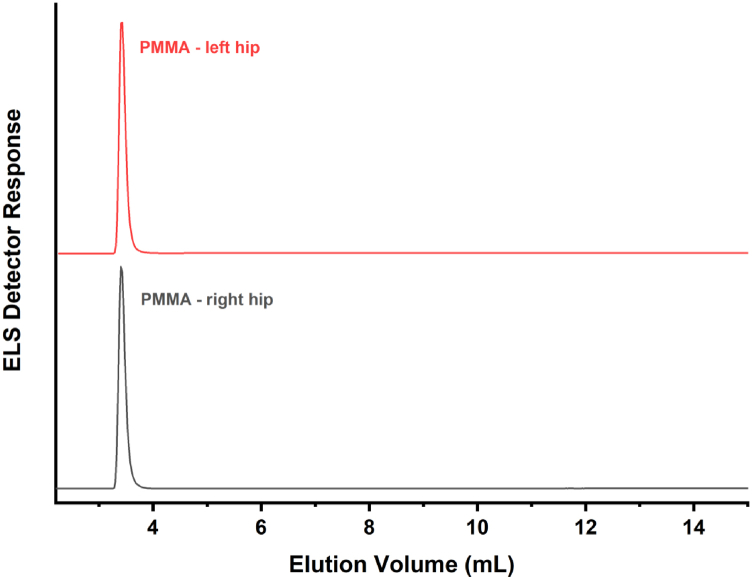
Size-exclusion chromatograms of the concave parts of the mold arthroplasties. The solid and dotted curves represent the refractive index detector and 90° light-scattering detector responses, respectively, while the lines represent the molar mass as a function of elution volume. The table below shows the weight- (Mw) and number- (Mn) of the average molar masses and dispersity of the PMMA materials from which the implants are made.
Figure S1
Figure S1
X-ray image after the implantation of THA of the right hip in June 2020.
Figure S2
Figure S2
X-ray images of (a) luxation of THA of the right hip in June 2020, (b) after the first revision in June 2020, (c) after the second revision in July 2020 and (d) after the treatment of periprosthetic fracture in July 2020.
Figure S3
Figure S3
The energy-dispersive X-ray spectrum of the interior of the concave part of the cup shown in Figure 4a. The chemical composition in weight % is given in the inset table.
Figure S4
Figure S4
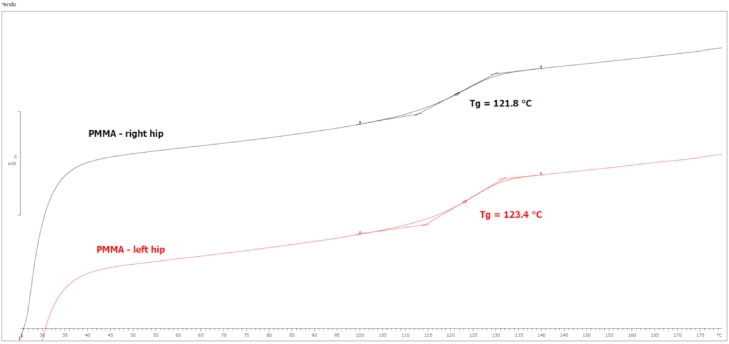
Differential scanning calorimetry (DSC) thermograms of the concave parts of the mould arthroplasties show comparable glass transition temperatures for both PMMA materials from which the implants are made.
Figure S5
Figure S5
High-performance liquid chromatograms (HPLC) of the concave parts of the mould arthroplasties show that the material of the 2 implants does not differ in chemical composition.

References

    1. Halvorsen V., Fenstad A.M., Engesæter L.B., Nordsletten L., Overgaard S., Pedersen A.B., et al. Outcome of 881 total hip arthroplasties in 747 patients 21 years or younger: data from the Nordic Arthroplasty Register Association (NARA) 1995-2016. Acta Orthop. 2019;90:331–337. - PMC - PubMed
    1. Luceri F., Morelli I., Sinicato C.M., Della Grazia A., Verdoni F., Maffulli N., et al. Medium-term outcomes of total hip arthroplasty in juvenile patients. J Orthop Surg Res. 2020;15:476. - PMC - PubMed
    1. Daurka J.S., Malik A.K., Robin D.A., Witt J.D. The results of uncemented total hip replacement in children with juvenile idiopathic arthritis at ten years. J Bone Joint Surg Br. 2012;94:1618–1624. - PubMed
    1. Patel N.K., Luff T., Whittingham-Jones P., Gooding C.R., Hashemi-Nejad A. Total hip arthroplasty in teenagers: an alternative to hip arthrodesis. Hip Int. 2012;22:621–627. - PubMed
    1. Shah K.N., Racine J., Jones L.C., Aaron R.K. Pathophysiology and risk factors for osteonecrosis. Curr Rev Musculoskelet Med. 2015;8:201–209. - PMC - PubMed

Publication types