. 2024 May 29:7:0377.
doi: 10.34133/research.0377. eCollection 2024.

4,4-Dimethylsterols Reduces Fat Accumulation via Inhibiting Fatty Acid Amide Hydrolase In Vitro and In Vivo

Affiliations

4,4-Dimethylsterols Reduces Fat Accumulation via Inhibiting Fatty Acid Amide Hydrolase In Vitro and In Vivo

Tao Zhang et al. Research (Wash D C). .

Abstract

4,4-Dimethylsterols constitute a unique class of phytosterols responsible for regulating endogenous cannabinoid system (ECS) functions. However, precise mechanism through which 4,4-dimethylsterols affect fat metabolism and the linkage to the ECS remain unresolved. In this study, we identified that 4,4-dimethylsterols, distinct from 4-demethseterols, act as inhibitors of fatty acid amide hydrolases (FAAHs) both in vivo and in vitro. Genetic ablation of FAAHs (faah-1) abolishes the effects of 4,4-dimethylsterols on fat accumulation and locomotion behavior in a Caenorhabditis elegans model. We confirmed that dietary intervention with 4,4-dimethylsterols in a high-fat diet (HFD) mouse model leads to a significant reduction in body weight (>11.28%) with improved lipid profiles in the liver and adipose tissues and increased fecal triacylglycerol excretion. Untargeted and targeted metabolomics further verified that 4,4-dimethylsterols influence unsaturated fatty acid biosynthesis and elevate oleoyl ethanolamine levels in the intestine. We propose a potential molecular mechanism in which 4,4-dimethylsterols engage in binding interactions with the catalytic pocket (Ser241) of FAAH-1 protein due to the shielded polarity, arising from the presence of 2 additional methyl groups (CH3). Consequently, 4,4-dimethylsterols represent an unexplored class of beneficial phytosterols that coordinate with FAAH-1 activity to reduce fat accumulation, which offers new insight into intervention strategies for treating diet-induced obesity.


Conflict of interest statement

Competing interests: The authors declare that they have no competing interests.

Figures

Fig. 1.
Fig. 1.
DMS suppresses cholesterol-depleted C. elegans growth but reduces fat accumulation and enhances locomotion in the presence of cholesterol. (A) DMS (lanosterol, β-amyrin, cycloartenol, and lupeol) fails to support the population growth in the third cholesterol-depleted generation of worms. (B) Cholesterol synthesis occurs in wild-type C. elegans when fed with 4-demethylsterol (stigmasterol) as analyzed by GC-MS analysis. (C) Dietary feeding of DMS in the presence of cholesterol reduces fat accumulation as indicated by lower GFP fluorescence intensity in worms carrying GFP-tagged lipid droplets (scale bar: 50 μm). (D) DMS treatment decreases triglycerides (TG) levels measured by using a TG assay kit. (E and F) Dietary feeding of DMS in the presence of cholesterol increases moving distance (E) and enhances moving speed (F) as analyzed by WormLab tracker software. Significant differences among 3 or more mean values were determined using one-way ANOVA with Tukey’s multiple comparisons test.
Fig.  2.
Fig.  2.
DMS exhibits inhibitory effect on FAAH-1 activity in C. elegans and in vitro. (A) OEA is a signal lipid involved in fat accumulation and locomotion. (B) Supplementation of DMS (cycloartenol and β-amyrin) leads to an increase in OEA levels and a reduction in OA levels in C. elegans. (C) Cycloartenol and β-amyrin decrease FAAH-1 expression in the pharynx by using FAAH-1::GFP transgenic worms (scale bar: 50 μm). (D and E) Genetic ablation of faah-1 abolished the effects of DMS on fat accumulation (D) and average moving speed (E). (F) An example of docking result between cycloartenol and FAAH-1 protein after molecular docking screening of various phytosterols using AutoGrid4 and AutoDock4 software. (G) Proposed mechanism of FAAH-1 inhibition by DMS via bonding to Ser241 residue. (H) Inhibitory activity assay by using purified human recombinant FAAH-1 enzyme confirms DMS as inhibitors of FAAH-1 in vitro. Significant differences among 3 or more mean values were determined using one-way ANOVA with Tukey’s multiple comparisons test.
Fig. 3.
Fig. 3.
Purified DMS from dietary oils reduces fat accumulation in cell models. Isolation (A), purity validation (B), and composition analysis (C) of different phytosterols by using MPLC, TLC, and HPLC-ELSD. (D) Structures and percentages of major phytosterols in RST, SST, and ST. (E) Oil red O staining of THLE-2 cells treated with different classes of phytosterols (ST, SST, and RST). (F) DMS supplementation reduces triglycerides accumulation in THLE-2 cells. Significant differences among 3 or more mean values were determined using one-way ANOVA with Tukey’s multiple comparisons test.
Fig. 4.
Fig. 4.
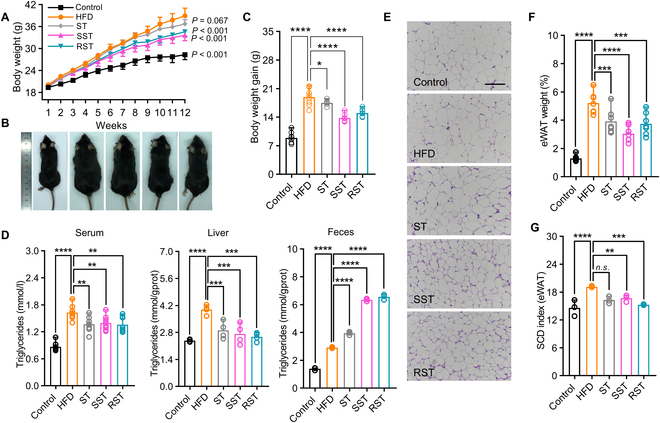
Dietary-derived DMS reduces obesity in a high-fat diet (HFD)-fed mouse model. (A) Body weight of mice fed with normal chow diet (Control), high-fat diet (HFD), and different phytosterols. (B) Representative appearances of mice from each group. (C) DMS significantly reduces body weight gain. (D) DMS decreases triglycerides level in serum and liver while enhancing triacylglycerol excretion in feces. Representative H&E staining (E), weight changes (F), and SCD index (G) of eWAT from different treatment groups (scale bar: 100 μm). Significant differences among 3 or more mean values were determined using one-way ANOVA with Tukey’s multiple comparisons test.
Fig.  5.
Fig.  5.
Alleviation of lipid metabolism and FAAH metabolites (NAE) in the intestine of DMS-treated mice. (A) PLS-DA plot based on the intestinal metabolite profiles of different groups (n = 6). (B) Volcano plot showing the Log2FC of significantly changed metabolites with DMS treatment (HFD/RST) (n = 6). (C) Metabolic pathway analysis organized by pathway enrichment analysis (P values) and pathway topology analysis (pathway impact). (D) DMS decreases fatty acid release rate and release rate constant during in vitro digestion. (E and F) Changes in the total N-acylethanolamine (NAE) level (E) and OEA levels in the cecum and duodenum (F). Significant differences among 3 or more mean values were determined by one-way ANOVA with Tukey’s multiple comparisons test.
Fig. 6.
Fig. 6.
Proposed mechanism of DMS-mediated fat reduction through FAAH-1 inhibition. FAAH-1 plays a critical role in hydrolyzing OEA into OA. DMS effectively inhibits FAAH-1, leading to increased levels of OEA. OEA acts as an agonist for peroxisome proliferator-activated receptor α (PPAR-α) and its homolog, nuclear hormone receptor-49 (NHR-49) in C. elegans. The elevated OEA concentration activates PPAR-α, promoting the β-oxidation pathway and reducing fat levels by down-regulating stearoyl-CoA desaturase (SCD) expression in the liver and adipose tissues. Furthermore, increased OEA inhibits pancreatic lipase activity, reducing intestinal fatty acid release and promoting fecal TG excretion. The FAAH-1-mediated lipid-lowering mechanism is independent of CB1R or food uptake.

References

    1. Barreiro EJ, Kümmerle AE, Fraga CAM. The methylation effect in medicinal chemistry. Chem Rev. 2011;111(9):5215–5246. - PubMed
    1. Cheng X, Smith JC. Biological membrane organization and cellular signaling. Chem Rev. 2019;119(9):5849–5880. - PubMed
    1. Darnet S, Schaller H. Metabolism and biological activities of 4-methyl-sterols. Molecules. 2019;24(3):451. - PMC - PubMed
    1. He W-S, Li L-L, Huang Q-J, Yin J, Cao X-C. Highly efficient synthesis of phytosterol linolenate in the presence of Bronsted acidic ionic liquid. Food Chem. 2018;263:1–7. - PubMed
    1. Zhang T, Xie L, Liu R, Chang M, Zhang H, Jin Q, Wang X. Revisiting the 4,4-dimethylsterols profile from different kinds of vegetable oils by using GC-MS. LWT. 2020;124: Article 109163.

LinkOut - more resources