


Lower Extremity Muscle Tendon Interaction Around Knee During Gait Among Adolescent Children with Cerebral Palsy with Varying Crouch Angle
- PMID: 38812859
- PMCID: PMC11130108
- DOI: 10.1007/s43465-024-01165-9
Lower Extremity Muscle Tendon Interaction Around Knee During Gait Among Adolescent Children with Cerebral Palsy with Varying Crouch Angle
Abstract
Background: Optimal management and surgical planning of severe bony deformities and muscle tendon unit contractures demands comprehensive evaluation of all structures including the dynamic muscle tendon length of all muscles around the joint during gait.
Objectives: Present study aimed to explore dynamic muscle-tendon length for all muscles around the knee joint along with pelvis, hip, and ankle joint kinematics among adolescent children with varying crouch angle.
Methods: Muscle-tendon length of 29 adolescent children with cerebral palsy with varying crouch angles was computed using a full-body musculo-skeletal model and expressed as a percentage of muscle-tendon length during walking compared to resting condition.
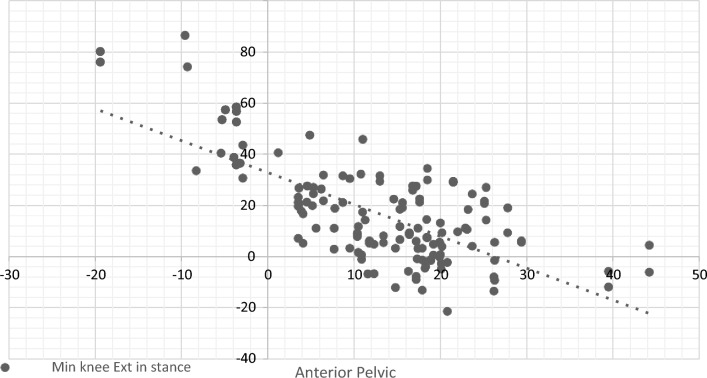
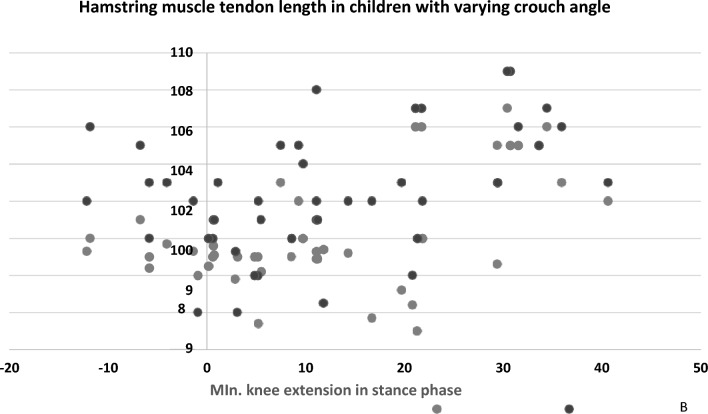
Results: Children with knee flexion angle greater than 25° demonstrated lower anterior pelvic tilt and 11% greater muscle-tendon length of semimembranosus and biceps femoris during stance phase of gait compared to children with knee flexion angle less than 25° and typically developing children (p < 0.01).
Conclusions: The findings of present study reported that routine bedside clinical evaluation in adolescent children with knee flexion angle greater than 25° revealed moderate shortening of hamstring muscle in supine position. Whereas instrumented objective evaluation of gait demonstrated lengthened hamstring muscle and reduced hip extension and relatively lower anterior pelvic tilt. Therefore, it may be valuable to add objective assessment of dynamic muscle-tendon length to kinematics of all lower-extremity joint motion during gait, in order to understand the muscle-joint interactions; particularly in children with severe crouch and plan specific, tailor-made surgical and non-surgical interventions.
Keywords: Adolescent children with cerebral palsy; Dynamic muscle tendon interaction; Greater crouch angle; Hamstring length.
© Indian Orthopaedics Association 2024. Springer Nature or its licensor (e.g. a society or other partner) holds exclusive rights to this article under a publishing agreement with the author(s) or other rightsholder(s); author self-archiving of the accepted manuscript version of this article is solely governed by the terms of such publishing agreement and applicable law.
Conflict of interest statement
Conflict of InterestThe authors state that they have no conflict of interest, financial or otherwise, concerning the material or methods used in this study or the findings specified in this paper.
Figures
Similar articles
-
Pre-operative hamstring length and velocity do not explain the reduced effectiveness of repeat hamstring lengthening in children with cerebral palsy and crouch gait.Gait Posture. 2019 Feb;68:323-328. doi: 10.1016/j.gaitpost.2018.11.033. Epub 2018 Nov 28. Gait Posture. 2019. PMID: 30572181 Free PMC article.
-
Repeat hamstring lengthening for crouch gait in children with cerebral palsy.J Pediatr Orthop. 2013 Jul-Aug;33(5):501-4. doi: 10.1097/BPO.0b013e318288b3e7. J Pediatr Orthop. 2013. PMID: 23752146
-
Predictors for anterior pelvic tilt following surgical correction of flexed knee gait including patellar tendon shortening in children with cerebral palsy.Gait Posture. 2017 May;54:8-14. doi: 10.1016/j.gaitpost.2017.02.015. Epub 2017 Feb 21. Gait Posture. 2017. PMID: 28242571
-
Does patella lowering as part of multilevel surgery improve knee kinematics in children with cerebral palsy and crouch gait? A meta-analysis of comparative studies.J Child Orthop. 2023 Dec 14;18(1):13-25. doi: 10.1177/18632521231217542. eCollection 2024 Feb. J Child Orthop. 2023. PMID: 38348440 Free PMC article. Review.
-
Crouch Gait in Cerebral Palsy: Current Concepts Review.Indian J Orthop. 2023 Sep 30;57(12):1913-1926. doi: 10.1007/s43465-023-01002-5. eCollection 2023 Dec. Indian J Orthop. 2023. PMID: 38009172 Free PMC article. Review.
References
-
- Svehlík M, Steinwender G, Kraus T, Saraph V, Lehmann T, Linhart WE, Zwick EB. The influence of age at single-event multilevel surgery on outcome in children with cerebral palsy who walk with flexed knee gait. Developmental Medicine and Child Neurology. 2011;53(8):730–735. doi: 10.1111/j.1469-8749.2011.03995.x. - DOI - PubMed
LinkOut - more resources
Full Text Sources