


Face detection mechanisms: Nature vs. nurture
- PMID: 38812973
- PMCID: PMC11133589
- DOI: 10.3389/fnins.2024.1404174
Face detection mechanisms: Nature vs. nurture
Abstract
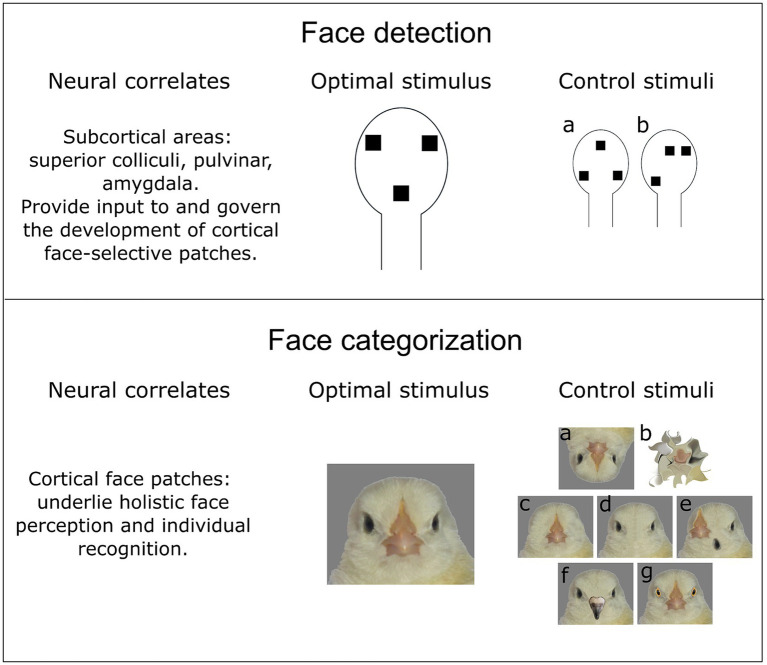
For many animals, faces are a vitally important visual stimulus. Hence, it is not surprising that face perception has become a very popular research topic in neuroscience, with ca. 2000 papers published every year. As a result, significant progress has been made in understanding the intricate mechanisms underlying this phenomenon. However, the ontogeny of face perception, in particular the role of innate predispositions, remains largely unexplored at the neural level. Several influential studies in monkeys have suggested that seeing faces is necessary for the development of the face-selective brain domains. At the same time, behavioural experiments with newborn human babies and newly-hatched domestic chicks demonstrate that a spontaneous preference towards faces emerges early in life without pre-existing experience. Moreover, we were recently able to record face-selective neural responses in the brain of young, face-naïve chicks, thus demonstrating the existence of an innate face detection mechanism. In this review, we discuss these seemingly contradictory results and propose potential experimental approaches to resolve some of the open questions.
Keywords: brain; face perception; innate; neuron; stimuli.
Copyright © 2024 Kobylkov and Vallortigara.
Conflict of interest statement
The authors declare that the research was conducted in the absence of any commercial or financial relationships that could be construed as a potential conflict of interest. The author(s) declared that they were an editorial board member of Frontiers, at the time of submission. This had no impact on the peer review process and the final decision.
Figures
References
Publication types
LinkOut - more resources
Full Text Sources
Research Materials
