Particulate Matter Exposure and Default Mode Network Equilibrium During Early Adolescence
- PMID: 38814823
- PMCID: PMC11387001
- DOI: 10.1089/brain.2023.0072
Particulate Matter Exposure and Default Mode Network Equilibrium During Early Adolescence
Abstract
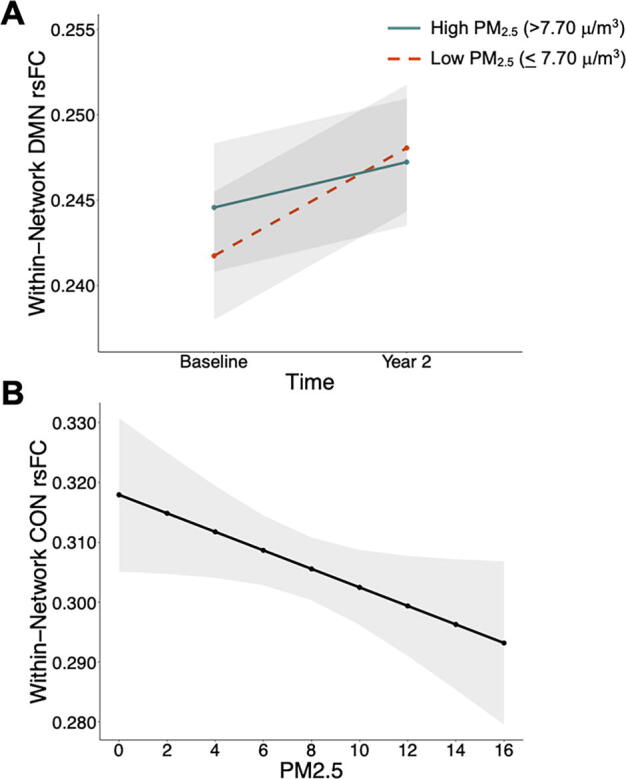
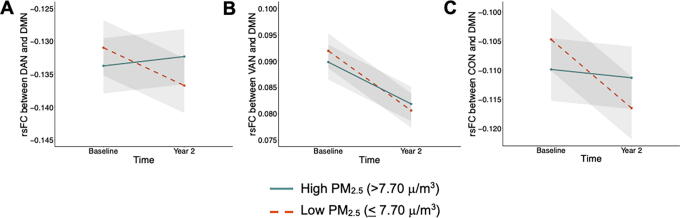
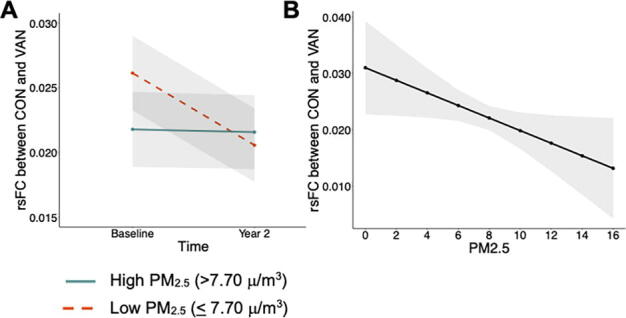
Background: Air pollution exposure has been associated with adverse cognitive and mental health outcomes in children, adolescents, and adults, although youth may be particularly susceptible given ongoing brain development. However, the neurodevelopmental mechanisms underlying the associations among air pollution, cognition, and mental health remain unclear. We examined the impact of particulate matter (PM2.5) on resting-state functional connectivity (rsFC) of the default mode network (DMN) and three key attention networks: dorsal attention, ventral attention, and cingulo-opercular. Methods: Longitudinal changes in rsFC within/between networks were assessed from baseline (9-10 years) to the 2-year follow-up (11-12 years) in 10,072 youth (M ± SD = 9.93 + 0.63 years; 49% female) from the Adolescent Brain Cognitive Development (ABCD®) study. Annual ambient PM2.5 concentrations from the 2016 calendar year were estimated using hybrid ensemble spatiotemporal models. RsFC was estimated using functional neuroimaging. Linear mixed models were used to test associations between PM2.5 and change in rsFC over time while adjusting for relevant covariates (e.g., age, sex, race/ethnicity, parental education, and family income) and other air pollutants (O3, NO2). Results: A PM2.5 × time interaction was significant for within-network rsFC of the DMN such that higher PM2.5 concentrations were associated with a smaller increase in rsFC over time. Further, significant PM2.5 × time interactions were observed for between-network rsFC of the DMN and all three attention networks, with varied directionality. Conclusion: PM2.5 exposure was associated with alterations in the development and equilibrium of the DMN-a network implicated in self-referential processing-and anticorrelated attention networks, which may impact trajectories of cognitive and mental health symptoms across adolescence.
Keywords: Developmental biology; Psychiatry; Resting-state networks.
© 2024, Mary Ann Liebert, Inc., publishers
Conflict of interest statement
While not relevant to the current work, the following are provided in the spirit of full disclosure: J.R.S. has received research support from the National Institutes of Health (NICHD, NIMH, NIEHS, NCATS), the Yung Family Foundation, and PCORI. He has received material support from Myriad and royalties from UpToDate, Springer, and Cambridge University Press. He has consulted with Cerevel, Intracellular Therapeutics, and Otsuka and plans to serve on an advisory board to Boehringer-Ingelheim and Genomind. The other co-authors have no conflicts to disclose.
Figures
References
-
- Achenbach TM, McConaughy SH, Howell CT. Child/adolescent behavioral and emotional probelms: Implications of cross-informant correlations for situational specificity. Psychological Bulletin 1987;101(2):213–232. - PubMed
-
- Bates D, Mächler M, Bolker B, et al. Fitting linear mixed-effects models using lme4. J Stat Soft 2015;67(1); doi: 10.18637/jss.v067.i01 - DOI
-
- Beesdo K, Pine DS, Lieb R, et al. Incidence and risk patterns of anxiety and depressive disorders and categorization of generalized anxiety disorder. Arch Gen Psychiatry 2010;67(1):47–57. - PubMed
Publication types
MeSH terms
Substances
Grants and funding
- U24 DA041147/DA/NIDA NIH HHS/United States
- U01 DA051039/DA/NIDA NIH HHS/United States
- U01 DA041120/DA/NIDA NIH HHS/United States
- U01 DA051018/DA/NIDA NIH HHS/United States
- U24 DA041123/DA/NIDA NIH HHS/United States
- U01 DA051038/DA/NIDA NIH HHS/United States
- U01 DA051037/DA/NIDA NIH HHS/United States
- U01 DA051016/DA/NIDA NIH HHS/United States
- U01 DA041106/DA/NIDA NIH HHS/United States
- U01 DA041117/DA/NIDA NIH HHS/United States
- U01 DA041148/DA/NIDA NIH HHS/United States
- F32 MH133274/MH/NIMH NIH HHS/United States
- U01 DA041174/DA/NIDA NIH HHS/United States
- U01 DA041093/DA/NIDA NIH HHS/United States
- P30 ES036084/ES/NIEHS NIH HHS/United States
- U01 DA041134/DA/NIDA NIH HHS/United States
- U01 DA041022/DA/NIDA NIH HHS/United States
- U01 DA041156/DA/NIDA NIH HHS/United States
- U01 DA050987/DA/NIDA NIH HHS/United States
- U01 DA041025/DA/NIDA NIH HHS/United States
- U01 DA050989/DA/NIDA NIH HHS/United States
- U01 DA041089/DA/NIDA NIH HHS/United States
- U01 DA050988/DA/NIDA NIH HHS/United States
- U01 DA041028/DA/NIDA NIH HHS/United States
- U01 DA041048/DA/NIDA NIH HHS/United States
- R01 ES031074/ES/NIEHS NIH HHS/United States
- R01 ES032295/ES/NIEHS NIH HHS/United States
- T32 GM139807/GM/NIGMS NIH HHS/United States
- K01 MH119241/MH/NIMH NIH HHS/United States
- R01 MH132830/MH/NIMH NIH HHS/United States
- R21 HD105882/HD/NICHD NIH HHS/United States
LinkOut - more resources
Full Text Sources
Medical