


The effect of a visual illusion and self-controlled practice on motor learning in children at risk for developmental coordination disorder
- PMID: 38816488
- PMCID: PMC11139998
- DOI: 10.1038/s41598-024-63387-z
The effect of a visual illusion and self-controlled practice on motor learning in children at risk for developmental coordination disorder
Abstract
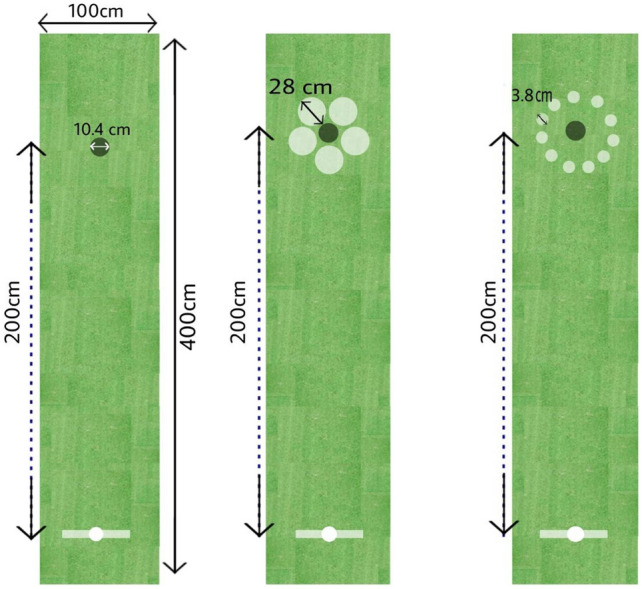
Numerous efforts have been made to test the OPTIMAL theory of motor learning in healthy children and adult populations. However, only a small number of studies have tested this theory in children with cognitive-motor disorders, such as developmental coordination disorder (DCD). The present study aims to examine the individual and additive effects of a visual illusion and self-controlled practice on a golf putting task in children at risk for DCD based on the OPTIMAL theory. Forty children at risk for DCD (mean age = 8.57 ± 1.05 years) were randomly assigned to four experimental groups (1-small visual illusion + self-controlled practice; 2-big visual illusion + self-controlled practice; 3-small visual illusion + yoked; 4-big visual illusion + yoked). Following 12 pretest trials of a golf putting task, the participants completed 5 blocks of 12 trials of practice on the first day. A retention test (12 trials) and a transfer dual-task test (12 trials) were conducted on the second day. The results indicated that in retention test the big visual illusion + self-controlled practice group was significantly better than the small visual illusion + yoked group (p = 0.01), while there was not any other significant difference between groups at retention test as well as between all groups at practice phase and transfer test (p > 0.05 for all comparisons). In other words, an additive effect has been observed just in the retention test but not the practice phase as well as transfer test. In general, the results of this study support the OPTIMAL theory of motor learning in children at risk for DCD and suggests to all educators who work with these children to use the combination of the visual illusion with self-controlled practice to improve the motor learning of children at risk for DCD.
Keywords: Autonomy support; DCD; Ebbinghaus illusion; Enhanced expectancies; Motor learning.
© 2024. The Author(s).
Conflict of interest statement
The authors declare no competing interests.
Figures


References
-
- Barnett AL. Motor assessment in developmental coordination disorder: From identification to intervention. Int. J. Disabil. Dev. Educ. 2008;55(2):113–129. doi: 10.1080/10349120802033436. - DOI
-
- American Psychiatric Association DS, American Psychiatric Association. Diagnostic and statistical manual of mental disorders: DSM-5. (American Psychiatric Association, 2013).
-
- Blank R, Barnett AL, Cairney J, Green D, Kirby A, Polatajko H, Rosenblum S, Smits-Engelsman B, Sugden D, Wilson P, Vinçon S. International clinical practice recommendations on the definition, diagnosis, assessment, intervention, and psychosocial aspects of developmental coordination disorder. Dev. Med. Child Neurol. 2019;61(3):242–285. doi: 10.1111/dmcn.14132. - DOI - PMC - PubMed
Publication types
MeSH terms
LinkOut - more resources
Full Text Sources
