. 2024 Aug;20(8):974-980.
doi: 10.1038/s41589-024-01632-2. Epub 2024 May 30.

De novo design of buttressed loops for sculpting protein functions

Affiliations

De novo design of buttressed loops for sculpting protein functions

Hanlun Jiang et al. Nat Chem Biol. 2024 Aug.

Abstract

In natural proteins, structured loops have central roles in molecular recognition, signal transduction and enzyme catalysis. However, because of the intrinsic flexibility and irregularity of loop regions, organizing multiple structured loops at protein functional sites has been very difficult to achieve by de novo protein design. Here we describe a solution to this problem that designs tandem repeat proteins with structured loops (9-14 residues) buttressed by extensive hydrogen bonding interactions. Experimental characterization shows that the designs are monodisperse, highly soluble, folded and thermally stable. Crystal structures are in close agreement with the design models, with the loops structured and buttressed as designed. We demonstrate the functionality afforded by loop buttressing by designing and characterizing binders for extended peptides in which the loops form one side of an extended binding pocket. The ability to design multiple structured loops should contribute generally to efforts to design new protein functions.


Conflict of interest statement

The authors declare no competing interests.

Figures

Fig. 1
Fig. 1. Computational design of RBLs.
a, Design strategy for generating and stabilizing multiple loops in helical repeat proteins. b, A gallery of diverse designed proteins that pass the in silico design filters. c, Loop buttressing hydrogen bonds in the designed proteins.
Fig. 2
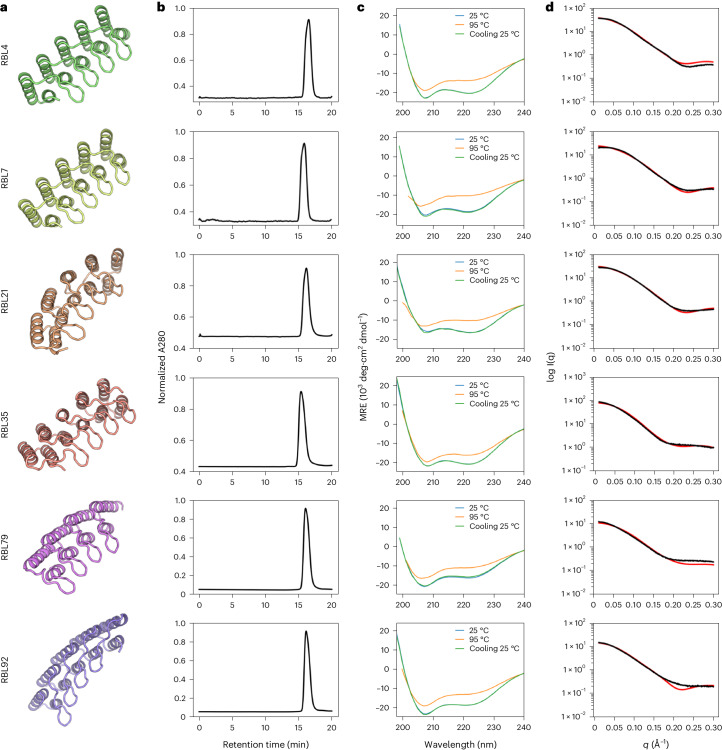
Fig. 2. Biophysical characterization of designed helical RBLs.
a, Design models of six representative designs. b, SEC traces monitoring absorbance at 280 nm. c, CD spectra collected at 25 °C (blue), 95 °C (orange) and 25 °C after cooling from 95 °C (green). d, Overlay of experimental (black) and theoretical (red) SAXS profiles.
Fig. 3
Fig. 3. Structural characterization by X-ray crystallography.
a, Superimposition of crystal structure (yellow) onto the design model of RBL4 (gray). b, Alignment of individual repeat units. ce, Accurately designed loop buttressing interactions: bidentate interloop hydrogen bonds (c), loop–helix salt bridge (d) and loop–helix hydrophobic contacts (e). f, Superimposition of crystal structure (blue) onto the design model of RBL7_C2_3 (gray). g, Superimposition of a monomer unit in the crystal structure onto the design model. hj, Accurately designed loop buttressing interactions: intraloop and interloop hydrogen bonds (h), bidentate interloop hydrogen bonds (i) and loop–helix hydrophobic contacts (j).
Fig. 4
Fig. 4. Designed repeat peptide-binding RBLs.
a,d,g, Design models of peptide-binding proteins in complex with (DLP)6 (a), (KLP)6 (d) and (DLS)6 (g). b,e,h, Sequence-specific interactions in the binder–peptide complexes: (DLP)6binder–(DLP)6 (b), (KLP)6binder–(KLP)6 (e) and (DLS)6binder–(DLS)6 (h). c,f,i, Fluorescence polarization measurement of binding between (DLP)6binder–(DLP)6 (c), (KLP)6binder–(KLP)6 (f) and (DLS)6binder–(DLS)6 (i). For each binder, a titration curve is plotted for the binding of each peptide (blue, (DLP)6; orange, (KLP)6; and green, (DLS)6).
Extended Data Fig. 1
Extended Data Fig. 1. TM scores between native ankyrin loops and the designed loops from RBLs.
Higher TM scores indicate higher structural similarity.
Extended Data Fig. 2
Extended Data Fig. 2. Comparison of hydrogen bonds and buried unsatisfied loop heavy atoms between ankyrin loops and the designed loops in RBLs.
(a) Distribution of the number of backbone-to-backbone hydrogen bonds involving one long loop in each structure normalized by the loop length. (b) Distribution of the number of backbone-to-side chain hydrogen bonds involving one long loop in each structure normalized by the loop length. (c) Number of buried unsatisfied loop heavy atoms in one long loop in each structure.
Extended Data Fig. 3
Extended Data Fig. 3. Characterization of RBLs by small-angle X-ray scattering.
The experimental profiles are shown in black, and the theoretical profiles are shown in red.
Extended Data Fig. 4
Extended Data Fig. 4. Characterization of the buttressed loops by X-ray crystallography.
(a,c) Residue-wise B-factor values of the crystal structures of RBL4 (a) and RBL7_C2_3 (c). The regions corresponding to the buttressed loops are highlighted in pink. (b,d) Simulated annealing composite omits maps of RBL4 (b) and RBL7_C2_3 (d). Details of the boxed area showing cross-eyed stereo views of 2mFo-DFc electron density maps are contoured at 1σ over the designed loops. Grid spacing of the maps is 0.25× the resolution of the structure.

Update of

References

    1. Yu, X., Yang, Y. P., Dikici, E., Deo, S. K. & Daunert, S. Beyond antibodies as binding partners: the role of antibody mimetics in bioanalysis. Annu. Rev. Anal. Chem.10, 293–320 (2017). - PMC - PubMed
    1. Simeon, R. & Chen, Z. In vitro-engineered non-antibody protein therapeutics. Protein Cell9, 3–14 (2018). - PMC - PubMed
    1. Stumpp, M. T., Dawson, K. M. & Binz, H. K. Beyond antibodies: the DARPin((R)) drug platform. BioDrugs34, 423–433 (2020). - PMC - PubMed
    1. Mosavi, L. K., Minor, D. L. & Peng, Z. Y. Consensus-derived structural determinants of the ankyrin repeat motif. Proc. Natl Acad. Sci. USA99, 16029–16034 (2002). - PMC - PubMed
    1. Pluckthun, A. Designed ankyrin repeat proteins (DARPins): binding proteins for research, diagnostics, and therapy. Annu. Rev. Pharmacol. Toxicol.55, 489–511 (2015). - PubMed

LinkOut - more resources