


Similarity judgements: the comparison of normative predictions and subjective evaluations - A study of the ratio model of similarity in social context
- PMID: 38817837
- PMCID: PMC11139025
- DOI: 10.3389/fpsyg.2024.1335707
Similarity judgements: the comparison of normative predictions and subjective evaluations - A study of the ratio model of similarity in social context
Abstract
Introduction: This study examines the consistency between subjective similarity evaluations and the theoretical predictions derived from Tversky's ratio model of similarity, alongside the impact of additional positive and negative features on perceived similarity to ideal and bad politicians.
Methods: Using a sample of 120 participants, we assessed the similarity of eight candidate profiles to an ideal and bad politician, varying in positive and negative features. Participants' subjective evaluations were compared with theoretical predictions derived from Tversky's ratio model. The analysis focused on how candidate and referent valence influenced observed versus theoretical similarity.
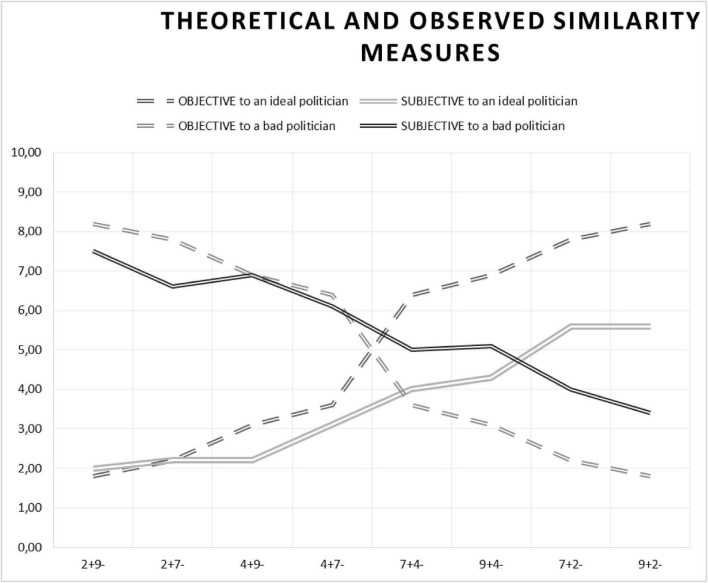
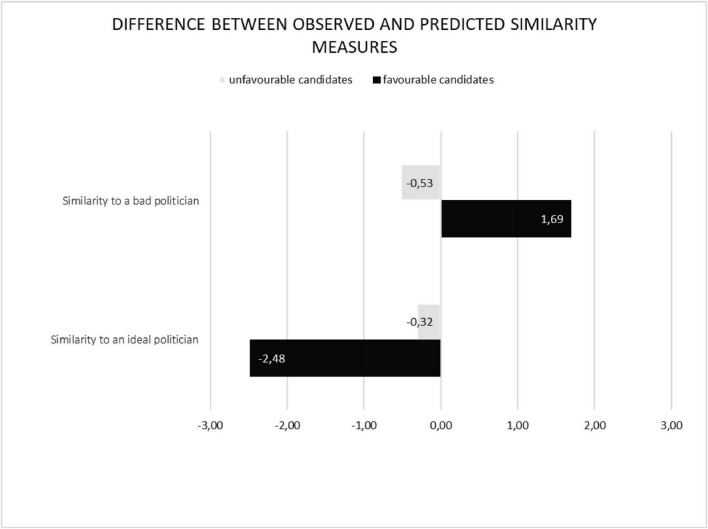
Results: Subjective similarity judgments deviated systematically from theoretical predictions, especially for positively featured candidates, indicating a negativity effect. Additional positive features decreased the perceived similarity of favorable candidates to an ideal politician, while additional negative features did not significantly affect similarity judgments of unfavorable candidates.
Discussion: Our findings underscore a significant disparity between subjective and objective similarity judgments, notably for favorable candidates. While the ratio model performs well for unfavorable candidates, its applicability diminishes for favorable ones, emphasizing the role of feature valence in decision-making. Further research on feature valence is crucial for a comprehensive understanding across contexts.
Keywords: objective similarity; positive-negative asymmetry; ratio model; similarity judgements; subjective similarity.
Copyright © 2024 Jabłońska, Falkowski and Mackiewicz.
Conflict of interest statement
The authors declare that the research was conducted in the absence of any commercial or financial relationships that could be construed as a potential conflict of interest.
Figures
References
-
- American Psychological Association [APA] (2010). Ethical Principles of Psychologists and Code of Conduct. Washington, DC: American Psychological Association.
-
- Baumeister R. F., Bratslavsky E., Finkenauer C., Vohs K. D. (2001). Bad is stronger than good. Rev. Gen. Psychol. 5 323–370. 10.1037//1089-2680.5.4.323 - DOI
-
- Blanz M., Mummendey A., Otten S. (1995). Positive – negative asymmetry in social discrimination: The impact of stimulus valence and size and status differentials on intergroup evaluations. Br. J. Soc. Psychol. 34 409–419. 10.1111/j.2044-8309.1995.tb01074.x - DOI
-
- Carstensen L. L., Mikels J. A. (2005). At the intersection of emotion and cognition: Aging and the positivity effect. Curr. Dir. Psychol. Sci. 14 117–121. 10.1111/j.0963-7214.2005.00348 - DOI
-
- Christenfeld N. (1995). Choices from identical options. Psychol. Sci. 6 50–55.
LinkOut - more resources
Full Text Sources
Research Materials
