


Tendency of microbial adhesion to denture base resins: a systematic review
- PMID: 38817845
- PMCID: PMC11137245
- DOI: 10.3389/froh.2024.1375186
Tendency of microbial adhesion to denture base resins: a systematic review
Abstract
Objectives: Digital denture fabrication became an alternative method to conventional denture fabrication. However reviewing the antimicrobial performance of newly introduced digital fabrication methods in comparison to the conventional method is neglected. Aim of study: this review was to compare the antiadherence properties of various CAD-CAM subtractive (milled), additive (3D printed) conventional denture base resins. In order to answer the developed PICO question: "Does CAD-CAM milled and 3D printed denture base resins have microbiological antiadherence properties over the conventional ones?" We included comparative studies on digitally fabricated Denture base resins with conventionally fabricated one in term of microbial adhesion.
Methods: All in vitro studies investigated the microbial adherence to CAD-CAM milled and 3D printed denture base resins in comparison to conventional were searched in the PubMed, Web of Sciences, and Scopus databases up to December 2023.
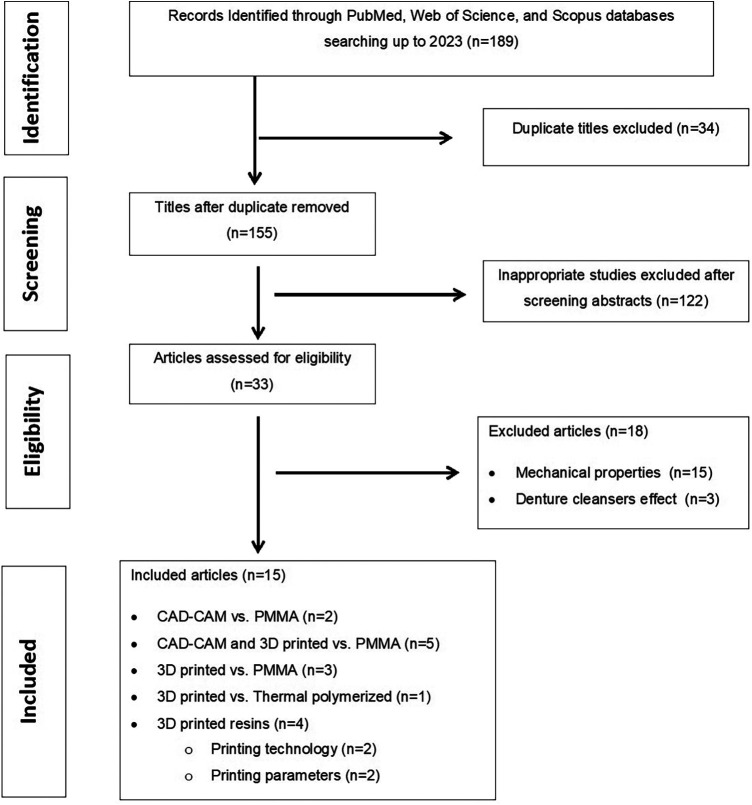
Results: Fifteen studies have been investigated the microbial adhesion to milled and 3D printed denture base resins. CAD-CAM milled resins significantly decreased the microbial adhesion when compared with the conventional resins and 3D printed resins, while the later showed a high tendency for microbial adhesion. The addition of antifungal agents to 3D printed resins significantly reduced C. albicans adhesion. In terms of 3D printing parameters, printing orientation affected adherence while printing technology had no effect on microbial adhesion.
Conclusion: Denture base materials and fabrication methods significantly affect the microbial adhesion. CAD-CAM milled denture base resins demonstrated low microbial adhesion. 3D-printed resins showed high tendency for C. albicans adhesion. The antiadherent properties of 3D-printed resins can be improved by incorporating antifungal agents or changing the printing parameters, but further investigations are required to validate these modifications.
Keywords: 3D printing; CAD-CAM milled; complete dentures; digital dentures; microbial adhesion.
© 2024 Alqarawi and Gad.
Conflict of interest statement
The authors declare that the research was conducted in the absence of any commercial or financial relationships that could be construed as a potential conflict of interest.
Figures
References
-
- Al-Khalifa KS, Gad MM, Alshahrani FA, Alqarawi FK, Hassanein FR, Khurshid Z, et al. Influence of propolis extract (caffeic acid phenethyl ester) addition on the Candida albicans adhesion and surface properties of autopolymerized acrylic resin. Int J Dent. (2022) 2022:6118660. 10.1155/2022/6118660 - DOI - PMC - PubMed
Publication types
LinkOut - more resources
Full Text Sources
Molecular Biology Databases
Miscellaneous
