


Potential of a laser pointer contact lens to improve the reliability of video-based eye-trackers in indoor and outdoor conditions
- PMID: 38818405
- PMCID: PMC11138218
- DOI: 10.16910/jemr.17.1.5
Potential of a laser pointer contact lens to improve the reliability of video-based eye-trackers in indoor and outdoor conditions
Abstract
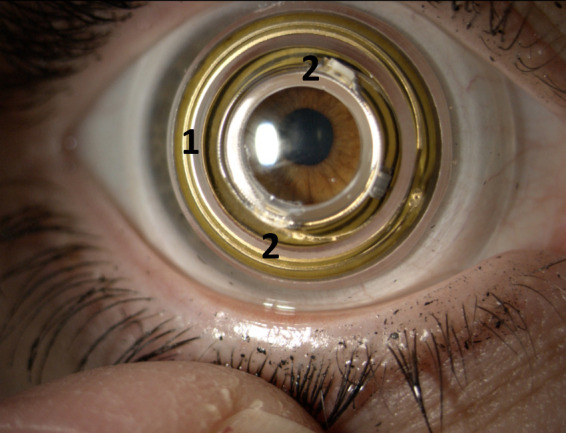
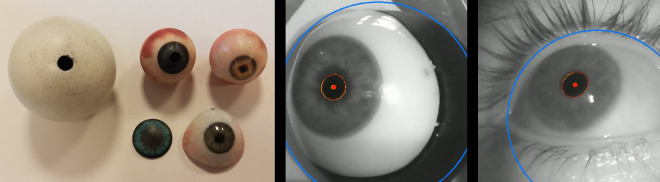
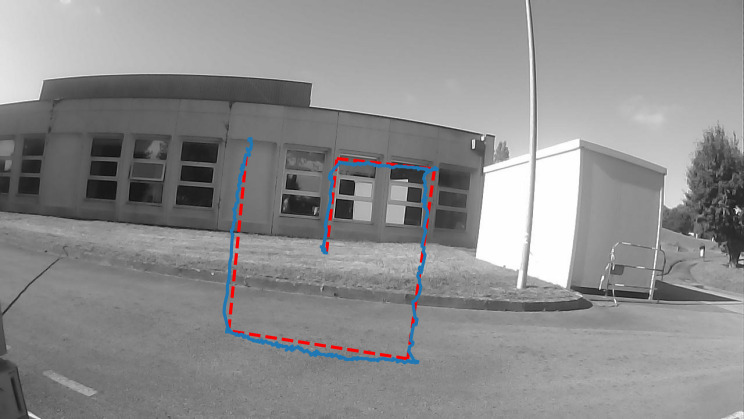
Many video-based eye trackers rely on detecting and tracking ocular features, a task that can be negatively affected by a number of individual or environmental factors. In this context, the aim of this study was to practically evaluate how the use of a scleral contact lens with two integrated nearinfrared lasers (denoted CLP) could improve the tracking robustness in difficult lighting conditions, particularly outdoor ones. We assessed the ability of the CLP (on a model eye) to detect the lasers and to deduce a gaze position with an accuracy better than 1° under four lighting conditions (1 lx, 250 lx, 50 klux and alternating 1lx /250 lx) on an artificial eye. These results were compared to the ability of a commercial eye tracker (Pupil Core) to detect the pupil on human eyes with a confidence score equal to or greater than 0.9. CLP provided good results in all conditions (tracking accuracy and detection rates). In comparison, the Pupil Core performed well in all indoor conditions (99% detection) but failed in outdoor conditions (9.85% detection). In conclusion, the CLP presents strong potential to improve the reliability of video-based eyetrackers in outdoor conditions by providing easy trackable feature.
Keywords: artificial eyes; calibration; contact lenses; eye-tracker; eye-tracking; gaze.
Copyright (©) 2024 François-Maël Robert, Marion Otheguy, Vincent Nourrit, Jean-Louis de Bougrenet de la Tocnaye.
Conflict of interest statement
The authors declares that the contents of the article are in agreement with the ethics described in http://biblio.unibe.ch/portale/elibrary/BOP/jemr/ethics.html and that there is no conflict of interest regarding the publication of this paper.
Figures



References
-
- Blignaut, P. (2014). Mapping the Pupil-Glint Vector to Gaze Coordinates in a Simple Video-Based Eye Tracker. Journal of Eye Movement Research, 7(1). 10.16910/jemr.7.1.4 - DOI
-
- Blignaut, P., & Wium, D. (2013). The effect of mapping function on the accuracy of a video-based eye tracker. Proceedings of the 2013 Conference on Eye Tracking South Africa, 39‑46. 10.1145/2509315.2509321 - DOI
-
- Cerrolaza, J. J., Villanueva, A., & Cabeza, R. (2008). Taxonomic study of polynomial regressions applied to the calibration of video-oculographic systems. Proceedings of the 2008 symposium on Eye tracking research & applications, 259-266. 10.1145/1344471.1344530 - DOI
-
- Dierkes, K., Kassner, M., & Bulling, A. (2018). A novel approach to single camera, glint-free 3D eye model fitting including corneal refraction. Proceedings of the 2018 ACM Symposium on Eye Tracking Research & Applications, 1‑9. 10.1145/3204493.3204525 - DOI
LinkOut - more resources
Full Text Sources
Miscellaneous