


Comparison of Barrett TK Universal II and Barrett Universal II TCRP Formulas in Power Calculations for 3 Presbyopia-Correcting Intraocular Lenses
- PMID: 38818525
- PMCID: PMC11137930
- DOI: 10.2147/OPTH.S461195
Comparison of Barrett TK Universal II and Barrett Universal II TCRP Formulas in Power Calculations for 3 Presbyopia-Correcting Intraocular Lenses
Abstract
Purpose: To compare Barrett TK Universal II and Barrett Universal II TCRP calculations in the power calculations for 3 presbyopia-correcting intraocular lenses (PC-IOL).
Methods: This observational study involved 64 eyes from 64 patients who prepared to undergo extraction of crystalline lenses combined with PC-IOL (Symfony ZXR00, PanOptix TFNT00, or AT LISA tri 839MP) implantation. All eyes underwent ocular biometric measurements with IOLMaster 700 and Pentacam HR, and the interdevice agreement of measurements including total keratometry (TK, IOLMaster 700) and total corneal refractive power (TCRP, Pentacam HR) was evaluated. IOL power calculations were performed using TK-based Barrett TK Universal II and TCRP-based Barrett Universal II calculations, respectively.
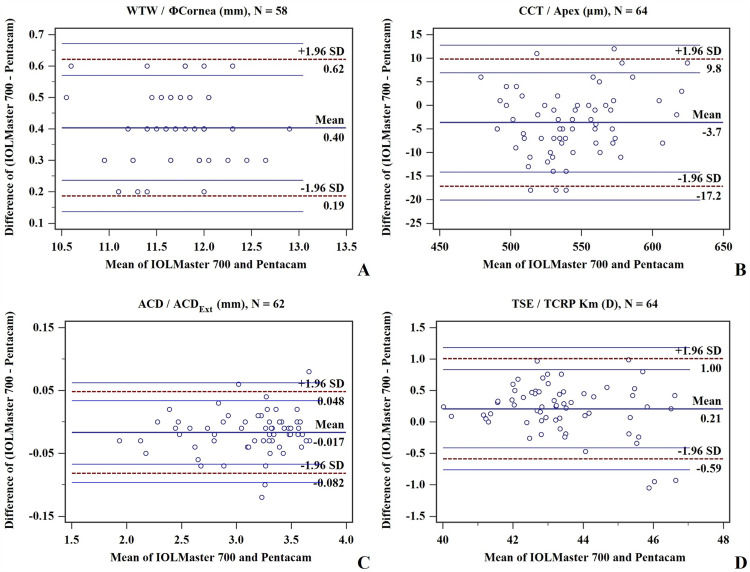
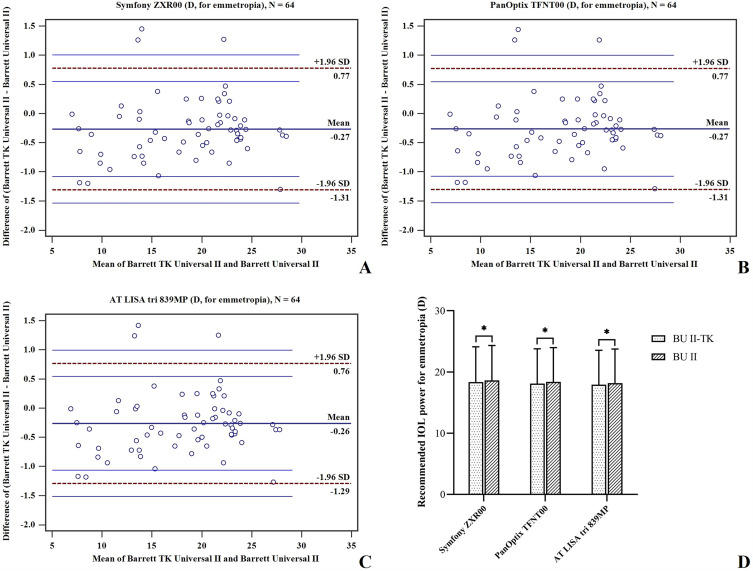
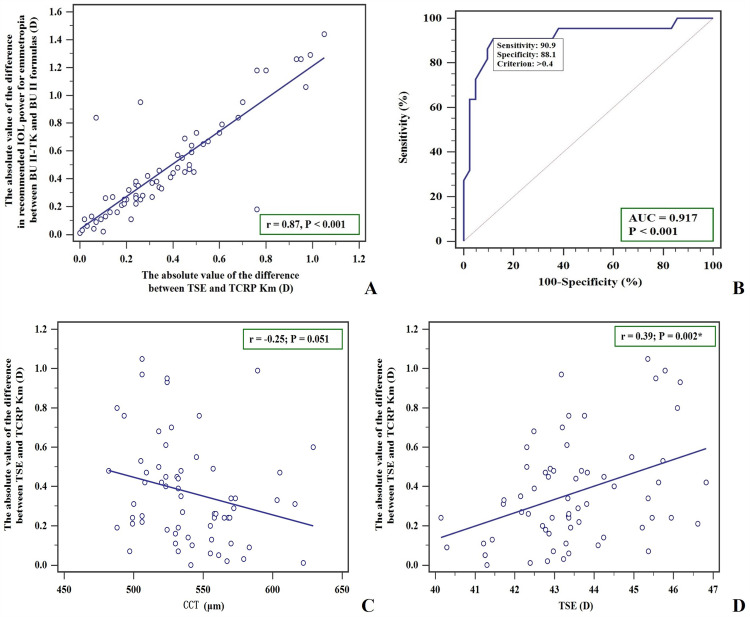
Results: Paired t-tests showed that the differences in white-to-white diameter, central corneal thickness, anterior chamber depth, and mean TK between IOLMaster 700 and Pentacam HR were slight but significant (all P<0.05), and the differences in recommended IOL power for emmetropia between two Barrett calculations were also significant in 3 PC-IOLs (all P<0.05). The ROC curve showed that the AUC was 0.917 (95% CI, 0.820-0.971) for the absolute value of the difference between TK and TCRP in discriminating the difference of ≥ ±0.5 D in predicted IOL power with best cutoff values of 0.4 D.
Conclusion: The novel Barrett TK Universal II formula built in IOLMaster 700 is comparable to TCRP-based Barrett Universal II calculation for IOL power calculation of PC-IOLs, and the convenience of using the Barrett TK Universal II formula should be founded on measurement consistency between devices.
Keywords: intraocular lens power calculation; presbyopic corrections; refractive prediction accuracy; scheimpflug tomography; swept-source optical biometer.
© 2024 Li et al.
Conflict of interest statement
The authors declare that the research was conducted in the absence of any commercial or financial relationships that could be construed as a potential conflict of interest.
Figures
Similar articles
-
Accuracy of toric intraocular lens power calculation depending on different keratometry values using a novel network based software platform.Front Med (Lausanne). 2024 Apr 11;11:1363286. doi: 10.3389/fmed.2024.1363286. eCollection 2024. Front Med (Lausanne). 2024. PMID: 38665295 Free PMC article.
-
Comparison of refractive outcomes using conventional keratometry or total keratometry for IOL power calculation in cataract surgery.Graefes Arch Clin Exp Ophthalmol. 2019 Dec;257(12):2677-2682. doi: 10.1007/s00417-019-04443-7. Epub 2019 Sep 5. Graefes Arch Clin Exp Ophthalmol. 2019. PMID: 31486917
-
Lower refractive prediction accuracy of total keratometry using intraocular lens formulas loaded onto a swept-source optical biometer.Graefes Arch Clin Exp Ophthalmol. 2023 Jan;261(1):137-146. doi: 10.1007/s00417-022-05777-5. Epub 2022 Jul 26. Graefes Arch Clin Exp Ophthalmol. 2023. PMID: 35881200
-
Prediction accuracy of standard and total keratometry by swept-source optical biometer for multifocal intraocular lens power calculation.Sci Rep. 2021 Feb 26;11(1):4794. doi: 10.1038/s41598-021-84238-1. Sci Rep. 2021. PMID: 33637786 Free PMC article.
-
Prediction Accuracy of Total Keratometry Compared to Standard Keratometry Using Different Intraocular Lens Power Formulas.J Refract Surg. 2019 Jun 1;35(6):362-368. doi: 10.3928/1081597X-20190422-02. J Refract Surg. 2019. PMID: 31185101
References
LinkOut - more resources
Full Text Sources
