. 2024 May 31;10(22):eadn9830.
doi: 10.1126/sciadv.adn9830. Epub 2024 May 31.

A heterogeneous mantle and crustal structure formed during the early differentiation of Mars

Affiliations

A heterogeneous mantle and crustal structure formed during the early differentiation of Mars

James M D Day et al. Sci Adv. .

Abstract

Highly siderophile element abundances and Os isotopes of nakhlite and chassignite meteorites demonstrate that they represent a comagmatic suite from Mars. Nakhlites experienced variable assimilation of >2-billion-year-old altered high Re/Os basaltic crust. This basaltic crust is distinct from the ancient crust represented by meteorites Allan Hills 84001 or impact-contaminated Northwest Africa 7034/7533. Nakhlites and chassignites that did not experience crustal assimilation reveal that they were extracted from a depleted lithospheric mantle distinct from the deep plume source of depleted shergottites. The comagmatic origin for nakhlites and chassignites demonstrates a layered martian interior comprising ancient enriched basaltic crust derived from trace element-rich shallow magma ocean cumulates, a variably metasomatized mantle lithosphere, and a trace element-depleted deep mantle sampled by plume magmatism.


Figures
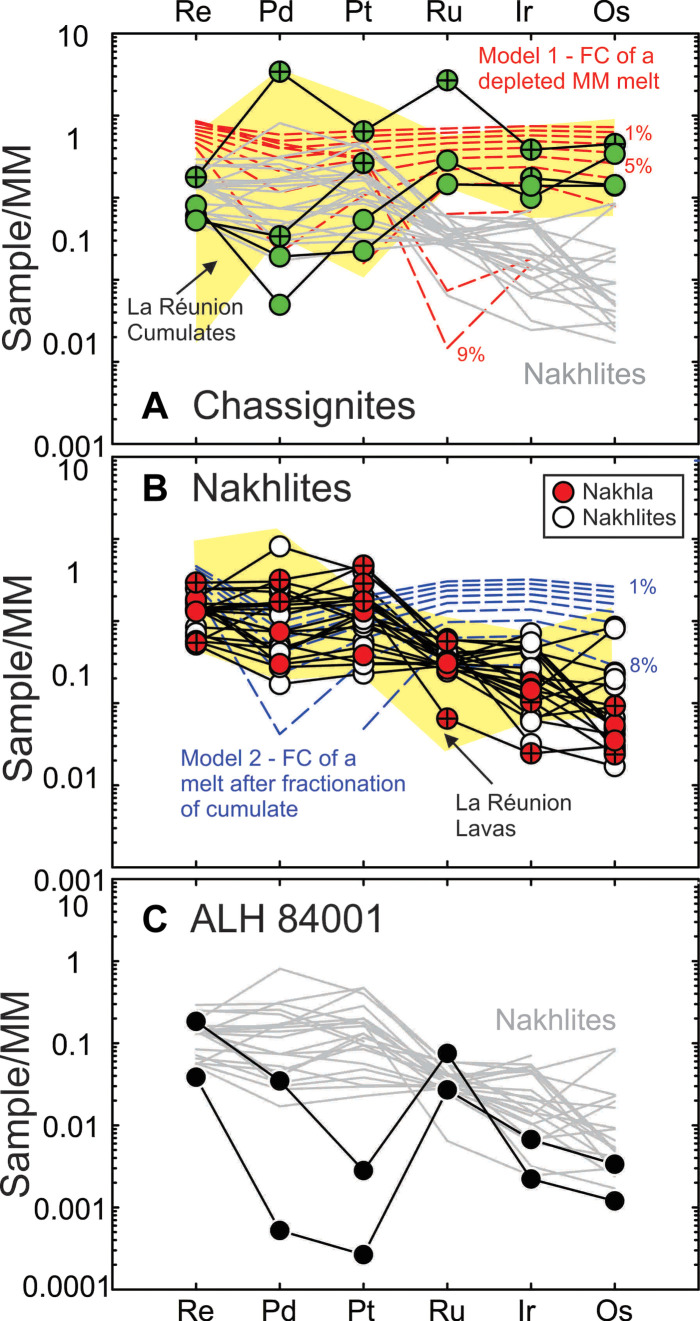
Fig. 1.
Fig. 1.. Martian mantle normalized HSE patterns.
Shown in (A) are chassignites, (B) nakhlites, and (C) ALH 84001. Symbols with crosses denote previously published data. Shown in (A) is model 1, a fractional crystallization (FC) model of a depleted martian mantle (MM) composition that experienced 5% prior melt depletion. Partial melt depletion of the MM composition results in only minor depletions of most HSE to the residue, with more major depletion for Pd, due to the lack of S exhaustion at these relatively low melt fractions. Shown in (B) is model 2, a fractional crystallization model for a melt after dunite (chassignite) cumulate removal. Model information is provided in the methods and the MM composition is from (32). Field of La Réunion cumulate dunites and lavas from (27). Published chassignite and nakhlite data from (–23).
Fig. 2.
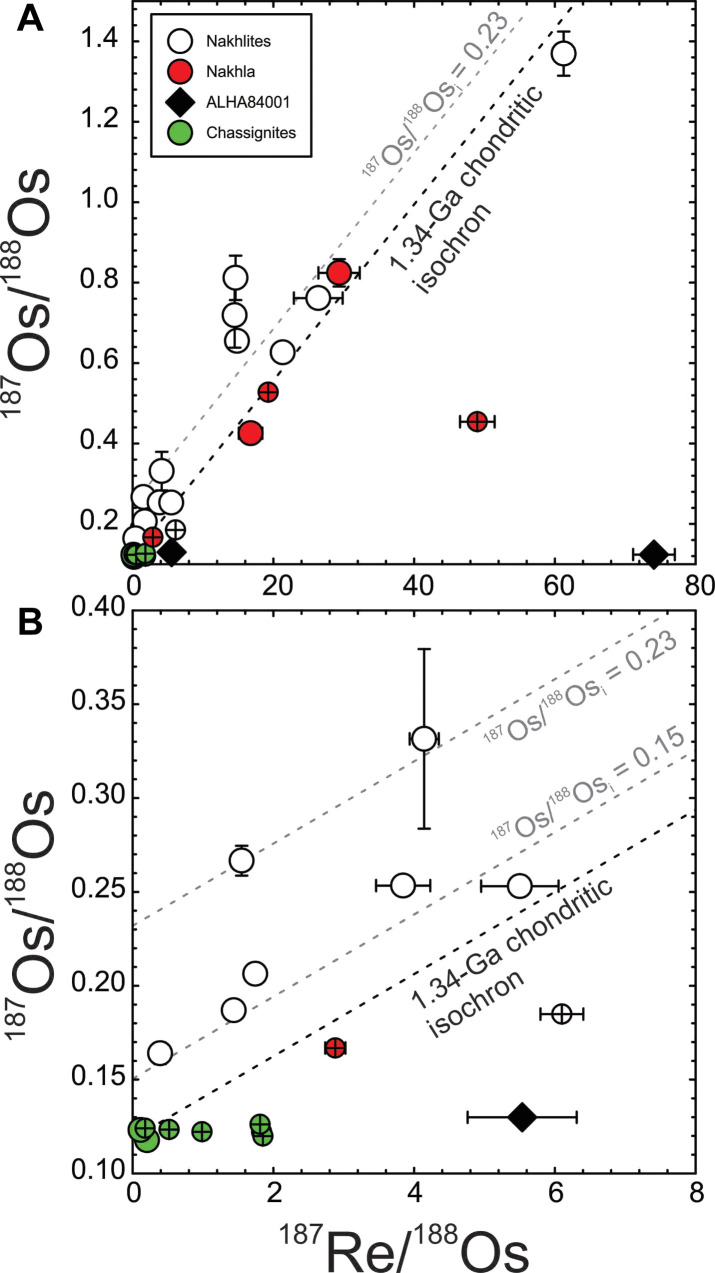
Fig. 2.. Rhenium-osmium isotope diagrams for nakhlites, chassignites, and ALH 84001.
(A) The full range of 187Re-187Os in the samples. (B) An expanded view of the lower left-hand region of (A). Symbols with crosses denote previously published data. The nakhlite meteorite Nakhla is separated from other nakhlites in these diagrams, as different sample fragments have been measured in this study and (–23). Shown for reference are the 1.34-Ga chondritic reference isochron and 1.34-Ga isochrons with radiogenic initial 187Os/188Os of 0.15 and 0.23. Published data from (20, 22, 23).
Fig. 3.
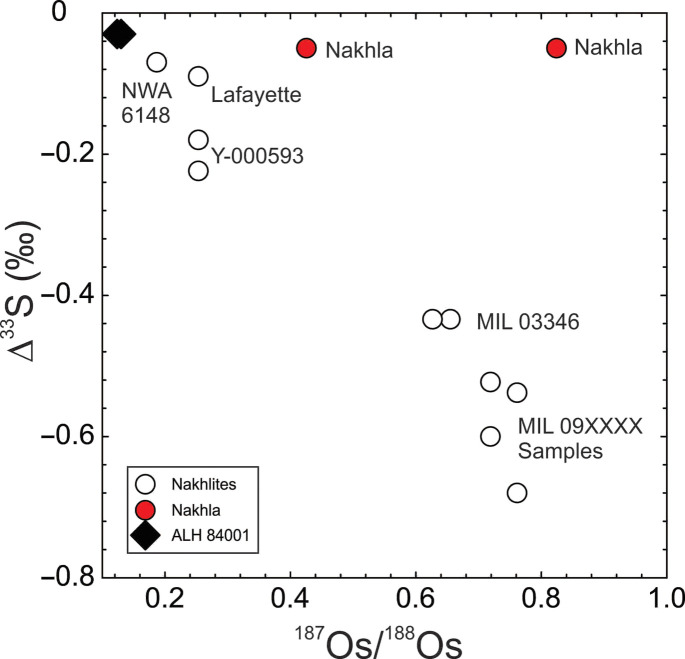
Fig. 3.. Measured 187Os/188Os versus Δ33S for nakhlites and ALH 84001.
Sulfur isotope data are from different aliquots to Os measured in this study from (9, 39, 40). Plots of age-corrected 187Os/188Os versus Δ33S reveal the same negative correlation but with more scatter due to the disturbance of Re in some of the studied meteorites (see the "Crustal assimilation occurring in nakhlites" section for details). MIL 09XXXX refers to MIL 090030, MIL 090032, and MIL 090136.
Fig. 4.
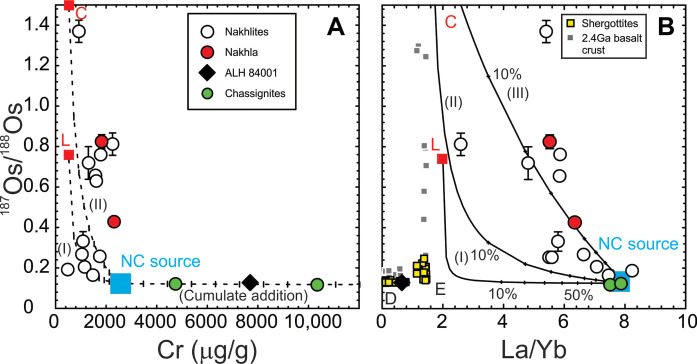
Fig. 4.. Modeling assimilation and fractional crystallization processes in nakhlites and chassignites.
Only data from this study are shown for nakhlites and chassignites as powder aliquots have been measured for both 187Os/188Os as well as (A) Cr and (B) La/Yb. Models in (A) and (B) show mixing between a nakhlite-chassignite primary mantle melt (NC source, blue square; Cr, 2500 μg/g; Os, 1.5 ng/g; 187Os/188Os, ~0.125; La/Yb, 8; and La, 3.8 μg/g) and a Los Angeles composition ([I] L; Cr, 600 μg/g; Os, 0.004 ng/g; 187Os/188Os, ~0.74; La/Yb, 2; and La, 2 μg/g) and a hypothetical ~2.4-Ga high-Re/Os crustal component (C; Cr, 500 μg/g; 187Os/188Os, ~2; La/Yb, 1.6; and La, 1 μg/g), with ratios of Os contents of either 75 relative to the NC source ([II]; Os, 0.02 ng/g) or 15 ([III]; 0.1 ng/g) to illustrate the influence of Os content in the partial melt produced from the assimilant. The Os isotopic composition of the 2.4-Ga crustal component represents the predicted ingrowth of 187Os from enriched shergottite samples, shown by the gray squares in (B). Also shown is the effect of cumulate addition between the NC source to an olivine cumulate with Cr-spinel (Cr, >20,000 μg/g; and Os, >3 ng/g). The Los Angeles composition is from (43), with other shergottite data from (16) and (32). The notations of D and E show the composition of ~0.2 Ga to 0.6 Ga depleted and enriched basaltic shergottites, respectively.
Fig. 5.
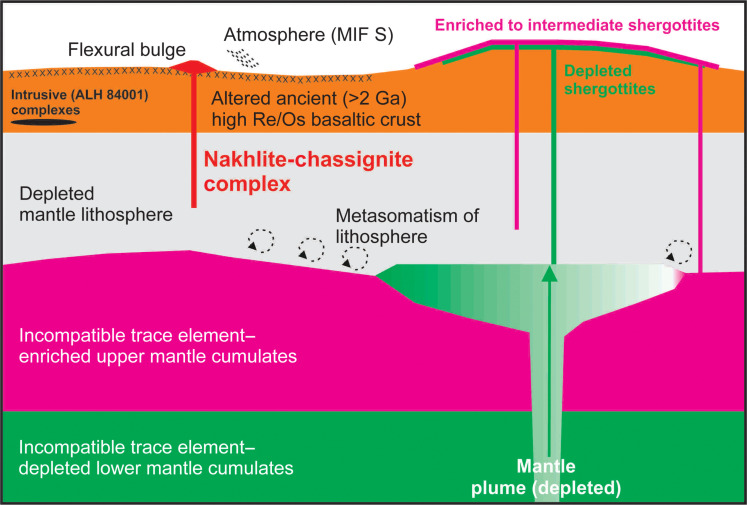
Fig. 5.. Schematic illustration of relations of nakhlite-chassignites to other martian meteorites and major martian silicate reservoirs.
Shown is the relationship of the flexural bulge due to loading of Tharsis on the lithosphere (16). Impingement by underlying plumes and small-scale melting at the lithosphere-asthenosphere boundary of Mars likely engenders mantle metasomatism, and this feature along with melting of ITE-enriched upper mantle cumulates likely explains enriched shergottites. Depleted shergottites require ITE-depleted sources and are likely fed from mantle plumes within Mars. Enriched and depleted shergottites could originate from the same regions on Mars or from distinct volcanic edifices. Nakhlites and chassignites were emplaced into older, altered, and enriched crust that did not experience noticeable impact contamination, like NWA 7034/7533. ALH 84001 is likely an intrusive cumulate of the old martian crust. MIF S refers to atmospheric that interacted with martian surface reservoirs.

References

    1. McSween H. Y. Jr., Petrology on Mars. Am. Mineral. 100, 2380–2395 (2015).
    1. Lapen T. J., Righter M., Brandon A. D., Debaille V., Beard B. L., Shafer J. T., Peslier A. H., A younger age for ALH84001 and its geochemical link to shergottite sources in Mars. Science 328, 347–351 (2010). - PubMed
    1. Bouvier L. C., Costa M. M., Connelly J. N., Jensen N. K., Wielandt D., Storey M., Nemchin A. A., Whitehouse M. J., Snape J. F., Bellucci J. J., Evidence for extremely rapid magma ocean crystallization and crust formation on Mars. Nature 558, 586–589 (2018). - PMC - PubMed
    1. Udry A., Howarth G. H., Herd C. D. K., Day J. M. D., Lapen T., Filiberto J., What martian meteorites reveal about the interior and surface of Mars. J. Geophys. Res. Planets 125, e2020JE006523 (2020).
    1. Dauphas N., Pourmand A., Hf–W–Th evidence for rapid growth of Mars and its status as a planetary embryo. Nature 473, 489–492 (2011). - PubMed