


NAT10 and cytidine acetylation in mRNA: intersecting paths in development and disease
- PMID: 38820741
- PMCID: PMC11317219
- DOI: 10.1016/j.gde.2024.102207
NAT10 and cytidine acetylation in mRNA: intersecting paths in development and disease
Abstract
N4-acetylcytidine (ac4C) is an RNA modification that is catalyzed by the enzyme NAT10. Constitutively found in tRNA and rRNA, ac4C displays a dynamic presence in mRNA that is shaped by developmental and induced shifts in NAT10 levels. However, deciphering ac4C functions in mRNA has been hampered by its context-dependent influences in translation and the complexity of isolating effects on specific mRNAs from other NAT10 activities. Recent advances have begun to overcome these obstacles by leveraging natural variations in mRNA acetylation in cancer, developmental transitions, and immune responses. Here, we synthesize the current literature with a focus on nuances that may fuel the perception of cellular discrepancies toward the development of a cohesive model of ac4C function in mRNA.
Published by Elsevier Ltd.
Conflict of interest statement
Declaration of Competing Interest The authors declare no conflicts of interest.
Figures
References
-
-
Arango D, Sturgill D, Yang R, Kanai T, Bauer P, Roy J, Wang Z, Hosogane M, Schiffers S, Oberdoerffer S: Direct epitranscriptomic regulation of mammalian translation initiation through N4-acetylcytidine. Mol Cell 2022, 82:2797–2814.e2711.
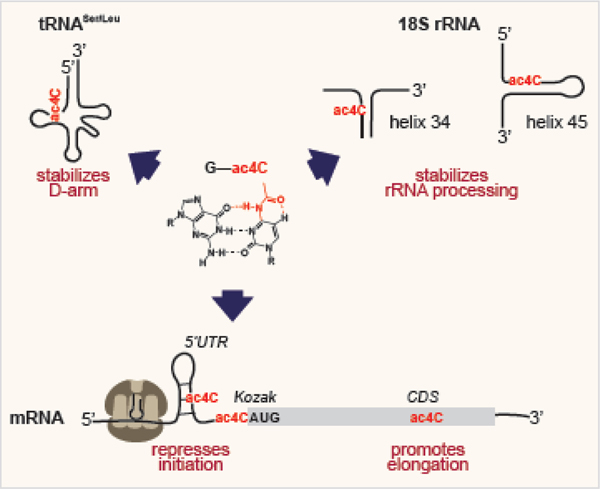
••Through a combination of mapping and functional assays, this work established positional dependence in ac4C activities. In 5’UTRs, ac4C inhibited translation initiation, while ac4C within coding sequences promoted translation elongation.
-
Publication types
MeSH terms
Substances
Grants and funding
LinkOut - more resources
Full Text Sources
