Empowerment Among Adolescent Girls in Nepal: A Concept Mapping Exploratory Study
- PMID: 38821870
- PMCID: PMC11216707
- DOI: 10.9745/GHSP-D-23-00010
Empowerment Among Adolescent Girls in Nepal: A Concept Mapping Exploratory Study
Abstract
Background: The concept of empowerment is challenging to operationalize and measure; it is multidimensional, the outcomes are not always directly observable, and meanings of empowerment are highly contextual and socially and culturally situated. This study aimed to explore perspectives of empowerment among adolescent girls in Nepal to identify statements for inclusion in a context-specific empowerment measure.
Methods: We used a participatory and mixed method research method called concept mapping in 3 districts in Nepal. Three sequential concept mapping sessions were used to solicit, organize, and process how participants responded to the prompt: "The life of an adolescent girl improves when she has/can…" The Concept Systems Global software was used to manage and analyze the concept mapping brainstorming, sorting, and rating data using established tools, such as multidimensional scaling and cluster analysis.
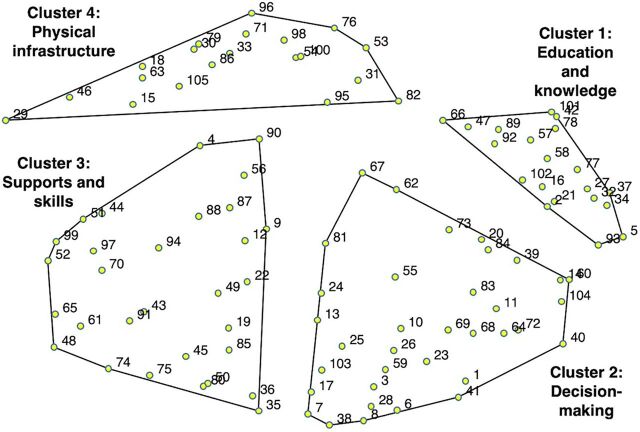
Results: Concept mapping was conducted with 113 participants, including national experts, program staff, adolescents, and their mothers. They identified 105 items that fall into a 4-cluster solution: education and knowledge, decision-making, supports and skills, and physical infrastructure. Rating data uncovered there was some overlap between the top 10 most important items between the national-level experts and other stakeholder groups; however, several components associated with empowerment differed by stakeholder group in terms of importance.
Conclusion: This research represents a critical step in exploring definitions of empowerment among adolescent girls in the Nepal context and with expert input. These results led to the development of a contextually specific definition of empowerment. Researchers and practitioners interested in developing context-specific understandings of complex topics that incorporate community voices and perspectives could use a similar concept mapping approach in other countries to explore various topics with diverse populations.
© Burke et al.
Figures
Comment on
-
Associations between quantitative measures of women's empowerment and access to care and health status for mothers and their children: A systematic review of evidence from the developing world.Soc Sci Med. 2016 Nov;169:119-131. doi: 10.1016/j.socscimed.2016.08.001. Epub 2016 Aug 22. Soc Sci Med. 2016. PMID: 27716549
References
-
- Sen G, Grown C. Development, Crises and Alternative Visions: Third World Women’s Perspectives. Monthly Review Press; 1987.
-
- UNICEF. Progress for Children: A Report Card on Adolescents. UNICEF; 2012. Accessed May 13, 2024. https://www.unicef.org/reports/progress-children-no-10
-
- WHO pledges extensive commitments towards women’s empowerment and health. News release. World Health Organization. July 5, 2021. Accessed May 13, 2024. https://www.who.int/news/item/05-07-2021-who-pledges-extensive-commitmen...
-
- Carter J, Byrne S, Schrader K, et al. . Learning about women’s empowerment in the context of development projects: do the figures tell us enough? Gender Dev. 2014; 22(2):327–349. 10.1080/13552074.2014.920986 - DOI
-
- Rowlands J. Questioning Empowerment. Working With Women in Honduras. Oxfam; 1997. Accessed May 13, 2024. https://policy-practice.oxfam.org/resources/questioning-empowerment-work...
Publication types
MeSH terms
Grants and funding
LinkOut - more resources
Full Text Sources