Review
. 2024 Jun 1;14(1):232.
doi: 10.1038/s41398-024-02911-1.

Optimising the use of electronic medical records for large scale research in psychiatry

Affiliations
Review

Optimising the use of electronic medical records for large scale research in psychiatry

Danielle Newby et al. Transl Psychiatry. .

Abstract

The explosion and abundance of digital data could facilitate large-scale research for psychiatry and mental health. Research using so-called "real world data"-such as electronic medical/health records-can be resource-efficient, facilitate rapid hypothesis generation and testing, complement existing evidence (e.g. from trials and evidence-synthesis) and may enable a route to translate evidence into clinically effective, outcomes-driven care for patient populations that may be under-represented. However, the interpretation and processing of real-world data sources is complex because the clinically important 'signal' is often contained in both structured and unstructured (narrative or "free-text") data. Techniques for extracting meaningful information (signal) from unstructured text exist and have advanced the re-use of routinely collected clinical data, but these techniques require cautious evaluation. In this paper, we survey the opportunities, risks and progress made in the use of electronic medical record (real-world) data for psychiatric research.


Conflict of interest statement

The authors declare no competing interests.

Figures
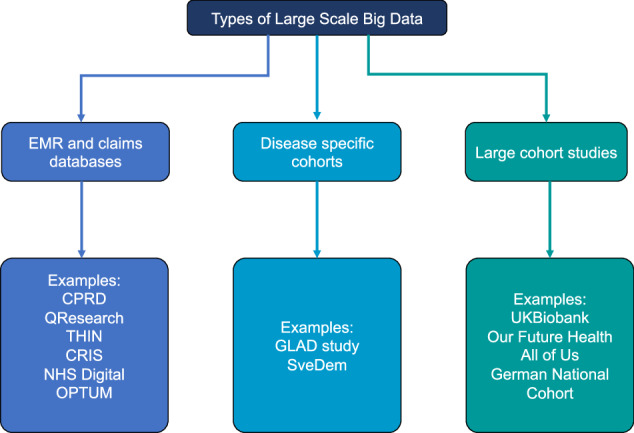
Fig. 1
Fig. 1. Examples of potential data sources for psychiatric research.
CPRD: Clinical Practice Research Datalink [174], QResearch (https://www.qresearch.org/), THIN: The health improvement network (https://www.the-health-improvement-network.com/), CRIS: Clinical Record Interactive Search, OPTUM (https://www.optum.com/), NHS Digital (https://digital.nhs.uk/), GLAD study: Genetic Links to Anxiety and Depression Study [175], SveDem: The Swedish Dementia Registry [176], UK Biobank [177], Our Future Health (https://ourfuturehealth.org.uk/), All of Us (https://allofus.nih.gov/), German National Cohort [178]. EMR and claims databases contain a variety of data formats which can be classified as structured or unstructured [69]. Structured data includes information such as age and gender, measurements such as blood pressure readings, height and also diagnosis codes, laboratory tests and medication prescribing. Whereas unstructured text includes narrative data such as clinical notes (e.g. biopsychosocial formulations, differential diagnoses, mental state examinations and risk formulations). Compared to narrative, unstructured data, structured data is easier to process with little pre-processing because it is stored in a standardised format. EHR and claims databases have vast patient numbers covering all diseases and disorders, giving the opportunity to look at psychiatric conditions and their comorbid diseases.
Fig. 2
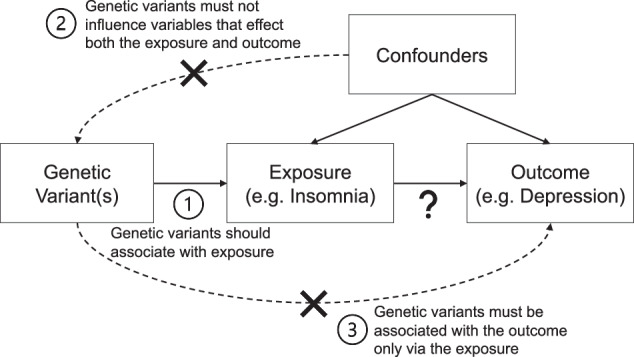
Fig. 2. The concept of Mendelian randomisation (MR) and its assumptions.
There are a growing number of MR studies being published that show causal effects related to disease-disease associations and drug-disease associations for mental health and old age psychiatry [–186] with extensions to traditional MR approaches, which could offer further insights [–189].

References

    1. Koning NR, Büchner FL, van den Berg AW, Choi SYA, Leeuwenburgh NA, Paijmans IJM, et al. The usefulness of electronic health records from preventive youth healthcare in the recognition of child mental health problems. Front Public Health 2021;9. 10.3389/fpubh.2021.658240. - PMC - PubMed
    1. Werbeloff N, Osborn DPJ, Patel R, Taylor M, Stewart R, Broadbent M, et al. The Camden & Islington Research Database: using electronic mental health records for research. PLoS ONE. 2018;13:e0190703. doi: 10.1371/journal.pone.0190703. - DOI - PMC - PubMed
    1. Patel R, Wee SN, Ramaswamy R, Thadani S, Tandi J, Garg R, et al. NeuroBlu, an electronic health record (EHR) trusted research environment (TRE) to support mental healthcare analytics with real-world data. BMJ Open. 2022;12:e057227. doi: 10.1136/bmjopen-2021-057227. - DOI - PMC - PubMed
    1. Castillo EG, Olfson M, Pincus HA, Vawdrey D, Stroup TS. Electronic health records in mental health research: a framework for developing valid research methods. Psychiatr Serv. 2015;66:193–6. doi: 10.1176/appi.ps.201400200. - DOI - PubMed
    1. Power MC, Engelman BC, Wei J, Glymour MM. Closing the gap between observational research and randomized controlled trials for prevention of Alzheimer disease and dementia. Epidemiol Rev. 2022;44:17–28. doi: 10.1093/epirev/mxac002. - DOI - PMC - PubMed