


Maximum surgical blood ordering schedule for elective surgical procedures in Omdurman teaching hospital, Sudan
- PMID: 38824497
- PMCID: PMC11143682
- DOI: 10.1186/s12893-024-02458-4
Maximum surgical blood ordering schedule for elective surgical procedures in Omdurman teaching hospital, Sudan
Abstract
Background: The need for blood during a surgical procedure is greater than what blood banks are able to provide. There is an excessive amount of blood being ordered for elective surgeries, surpassing the actual requirements. Only 30% of the cross matched blood is actually used in these surgeries. The accuracy of estimating the transfusion needs before a surgical procedure can be determined by looking at the cross match to transfusion ratio and the transfusion index. "These indicators play a crucial role in developing the maximum surgical blood ordering schedule; in this study, these indicators were tested."
Aim of study: Is to determine the efficiency of blood ordering and transfusion practices for patients undergoing elective surgeries.
Methods: This study is a prospective cross-sectional hospital-based study done at Omdurman Teaching Hospital-Sudan. Conducted for the duration of 6 months period from July to December 2019.The study participants were patients who underwent elective surgical procedures in general surgery and Urology departments as total coverage sample over a period of study duration. Ethical clearance obtained from ethical committee of Sudan Medical Specialization Board.
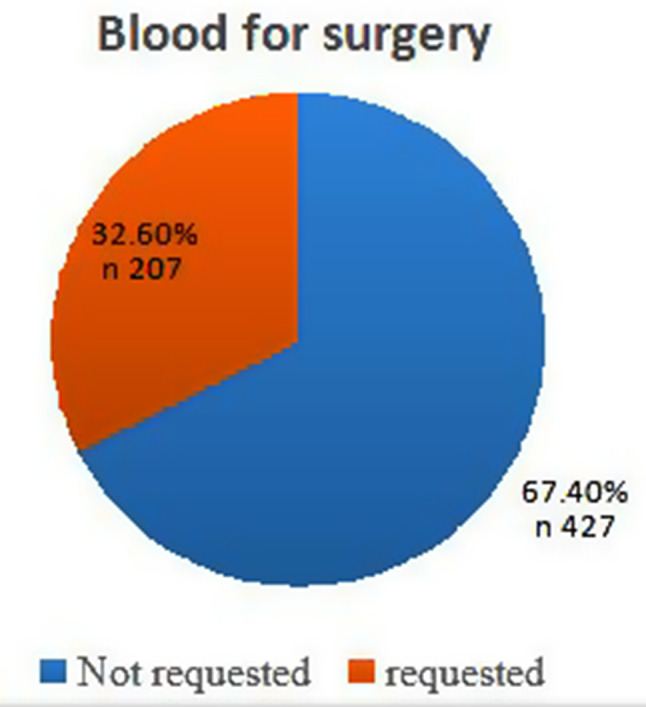
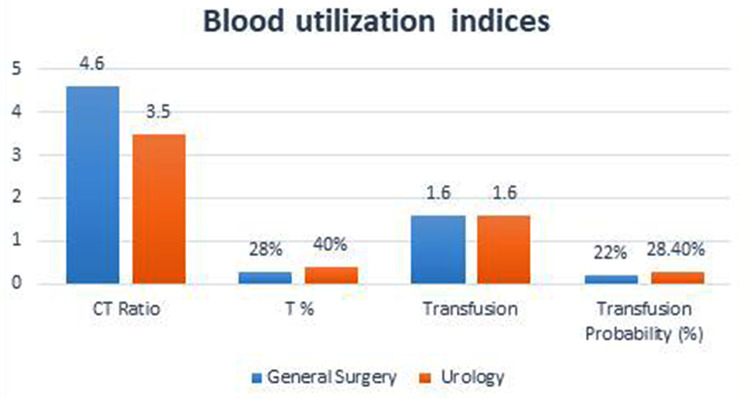
Results: Two hundreds seven patients included in this study, the amount of blood units requested were 443-unit, cross matching for 98.6% (n 437) of units were done. Only 100 unit were Transfused (22,8%). The calculated CT ratio was 4.4, transfusion index was 1.6 and transfusion probability was 29.9%.
Conclusion: Transfusion probability and transfusion index of the present study were optimal but comparatively higher than the standard guidelines as most of the cross matched blood was not utilized.
Keywords: Blood in surgery; Blood transfusion; Cross-match to transfusion ratio (CTR); MSBOS.
© 2024. The Author(s).
Conflict of interest statement
The authors declare no competing interests.
The authors of this paper have no invested interests in products described or used in this paper. The authors have no conflict of interests.
Figures
References
-
- Hall TC, Pattenden C, Hollobone C, Pollard C, Dennison AR. Blood transfusion policies in elective general surgery: How to optimise cross-match-to-transfusion ratios. Transfus Med Hemother. 2013;40(1):27–31. 10.1159/000345660. https://www.ncbi.nlm.nih.gov/pmc/articles/PMC3635964. - PMC - PubMed
-
- Article O. Blood Requisition and Utilization Practice in Surgical Patients in a Teaching Hospital Western Nepal. Kathmandu Univ Med J (KUMJ). 2016 Jan-Mar;14(53):27–30. https://www.ncbi.nlm.nih.gov/pubmed/27892437. - PubMed
-
- Cap AP et al. Whole Blood Transfusion. Mil Med. 2018;183:44–51. 10.1093/milmed/usy120. https://www.ncbi.nlm.nih.gov/pubmed/30189061. - PubMed
-
- Arya RC, Wander GS, Gupta P. Blood component therapy: Which, when and how much. J Anaesthesiol Clin Pharmacol. 2011;27:278 – 84. http://www.joacp.org/text.asp?2011/27/2/278/81849. - PMC - PubMed
-
- Fathelrahman AI. Assessing Blood Bank Items Procurement & Supply Management System In Central Medical Supplies Sudan. 2012. http://nmsf.gov.sd/includes/pdf/ran.pdf.
MeSH terms
LinkOut - more resources
Full Text Sources
Medical
Research Materials
