


The TEOGIC study project: a comprehensive characterization of early onset gastrointestinal cancer in the Northern area of Spain
- PMID: 38824512
- PMCID: PMC11143674
- DOI: 10.1186/s12885-024-12454-9
The TEOGIC study project: a comprehensive characterization of early onset gastrointestinal cancer in the Northern area of Spain
Erratum in
-
Correction: the TEOGIC study project: a comprehensive characterization of early onset gastrointestinal cancer in the Northern area of Spain.BMC Cancer. 2024 Jul 9;24(1):819. doi: 10.1186/s12885-024-12581-3. BMC Cancer. 2024. PMID: 38982387 Free PMC article. No abstract available.
Abstract
Background: Gastrointestinal cancers represent one of the most prevalent diseases worldwide. Strikingly, the incidence of Early Onset Gastrointestinal Cancer (EOGIC) has been rising during the last decades and changes in lifestyle and environmental exposure seem to play a role. EOGIC has been defined as a different entity compared to on-average gastrointestinal cancer, with distinct clinical and molecular characteristics. Inherent to the particularities of younger age, there is an unmet need for a tailored approach for the management of these patients. The TEOGIC proposes a comprehensive study to characterize EOGIC patients in the northern of Spain.
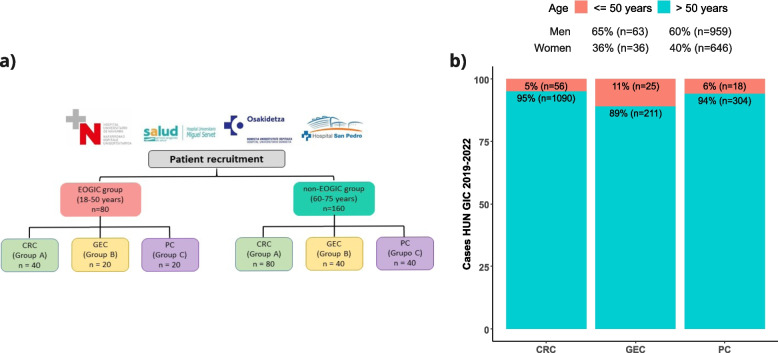
Methods: Patients with histologically confirmed new diagnosis of colorectal, gastroesophageal and pancreatic adenocarcinoma will be considered for two cohorts: EOGIC (≤ 50 years old) and non-EOGIC (60-75 years old), with a ratio of 1:2. Two hundred and forty patients will be recruited in 4 Public Hospitals from northern Spain. After receiving unified informed consent, demographic and clinical data of the patients will be collected in a REDCap database. Lifestyle related data will be obtained in questionnaires assessing diet, physical activity and the general quality of life of the patients before diagnosis. Biological samples prior to any onco-specific treatment will be obtained for the analyses of circulating inflammatory proteins, gut microbiota, and the proteome of the tumor microenvironment. Histologic characteristics and routine biomarkers will be also collected. Thereafter, data will be integrated and analyzed to assess tumor specific, pan-tumor and sex-associated differential characteristics of EOGIC.
Discussion: The underlying risk factors and differential characteristics of EOGIC remain poorly studied, particularly in our geographical area. Although limited by the exploratory nature and the small sample size estimated to be recruited, TEOGIC represents the first attempt to comprehensively characterize these young patients, and thus attend to their special needs. Findings derived from this study could contribute to raise awareness and preventive behaviors in the population. In parallel, molecular studies could lead to the identification of potential novel non-invasive biomarkers and therapeutic targets that would help in the development of the tailored clinical management of these patients, focusing on screening programs for early diagnosis and precision medicine.
Keywords: Colorectal cancer; Early onset gastrointestinal cancer; Environmental risk factors; Gastroesophageal cancer; Gastrointestinal cancer; Microbiome; Pancreatic cancer; Precision medicine; Tumor microenvironment.
© 2024. The Author(s).
Conflict of interest statement
RV has been involved as a consultant for advisory roles with Servier, Roche and Merck Sharp and has received speaker honoraria from Roche, Amgen, Merck Sharp and Dohme, Astra Zeneca. IL, NC, AEH, IC, FRP, CV, DG, JS, IFR, MR, FE, AGN, AL, VA, RPC and SL declare no conflict of interest. AL has received speaker honoraria from Pierre-Fabre. HA has been involved as a consultant for advisory roles from Astra Zeneca and for trial coordination from Ferrer Farma and received speaker honoraria from Takeda. VA has been involved as a consultant for advisory roles and received speaker honoraria from MSD, Bristol, Lilly, Astra-Zeneca and Pierre-Fabre. IHG has received speaker honoraria from Astra Zeneca. EM has been involved as a consultant for advisory roles with Servier, Roche and Merck Sharp and Dohme. RD declares advisory role for Roche, Foundation Medicine, received a speaker’s fee from Roche, Ipsen, Amgen, Servier, Sanofi, Libbs, Merck Sharp & Dohme, Lilly, AstraZeneca, Janssen, Takeda, Bristol Myers Squibb, GlaxoSmithKline, Gilead, research grants from Merck, Novartis, Daiichi-Sankyo, GlaxoSmithKline and AstraZeneca, and is investor in Trialing Health, S.L. AMC declares advisory role for Servier, Novartis, Pharmamar and Bristol Myers Squibb, received speaker honoraria from Novartis, Roche, Merck Sharp and Dohme, Merck, Pierre Fabre, Amgen, Sanofi, Servier and Bristol Myers Squib. MA has been involved as a consultant for advisory roles with Amgen, BMS, MSD, Lilly and Servier.
Figures

References
-
- (SEOM) SEdOM. Las Cifras del Cancer en España 2024. https://seom.org/ejercicio-contra-el-cancer/las-cifras-del-cancer-en-esp.... Available from: https://www.seom.org/images/LAS_CIFRAS_2024.pdf.
MeSH terms
Substances
Grants and funding
- 8FJC2021-046521-I/Agencia Estatal de Investigación
- CLJUN234885LECU/Fundación Científica Asociación Española Contra el Cáncer
- CLJUN19010ARAS/Fundación Científica Asociación Española Contra el Cáncer
- AECC SEED IDEAS 2023/Fundación Científica Asociación Española Contra el Cáncer
- Knowledge Generation Proyects 2022/Ministerio de Ciencia, Innovación y Universidades
LinkOut - more resources
Full Text Sources
