


Associations Between Estimated Pulse Wave Velocity and Five-Year All-Cause Mortality in Patients with Atherosclerotic Cardiovascular Disease with and without Standard Modifiable Risk Factors: Evidence From NHANES 1999-2016
- PMID: 38827433
- PMCID: PMC11144008
- DOI: 10.2147/CLEP.S457054
Associations Between Estimated Pulse Wave Velocity and Five-Year All-Cause Mortality in Patients with Atherosclerotic Cardiovascular Disease with and without Standard Modifiable Risk Factors: Evidence From NHANES 1999-2016
Abstract
Aim: The study aimed to analyze the associations between estimated pulse wave velocity (ePWV) and 5-year mortality in atherosclerotic cardiovascular disease (ASCVD) patients with and without standard modifiable risk factors (SMuRFs), which included smoking status, hypertension, diabetes, and hypercholesterolemia.
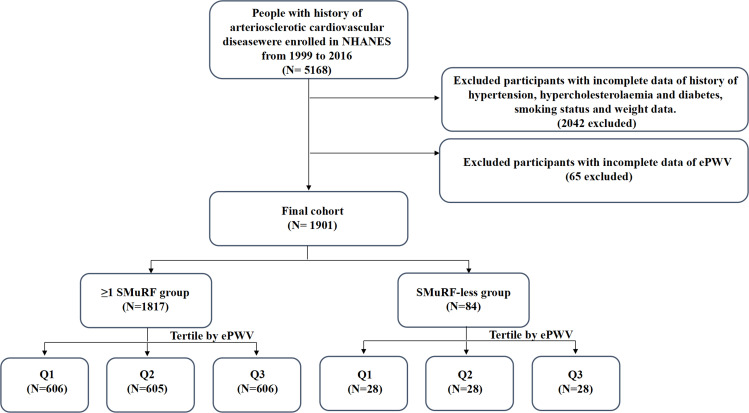
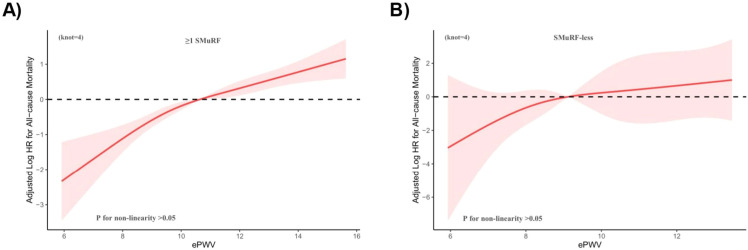
Methods: The present retrospective cohort study utilized data from the National Health and Nutrition Examination Survey (NHANES) between 1999 and 2016. Patients with ASCVD who completed both the questionnaire survey and serum testing were included. Patients were categorized into the ≥1 SMuRF group if they had at least one SMuRF, while those without any SMuRFs were classified into the SMuRF-less group. The ePWV, which was calculated using the age and mean blood pressure, was evenly divided into three categories: low (Q1), medium (Q2), and high (Q3). Multivariable weighted Cox proportional-hazard regression analyses were utilized to explore the risk factors associated with 5-year mortality in patients with and without SMuRFs. And restricted cubic spline curve (RCS) was used to assess their nonlinear correlation.
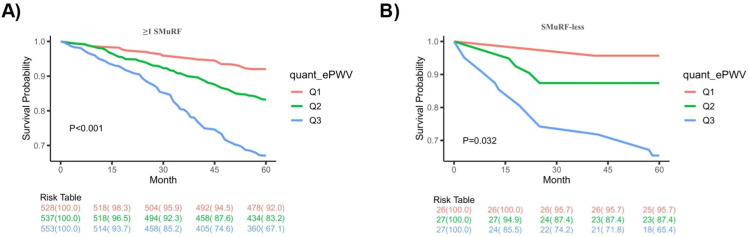
Results: A total of 1901 patients with ASCVD were included in the study. For the patients in ≥1 SMuRF group, the Q3 group included patients who were older, with a higher proportion of males, more comorbidities, and a lower body mass index than the Q1 group (P<0.05). The Cox proportional-hazard regression model results revealed, the Q3 group had a higher risk of 5-year mortality than the Q1 group [hazard ratio (HR) 4.30, 95% confidence interval (CI) (2.66, 6.95), P<0.001]. RCS demonstrated a linear trend between high level of ePWV and decreased risks of mortality. Similar results were observed in the SMuRF-less group [HR 10.62, 95% CI (1.22, 92.06), P=0.032].
Conclusion: A high level of ePWV signified a higher risk of 5-year mortality in ASCVD patients with and without SMuRFs.
Keywords: all-cause mortality; atherosclerotic cardiovascular disease; estimated pulse wave velocity; standard modifiable risk factors.
© 2024 Li et al.
Conflict of interest statement
The authors report no conflicts of interest in this work.
Figures
References
-
- Aboyans V; Causes of Death Collaborators. Global, regional, and national age-sex specific all-cause and cause-specific mortality for 240 causes of death, 1990–2013: a systematic analysis for the global burden of disease study 2013. Lancet. 2015;385(9963):117–171. doi:10.1016/s0140-6736(14)61682-2 - DOI - PMC - PubMed
LinkOut - more resources
Full Text Sources
