Radiologic Assessment of Knee Phenotypes Based on the Coronal Plane Alignment of the Knee Classification in a Korean Population
- PMID: 38827768
- PMCID: PMC11130633
- DOI: 10.4055/cios23250
Radiologic Assessment of Knee Phenotypes Based on the Coronal Plane Alignment of the Knee Classification in a Korean Population
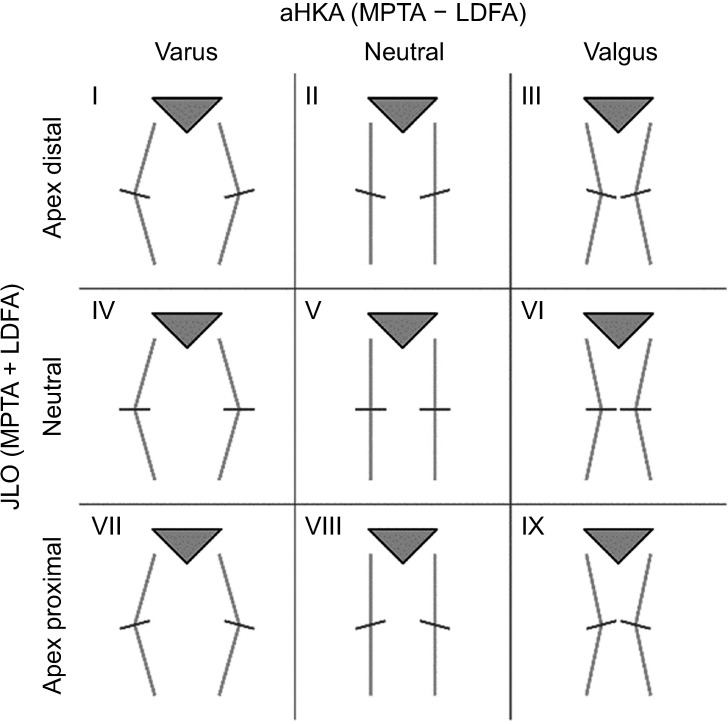
Abstract
Background: The Coronal Plane Alignment of the Knee (CPAK) classification system has been developed as a comprehensive system that describes 9 coronal plane phenotypes based on constitutional limb alignment and joint line obliquity (JLO). Due to the characteristics of Asian populations, which show more varus and wider distribution in lower limb alignment than other populations, modification of the boundaries of the arithmetic hip-knee-ankle angle (aHKA) and JLO should be considered. The purpose of this study was to determine the knee phenotype in a Korean population based on the original CPAK and modified CPAK classification systems.
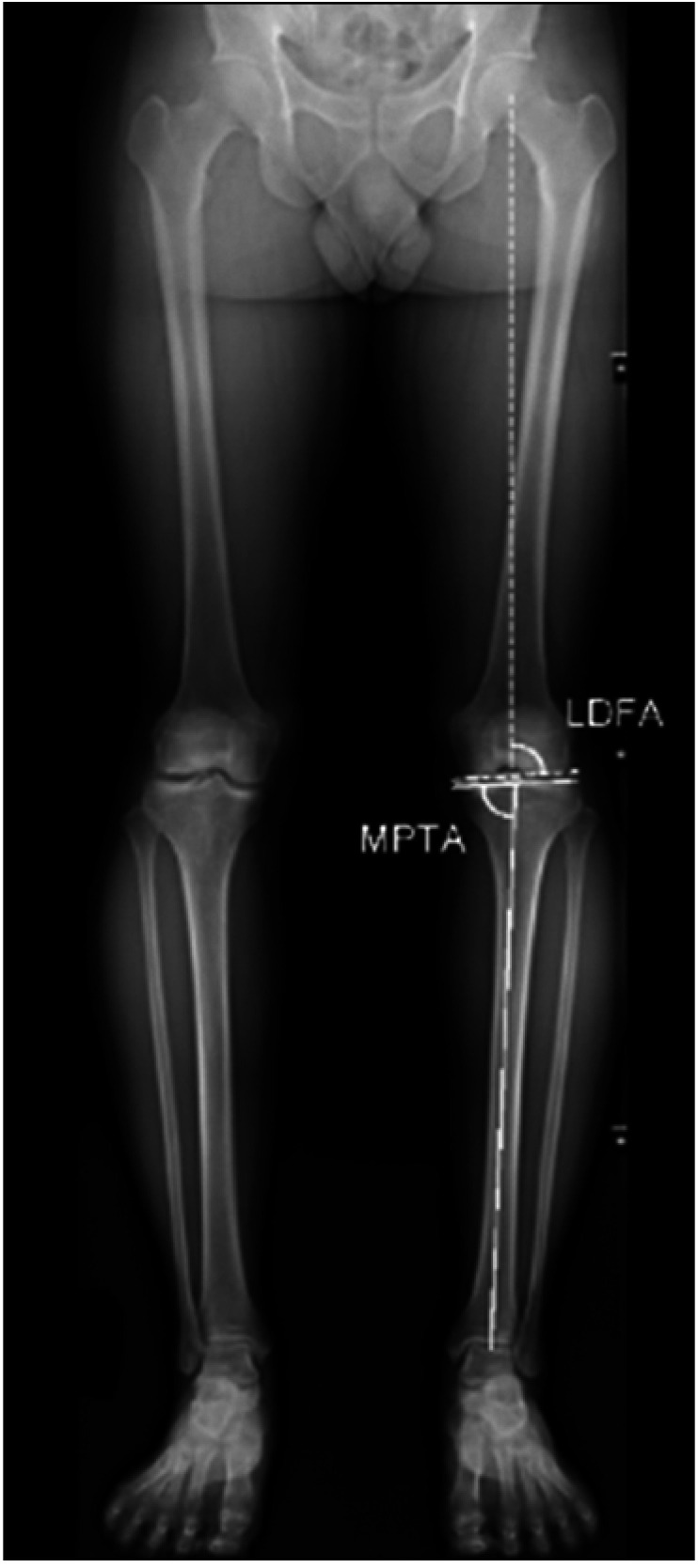
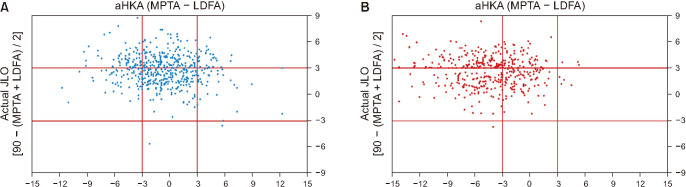
Methods: We reviewed prospectively collected data of 500 healthy and 500 osteoarthritic knees between 2021 and 2023 using radiographic analysis and divided them based on the modified CPAK classification system by widening the neutral boundaries of the aHKA to 0° ± 3° and using the actual JLO as a new variable. Using long-leg standing weight-bearing radiographs, 6 radiographic parameters were measured to evaluate the CPAK type: the mechanical HKA angle, medial proximal tibial angle (MPTA), lateral distal femoral angle (LDFA), aHKA, JLO, and actual JLO.
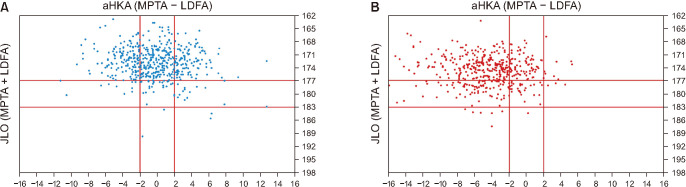
Results: From 2 cohorts of 1,000 knees, the frequency distribution representing all CPAK types was different between the healthy and arthritic groups. The most common categories were type II (38.2%) in the healthy group and type I (53.8%) in the arthritic group based on the original CPAK classification. The left and upward shift in the distribution of knee phenotypes in the original classification was corrected evenly after re-establishing the boundaries of a neutral aHKA and the actual JLO. According to the modified CPAK classification system, the most common categories were type II (35.2%) in the healthy group and type I (38.0%) in the arthritic group.
Conclusions: Although the modified CPAK classification corrected the uneven distribution seen when applying the original classification system in a Korean population, the most common category was type I in Korean patients with osteoarthritic knees in both classification systems. Furthermore, there were different frequencies of knee phenotypes among healthy and arthritic knees.
Keywords: Constitutional varus; Coronal plane alignment of the knee; Knee phenotypes; Osteoarthritis; Total knee arthroplasty.
Copyright © 2024 by The Korean Orthopaedic Association.
Conflict of interest statement
CONFLICT OF INTEREST: No potential conflict of interest relevant to this article was reported.
Figures
References
-
- Longstaff LM, Sloan K, Stamp N, Scaddan M, Beaver R. Good alignment after total knee arthroplasty leads to faster rehabilitation and better function. J Arthroplasty. 2009;24(4):570–578. - PubMed
-
- Gunaratne R, Pratt DN, Banda J, Fick DP, Khan RJ, Robertson BW. Patient dissatisfaction following total knee arthroplasty: a systematic review of the literature. J Arthroplasty. 2017;32(12):3854–3860. - PubMed
-
- Jin QH, Lee WG, Song EK, Kim WJ, Jin C, Seon JK. No difference in the anteroposterior stability between the GRADIUS and multi-radius designs in total knee arthroplasty. Knee. 2020;27(4):1197–1204. - PubMed
MeSH terms
LinkOut - more resources
Full Text Sources