


Risk of recurrence after discontinuing anticoagulation in patients with COVID-19- associated venous thromboembolism: a prospective multicentre cohort study
- PMID: 38828131
- PMCID: PMC11139764
- DOI: 10.1016/j.eclinm.2024.102659
Risk of recurrence after discontinuing anticoagulation in patients with COVID-19- associated venous thromboembolism: a prospective multicentre cohort study
Abstract
Background: The clinical relevance of recurrent venous thromboembolism (VTE) after discontinuing anticoagulation in patients with COVID-19-associated VTE remains uncertain. We estimated the incidence rates and mortality of VTE recurrences developing after discontinuing anticoagulation in patients with COVID-19-associated VTE.
Methods: A prospective, multicenter, non-interventional study was conducted between March 25, 2020, and July 26, 2023, including patients who had discontinued anticoagulation after at least 3 months of therapy. All patients from the registry were analyzed during the study period to verify inclusion criteria. Patients with superficial vein thrombosis, those who did not receive at least 3 months of anticoagulant therapy, and those who were followed for less than 15 days after discontinuing anticoagulation were excluded. Outcomes were: 1) Incidence rates of symptomatic VTE recurrences, and 2) fatal PE. The rate of VTE recurrences was defined as the number of patients with recurrent VTE divided by the patient-years at risk of recurrent VTE during the period when anticoagulation was discontinued.
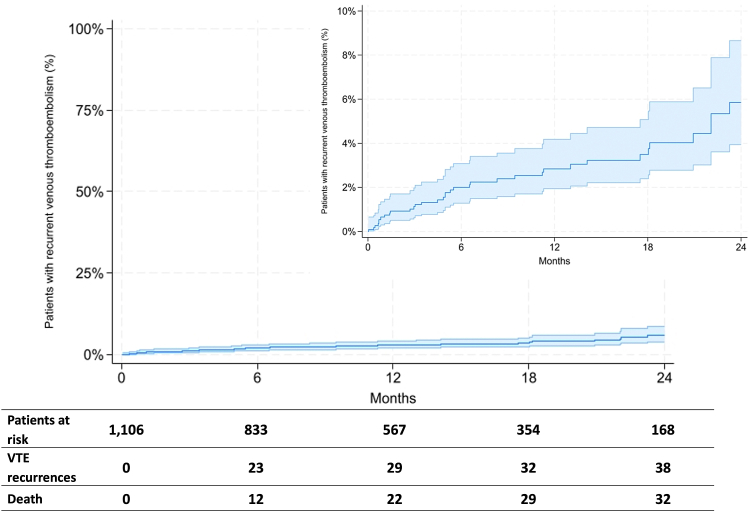
Findings: Among 1106 patients with COVID-19-associated VTE (age 62.3 ± 14.4 years; 62.9% male) followed-up for 12.5 months (p25-75, 6.3-20.1) after discontinuing anticoagulation, there were 38 VTE recurrences (3.5%, 95% confidence interval [CI]: 2.5-4.7%), with a rate of 3.1 per 100 patient-years (95% CI: 2.2-4.2). No patient died of recurrent PE (0%, 95% CI: 0-7.6%). Subgroup analyses showed that patients with diagnosis in 2021-2022 (vs. 2020) (Hazard ratio [HR] 2.86; 95% CI 1.45-5.68) or those with isolated deep vein thrombosis (vs. pulmonary embolism) (HR 2.31; 95% CI 1.19-4.49) had significantly higher rates of VTE recurrences.
Interpretation: In patients with COVID-19-associated VTE who discontinued anticoagulation after at least 3 months of treatment, the incidence rate of recurrent VTE and the case-fatality rate was low. Therefore, it conceivable that long-term anticoagulation may not be required for many patients with COVID-19-associated VTE, although further research is needed to confirm these findings.
Funding: Sanofi and Rovi, Sanofi Spain.
Keywords: Anticoagulation; COVID-19; Pulmonary embolism; SARS-CoV-2; Venous thromboembolism.
© 2024 The Authors.
Conflict of interest statement
BB is supported by a Career Development Award from the American Heart Association and VIVA Physicians (#938814). BB was supported by the Scott Schoen and Nancy Adams IGNITE Award and is supported by the Mary Ann Tynan Research Scientist award from the Mary Horrigan Connors Center for Women's Health and Gender Biology at Brigham and Women's Hospital, and the Heart and Vascular Center Junior Faculty Award from Brigham and Women's Hospital. BB reports that he is a consulting expert, on behalf of the plaintiff, for litigation related to two specific brand models of IVC filters. BB has not been involved in the litigation in 2022 or 2023 nor has he received any compensation in 2022 or 2023. BB reports that he is a member of the Medical Advisory Board for the North American Thrombosis Forum and serves in the Data Safety and Monitory Board of the NAIL-IT trial funded by the National Heart, Lung, and Blood Institute, and Translational Sciences. MM received fees from Sanofi, Leo Pharma, Rovi and the Catholic University of Murcia (Spain) sponsored the RIETE registry with unrestricted educational grants. Payments were made to the FUENTE foundation. DJ received honoraria for lectures from BMS and Sanofi. LJP received grants from Leo Pharma and MSD and personal fees from Daichii, Rovi, GlaxoSmithKline, BMS and Johnson and Johnson outside the submitted work. No other conflict of interest declared.
Figures

References
-
- Poissy J., Goutay J., Caplan M., et al. Pulmonary embolism in patients with COVID-19: awareness of an increased prevalence. Circulation. 2020;142:184–186. - PubMed
LinkOut - more resources
Full Text Sources
Miscellaneous
