


Green light is similarly effective in promoting plant biomass as red/blue light: a meta-analysis
- PMID: 38829698
- PMCID: PMC11427831
- DOI: 10.1093/jxb/erae259
Green light is similarly effective in promoting plant biomass as red/blue light: a meta-analysis
Abstract
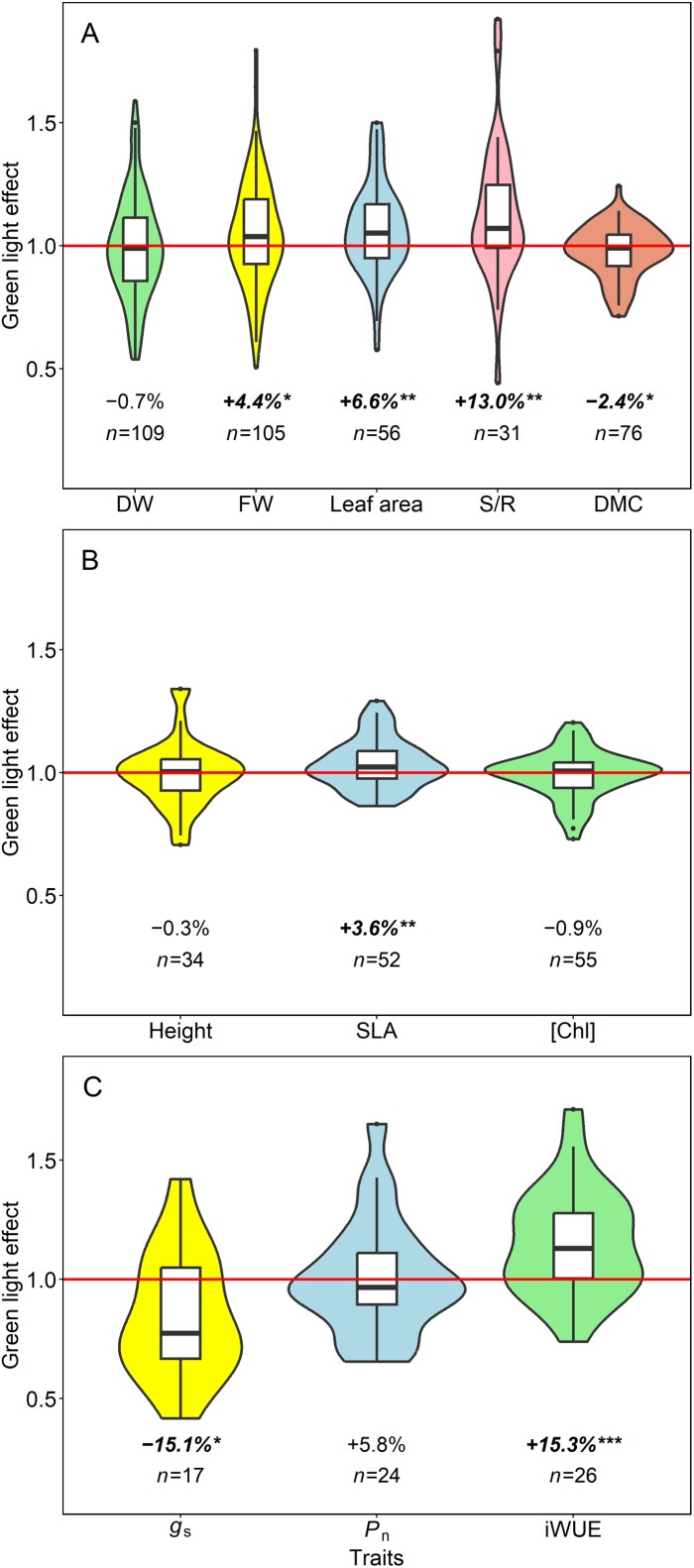
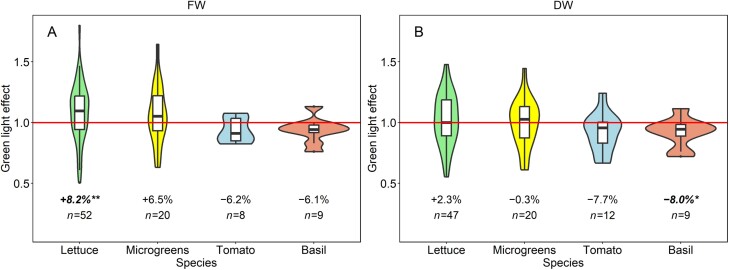
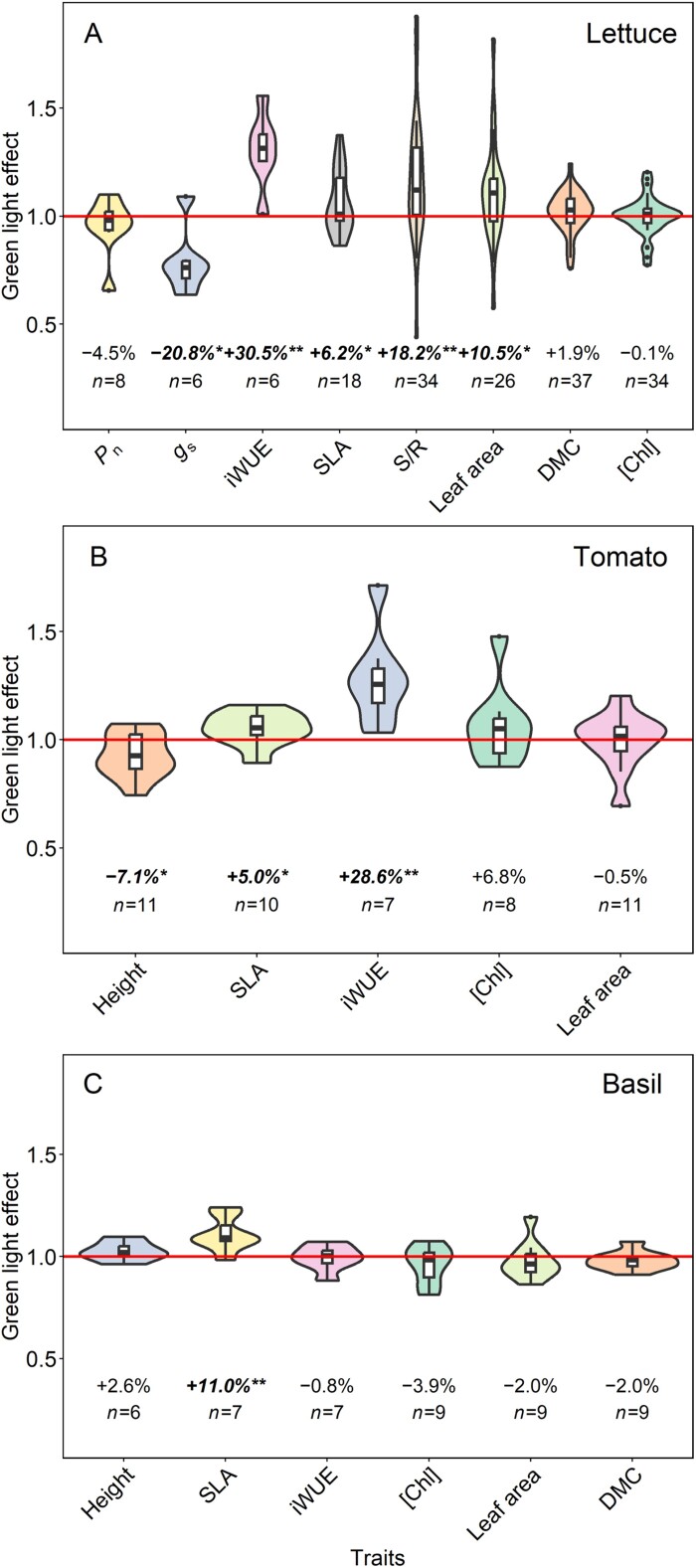
Whether green light promotes or represses plant growth is an unresolved but important question, warranting a global meta-analysis of published data. We collected 136 datasets from 48 publications on 17 crop species, and calculated the green light effect for a range of plant traits. For each trait the effect was calculated as the ratio between the trait value attained under a red/blue background light plus green, divided by the value attained under the background light only, both having the same light intensity. Generally, green light strongly increased intrinsic water use efficiency (15%), the shoot-to-root ratio (13%), and decreased stomatal conductance (-15%). Moreover, green light increased fresh weight to a small extent (4%), but not plant dry weight, resulting in a reduced dry matter content (-2%). Hence, green light is similarly effective at increasing biomass as red and blue light. Green light also showed to increase leaf area (7%) and specific leaf area (4%; i.e. thinner leaves). Furthermore, effects of green light were species-dependent, with positive effects on biomass for lettuce and microgreens, and negative effects in basil and tomato. Our data suggest that future research should focus on the role of green light in modulating water loss, its putative role as a shade signal, and the causes for its species-specific effects on crop biomass.
Keywords: Green light; LED; intrinsic water use efficiency; meta-analysis; plant growth; quantitative analysis; shoot–root ratio; stomatal conductance.
© The Author(s) 2024. Published by Oxford University Press on behalf of the Society for Experimental Biology.
Conflict of interest statement
The authors declare no conflicts of interest.
Figures
References
-
- Bantis F, Smirnakou S, Ouzounis T, Koukounaras A, Ntagkas N, Radoglou K.. 2018. Current status and recent achievements in the field of horticulture with the use of light-emitting diodes (LEDs). Scientia Horticulturae 235, 437–451.
-
- Bian Z, Cheng R, Yang Q, Wang J, Lu C.. 2016. Continuous light from red, blue, and green light-emitting diodes reduces nitrate content and enhances phytochemical concentrations and antioxidant capacity in lettuce. Journal of the American Society for Horticultural Science 141, 186–195.
-
- Bian Z, Zhang X, Wang Y, Lu C.. 2019. Improving drought tolerance by altering the photosynthetic rate and stomatal aperture via green light in tomato (Solanum lycopersicum L.) seedlings under drought conditions. Environmental and Experimental Botany 167, 103844.
Publication types
MeSH terms
Grants and funding
LinkOut - more resources
Full Text Sources
