. 2024 Jun 3;15(1):4567.
doi: 10.1038/s41467-024-48763-7.

Identification and validation of a blood- based diagnostic lipidomic signature of pediatric inflammatory bowel disease

Affiliations

Identification and validation of a blood- based diagnostic lipidomic signature of pediatric inflammatory bowel disease

Samira Salihovic et al. Nat Commun. .

Abstract

Improved biomarkers are needed for pediatric inflammatory bowel disease. Here we identify a diagnostic lipidomic signature for pediatric inflammatory bowel disease by analyzing blood samples from a discovery cohort of incident treatment-naïve pediatric patients and validating findings in an independent inception cohort. The lipidomic signature comprising of only lactosyl ceramide (d18:1/16:0) and phosphatidylcholine (18:0p/22:6) improves the diagnostic prediction compared with high-sensitivity C-reactive protein. Adding high-sensitivity C-reactive protein to the signature does not improve its performance. In patients providing a stool sample, the diagnostic performance of the lipidomic signature and fecal calprotectin, a marker of gastrointestinal inflammation, does not substantially differ. Upon investigation in a third pediatric cohort, the findings of increased lactosyl ceramide (d18:1/16:0) and decreased phosphatidylcholine (18:0p/22:6) absolute concentrations are confirmed. Translation of the lipidomic signature into a scalable diagnostic blood test for pediatric inflammatory bowel disease has the potential to support clinical decision making.


Conflict of interest statement

Dr Salihovic has no conflicts of interest to disclose. Dr Nyström has served as speaker and/or advisory board member for Abigo, Baxter, Ferring, Fresenius-Kabi, Mylan/Meda, Nutricia, Shire, Takeda, Thermo Fisher Scientific, Tillotts Pharma, and Viatris. Dr Bache-Wiig Mathisen has served as advisory board member for Tillotts Pharma. Dr Andersen has no conflicts of interest to disclose. Dr Olbjørn has no conflicts of interest to disclose. Dr Perminow has served as a speaker and/or advisory borad member for AbbVie. She has also received grant support from Ferring, Tillotts Pharma and Takeda. Dr Opheim has no conflicts of interest to disclose. Dr. Detlie has served as a speaker, consultant, or advisory board member for AbbVie, Ferring, Pfizer, Pharmacosmos, Tillotts, and Vifor Pharma. He has received unrestricted research grants from AbbVie, and Pharmacosmos. Dr Huppertz-Hauss has no conflicts of interest to disclose. Dr Bazov has no conflicts of interest to disclose. Dr Kruse has no conflicts of interest to disclose. Dr Lindqvist has no conflicts of interest to disclose. Dr. C. R. H. Hedin has received speaker fees from Takeda, Ferring, AbbVie, and Janssen, and consultancy fees from Pfizer. She has acted as local principal investigator for clinical trials for Janssen and GlaxoSmithKline. She is PI on projects at the Karolinska Institutet partly funded by investigator-initiated grants from Takeda and Tillotts. None of these activities have any relation to the present study. Dr Carlson has received speaker’s fees from ViforPharma. She is the national PI for clinical trials for AstraZeneca. None of these activities have any relation to the present study. Dr Öhman has received financial support for research from Genetic Analysis A.S., Biocodex, Danone Research and AstraZeneca and served as Consultant/Advisory Board member for Genetic Analysis A.S., and as a speaker for Biocodex, Janssen, Ferring Pharmaceuticals, Takeda, AbbVie, Novartis, Avanos, and MEDA. Dr Magnusson has no conflicts of interest to disclose. Dr Keita has no conflicts of interest to disclose. Dr Söderholm has no conflicts of interest to disclose. Dr D’Amato has received unrestricted research grants and serves as consultant for QOL Medical. Dr Orešič has no conflicts of interest to disclose. Dr Noble has no conflicts of interest to disclose. Dr Satsangi has consultancy fees from Janssen. Current research support from The Helmsley Trust, CCUK, and EC Horizon 2020 programme. Dr Uhlig has received research support or consultancy fees from Janssen, UCB Pharma, Eli Lilly, Boehringer Ingelheim, Pfizer, AbbVie, BMS Celgene, GSK, OMass and MiroBio. Dr Dorn-Rasmussen has no conflicts of interest to disclose. Dr Wewer has no conflicts of interest to disclose. Dr Burisch reports personal fees from AbbVie, Celgene, Pfizer, Samsung Bioepis, Pharmacosmos, Ferring, and Galapagos; grants and personal fees from Janssen, MSD, Takeda, Tillots Pharma, and Bristol Myers Squibb; and grants from Novo Nordisk. Dr Repsilber has no conflicts of interest to disclose. Dr Hyötyläinen has no conflicts of interest to disclose. Dr Høivik has served as a speaker and/or advisory board member for AbbVie, Ferring, Galapagos, MEDA, MSD, Pfizer, Takeda, and Tillotts Pharma. She has also received grant support from Ferring, Tillotts Pharma, Takeda, and Pfizer. Dr Halfvarson has served as speaker and/or advisory board member for AbbVie, Aqilion, BMS, Celgene, Celltrion, Dr Falk Pharma and the Falk Foundation, Ferring, Galapagos, Gilead, Hospira, Index Pharma, Janssen, MEDA, Medivir, MSD, Novartis, Pfizer, Prometheus Laboratories Inc., Sandoz, Shire, Takeda, Thermo Fisher Scientific, Tillotts Pharma, Vifor Pharma, UCB and received grant support from Janssen, MSD and Takeda.

Figures
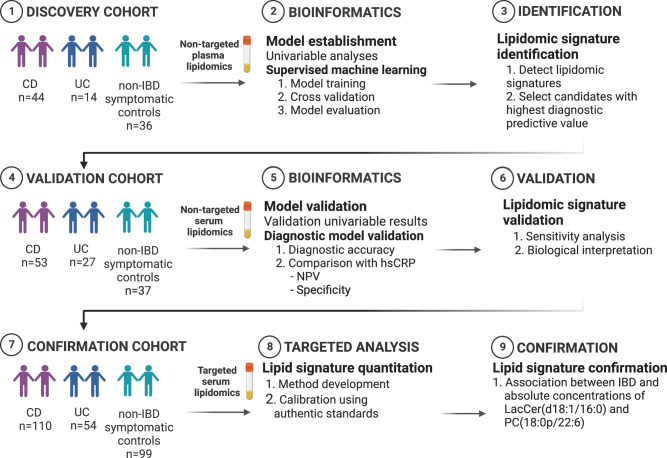
Fig. 1
Fig. 1. The overall study design.
Illustration of the collection of blood samples from a regional Swedish inception cohort comprising treatment-naïve pediatric patients referred for suspected pediatric IBD. The study findings were validated using the Norwegian population-based IBSEN III pediatric inception cohort and further confirmed in an independent third pediatric cohort. The graphics in this figure were created using Biorender.com. Abbreviations: IBD, inflammatory bowel disease.
Fig. 2
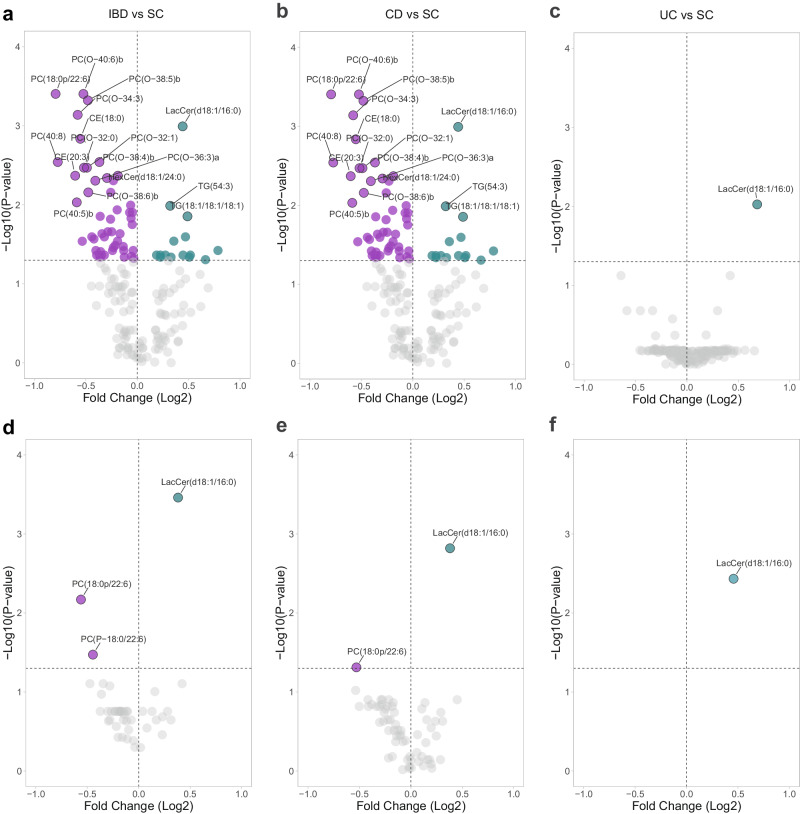
Fig. 2. Identification of individual molecular lipids that distinguish patients with IBD from symptomatic controls.
Univariable analysis revealed distinct circulating levels of molecular lipids between IBD, CD, UC and SC in both the discovery cohort (ac) and the validation cohort (df), using Wilcoxon rank sum test. The volcano plot represents the Fold Change (Log2) on the x-axis and the corresponding false discovery rate-corrected 2-sided -Log10(P value) on the y-axis. IBD inflammatory bowel disease, CD Crohn’s disease, UC ulcerative colitis, SC symptomatic controls. Source data are provided as a Source Data file.
Fig. 3
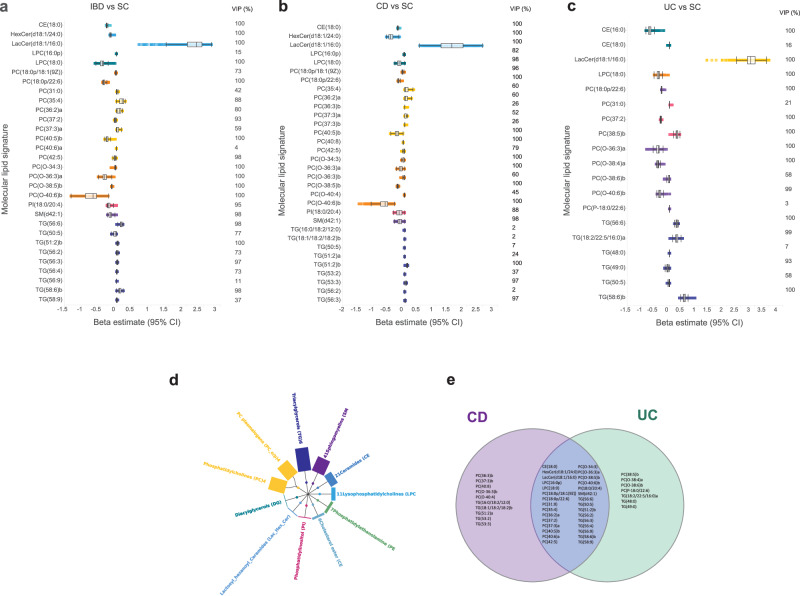
Fig. 3. Molecular lipid signatures of IBD.
Variable selection of diagnostic lipidomic signatures using the SCAD model in the discovery cohort (N = 94). The bars represent the effect estimates (Beta [95% CI]) of the corresponding molecular lipids selected by the model during fivefold cross-validation. The left and right lines of the boxes indicate the first and third quartiles, the lines in the middle represent the median, and the whiskers extending to the most extreme points within 1.5 times the IQR. Information about the variable importance projection (VIP, %) for each molecular lipid is provided to the right side of each forest plot. a In the comparison of IBD vs SC, a diagnostic lipidomics signature consisting of 30 molecular lipids was selected. b In the comparison of CD vs SC, a lipidomic signature comprising 32 molecular lipids was selected. c In the comparison of UC vs SC, a diagnostic lipidomic signature composed of 19 molecular lipids was selected. d Distribution of lipid classes among the 169 lipids that were detected and annotated in both the discovery and validation cohort (N = 117). e Venn diagram showing the overlap of molecular lipids among the group comparisons: CD vs SC, and UC vs SC. IBD inflammatory bowel disease, CD Crohn’s disease, UC ulcerative colitis, SC symptomatic controls, BMI body mass index, hsCRP high-sensitivity C-reactive protein, LacCer(d18:1/16:0) lactosyl ceramide (d18:1/16:0); PC(18:0p/22:6), phosphatidylcholine (18:0p/22:6). Source data are provided as a Source Data file.
Fig. 4
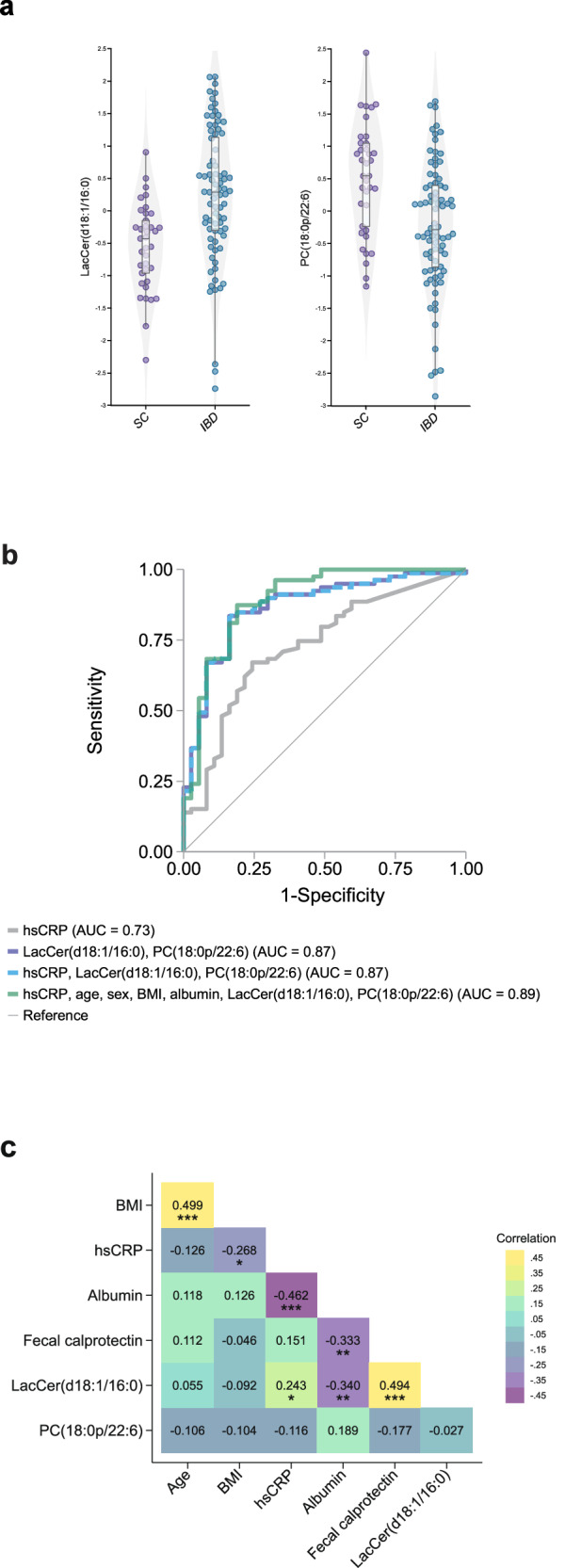
Fig. 4. Validation of a diagnostic lipidomic signature in the validation cohort and the relationship with clinical features.
a Plots depicting the log-transformed unit variance scaled distribution of LacCer(d18:1/16:0) and PC(18:1p/22:6) in individuals with IBD compared to symptomatic controls (SC) in the validation cohort (N = 117). The upper and lower lines of the boxes indicate the third and first quartiles, the lines in the middle represent the median, and the whiskers extending to the most extreme points within 1.5 times the IQR. Source data are provided as a Source Data file. b Receiver operating characteristic (ROC) curve illustrating the diagnostic prediction of pediatric inflammatory bowel disease (IBD) in the validation cohort using logistic regression. The model performance and validity measures were as follows: the area under the curve (AUC) for hsCRP was 0.73 (95% CI 0.63–0.82), while the AUC for the top two validated lipidomic markers, LacCer(d18:1/16:0) and PC(18:0p/22:6), was 0.87 (95% CI 0.80–0.94, P = 0.0004). Furthermore, the AUC for hsCRP in combination with the two top validated lipids was 0.87 (95% CI 0.80–0.94). c Pair-wise correlations of age, BMI, hsCRP, albumin, fecal calprotectin, LacCer(d18:1/16:0) and PC(18:0p/22:6) among all participants in the discovery cohort were assessed using Pearsons correlation coefficient (*P < 0.05, **P < 0.01 ***P < 0.001). BMI body mass index, hsCRP high-sensitivity C-reactive protein.
Fig. 5
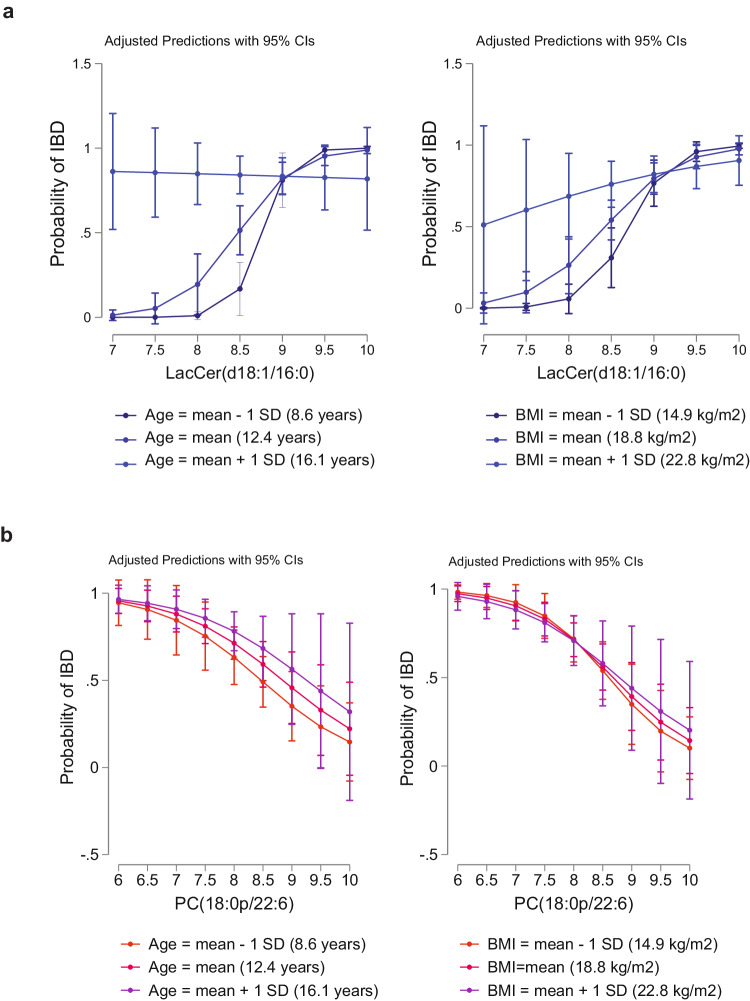
Fig. 5. Influence of age and BMI on the association of molecular lipids and IBD.
a Adjusted predictions of IBD at mean and ±1 SD in age and BMI at measured levels of LacCer(d18:1/16:0) in the validation cohort (N = 117). b Adjusted predictions of IBD at mean and ±1 SD in age and BMI at measured levels of PC(18:0p/22:6) in the validation cohort. BMI body mass index, SD standard deviation.
Fig. 6
Fig. 6. Targeted analysis of the molecular lipid signature in the confirmation cohort.
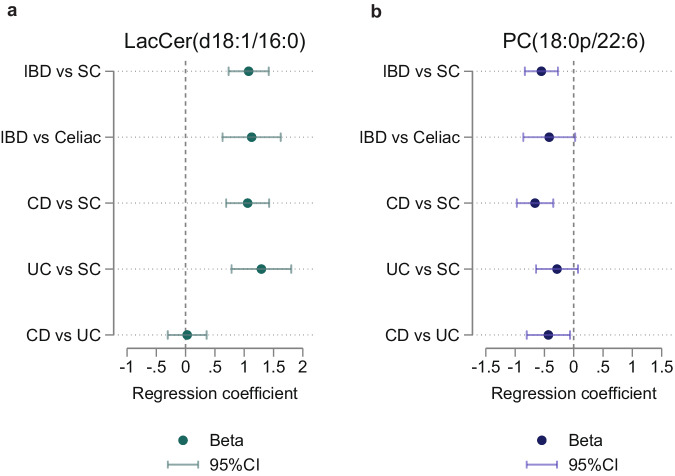
a Results from logistic regression analysis of LacCer(d18:1/16:0) among the five different comparisons IBD vs SC, IBD vs Celiac disease, CD vs SC, UC vs SC, and CD vs UC in the confirmation cohort (N = 263). Data are presented as beta coefficients with 95% confidence interval lines. All group comparisons, except CD vs UC (P = 0.87), were statistically significant (P  <  0.05). b Results from logistic regression analysis of PC(18:1p/22:6) among the five different comparisons IBD vs SC, IBD vs Celiac disease, CD vs SC, UC vs SC, and CD vs UC. Data are presented as beta coefficients with 95% confidence interval lines. All group comparisons, except UC vs SC (P = 0.12), were statistically significant (P  <  0.05). IBD inflammatory bowel disease, CD Crohn’s disease, UC ulcerative colitis, SC symptomatic controls, LacCer(d18:1/16:0), Lactosyl Ceramide (d18:1/16:0), PC(18:1p/22:6), phosphatidylcholine (18:1p/22:6). Source data are provided as a Source Data file.

References

    1. Ashton JJ, et al. Incidence and prevalence of paediatric inflammatory bowel disease continues to increase in the South of England. J. Pediatr. Gastroenterol. Nutr. 2022;75:e20–e24. doi: 10.1097/MPG.0000000000003511. - DOI - PubMed
    1. Agrawal M, et al. The rising burden of inflammatory bowel disease in Denmark Over Two Decades: A nationwide cohort study. Gastroenterology. 2022;163:1547–1554.e1545. doi: 10.1053/j.gastro.2022.07.062. - DOI - PMC - PubMed
    1. Kuenzig ME, et al. Twenty-first century trends in the global epidemiology of pediatric-onset inflammatory bowel disease: Systematic review. Gastroenterology. 2022;162:1147–1159.e1144. doi: 10.1053/j.gastro.2021.12.282. - DOI - PubMed
    1. Malham M, et al. Paediatric onset inflammatory bowel disease is a distinct and aggressive phenotype—a comparative population-based study. GastroHep. 2019;1:266–273. doi: 10.1002/ygh2.368. - DOI
    1. Fuller MK. Pediatric inflammatory bowel Disease: Special considerations. Surg. Clin. North Am. 2019;99:1177–1183. doi: 10.1016/j.suc.2019.08.008. - DOI - PubMed

Publication types