


Humidity and temperature preference in two Neotropical species of sand flies
- PMID: 38831449
- PMCID: PMC11149334
- DOI: 10.1186/s13071-024-06325-2
Humidity and temperature preference in two Neotropical species of sand flies
Abstract
Background: Arthropods vector a multitude of human disease-causing organisms, and their geographic ranges are shifting rapidly in response to changing climatic conditions. This is, in turn, altering the landscape of disease risk for human populations that are brought into novel contact with the vectors and the diseases they carry. Sand flies in the genera Lutzomyia and Pintomyia are vectors of serious disease-causing agents such as Leishmania (the etiological agent of leishmaniasis) and may be expanding their range in the face of climate change. Understanding the climatic conditions that vector species both tolerate physiologically and prefer behaviorally is critical to predicting the direction and magnitude of range expansions and the resulting impacts on human health. Temperature and humidity are key factors that determine the geographic extent of many arthropods, including vector species.
Methods: We characterized the habitat of two species of sand flies, Lutzomyia longipalpis and Pintomyia evansi. Additionally, we studied two behavioral factors of thermal fitness-thermal and humidity preference in two species of sand flies alongside a key aspect of physiological tolerance-desiccation resistance.
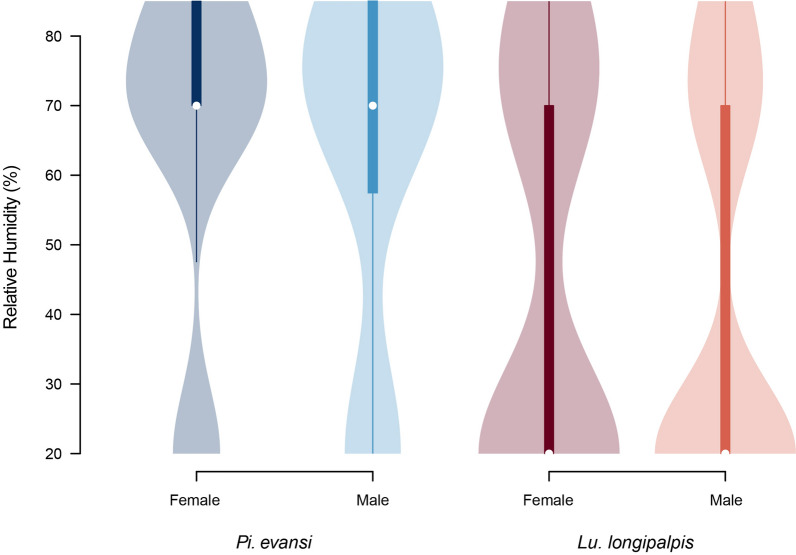
Results: We found that Lu. longipalpis is found at cooler and drier conditions than Pi. evansi. Our results also show significant interspecific differences in both behavioral traits, with Pi. evansi preferring warmer, more humid conditions than Lu. longipalpis. Finally, we found that Lu. longipalpis shows greater tolerance to extreme low humidity, and that this is especially pronounced in males of the species.
Conclusions: Taken together, our results suggest that temperature and humidity conditions are key aspects of the climatic niche of Lutzomyia and Pintomyia sand flies and underscore the value of integrative studies of climatic tolerance and preference in vector biology.
Keywords: Leishmania; Lutzomyia; Pintomyia; Climate change; Desiccation; Humidity preference; Leishmaniasis; Psychodidae; Sand fly; Temperature preference.
© 2024. The Author(s).
Conflict of interest statement
The authors declare that they have no known competing financial interests or personal relationships that could have appeared to influence the work reported in this paper.
Figures




References
-
- Sakai AK, Allendorf FW, Holt JS, Lodge DM, Molofsky J, With KA, Baughman S, Cabin RJ, Cohen JE, Ellstrand NC, McCauley DE, O'Neil P, Parker IM, Thompson JN, Weller SG. The population biology of invasive species. Annu Rev Ecol Syst. 2001;32:305–332. doi: 10.1146/annurev.ecolsys.32.081501.114037. - DOI
-
- Thomas CD, Cameron A, Green RE, Bakkenes M, Beaumont LJ, Collingham YC, Erasmus BF, De Siqueira BF, Grainger A, Hannah L, Hughes L, Huntley B, Van Jaarsveld AS, Midgley GF, Miles L, Ortega-Huerta MA, Peterson AT, Phillips OL, Williams SE. Extinction risk from climate change. Nature. 2004;427:145–148. doi: 10.1038/nature02121. - DOI - PubMed
-
- Pyšek P, Richardson DM. Invasive species, environmental change and management, and health. Annu Rev Environ Resour. 2010;35:25–55. doi: 10.1146/annurev-environ-033009-095548. - DOI
-
- Keller RP, Geist J, Jeschke JM, Kühn I. Invasive species in Europe: ecology, status, and policy. Environ Sci Eur. 2011;23:23. doi: 10.1186/2190-4715-23-23. - DOI
-
- Hongoh V, Berrang-Ford L, Scott ME, Lindsay LR. Expanding geographical distribution of the mosquito, Culex pipiens, in Canada under climate change. Appl Geogr. 2012;33:53–62. doi: 10.1016/j.apgeog.2011.05.015. - DOI
MeSH terms
Grants and funding
LinkOut - more resources
Full Text Sources
Research Materials
Miscellaneous
