Review
. 2024 Jun 3;17(1):39.
doi: 10.1186/s13045-024-01558-1.

Targeting FGFR for cancer therapy

Affiliations
Review

Targeting FGFR for cancer therapy

Pei Zhang et al. J Hematol Oncol. .

Abstract

The FGFR signaling pathway is integral to cellular activities, including proliferation, differentiation, and survival. Dysregulation of this pathway is implicated in numerous human cancers, positioning FGFR as a prominent therapeutic target. Here, we conduct a comprehensive review of the function, signaling pathways and abnormal alterations of FGFR, as well as its role in tumorigenesis and development. Additionally, we provide an in-depth analysis of pivotal phase 2 and 3 clinical trials evaluating the performance and safety of FGFR inhibitors in oncology, thereby shedding light on the current state of clinical research in this field. Then, we highlight four drugs that have been approved for marketing by the FDA, offering insights into their molecular mechanisms and clinical achievements. Our discussion encompasses the intricate landscape of FGFR-driven tumorigenesis, current techniques for pinpointing FGFR anomalies, and clinical experiences with FGFR inhibitor regimens. Furthermore, we discuss the inherent challenges of targeting the FGFR pathway, encompassing resistance mechanisms such as activation by gatekeeper mutations, alternative pathways, and potential adverse reactions. By synthesizing the current evidence, we underscore the potential of FGFR-centric therapies to enhance patient prognosis, while emphasizing the imperative need for continued research to surmount resistance and optimize treatment modalities.

Keywords: Clinical trials; Drug resistance; FDA-approved drugs; FGFR; Tumors.


Conflict of interest statement

There are no competing interests to declare.

Figures
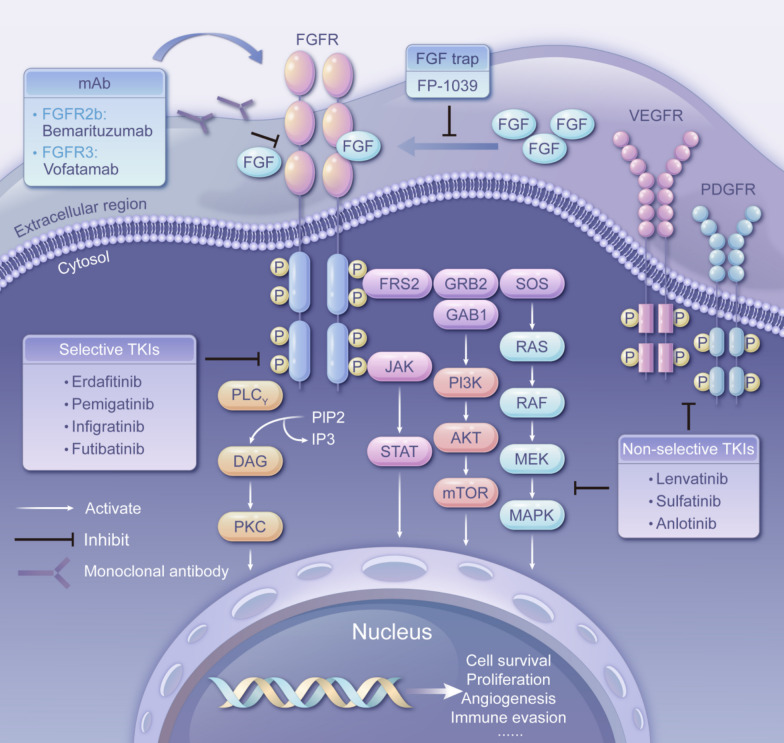
Fig. 1
Fig. 1
FGFR signals and inhibitors. This interaction triggers a downstream signaling network that encompasses the Ras-Raf-MAPK, PI3K-AKT, PLCγ, and STATs pathways, resulting in a range of cellular responses, including proliferation, differentiation, survival, migration, and angiogenesis
Fig. 2
Fig. 2
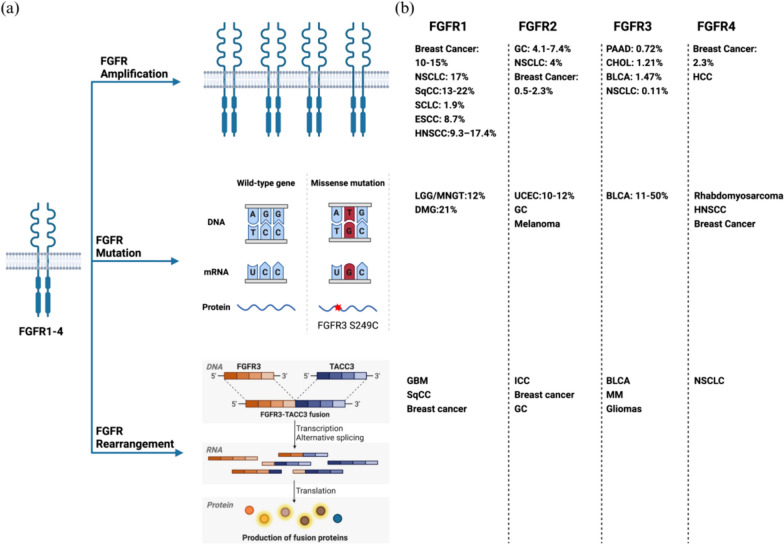
Displays a summary of FGFR alterations in cancers. a FGFR alterations may be categorized as amplification, point mutation, and rearrangement. The graphic illustrates the usage of FGFR3 S249C mutation and FGFR3-TACC3 for a basic mechanism explanation. b Presence of FGFR in various tumors. (NSCLC: non-Small cell lung carcinoma; SqCC: squamous cell cancer; SCLC: small cell lung carcinoma; ESCC: esophageal squamous cell carcinoma; HNSCC: head and neck squamous cell carcinoma; LGG: low-grade glioma; MNGT: mixedneuronal-glialtumors; DMG: diffuse midline gliomas; GBM: glioblastoma; GC: gastric cancer; UCEC: uterine corpus endometrial carcinoma; ICC: intrahepatic cholangiocarcinoma; PAAD: pancreatic cancer; CHOL: cholangiocarcinoma; BLCA: bladder cancer; MM: multiple myeloma; HCC: hepatocellular carcinoma)
Fig. 3
Fig. 3
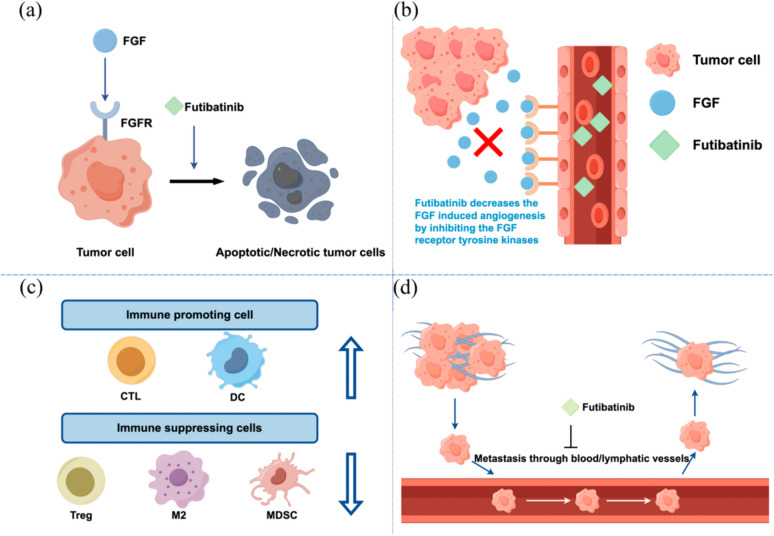
Take Futibatinib as an example, showing the functions of FGFR inhibitors. a Cell apoptosis. b Antiangiogenic impact. c Regulation of the immunological microenvironment. d Anti-metastatic impact
Fig. 4
Fig. 4
a Crystal structures of the compound Infigratinib and the compound Infigratinib in FGFR1 (PDB ID 3TT0). b Crystal structures of the compound Pemigatinib and the compound Pemigatinib in FGFR1 (PDB ID 7WCL). c Crystal structures of the compound Erdafitinib and the compound Erdafitinib in FGFR1 (PDB ID 5EW8). d Crystal structures of the compound Futibatinib and the compound Futibatinib in FGFR1 (PDB ID 6MZW)
Fig. 5
Fig. 5
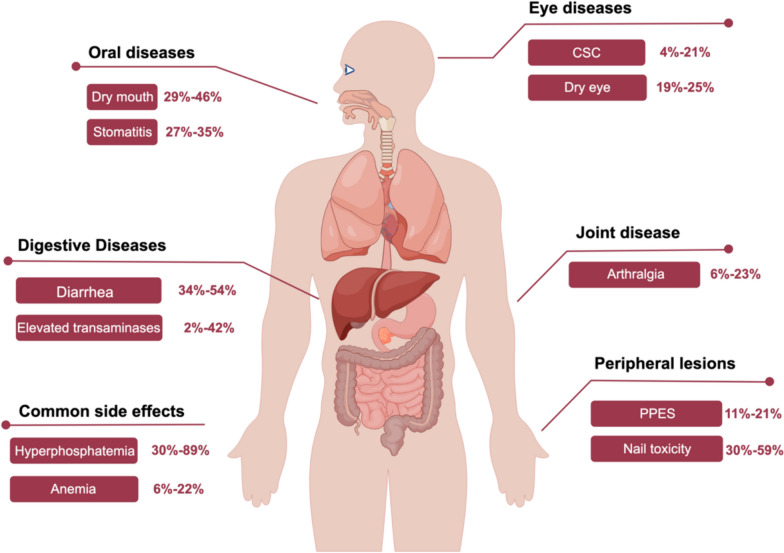
Common side effects of FGFR inhibitor. The side effects of FGFR inhibitors can be seen in many systems throughout the body, among which hyperphosphatemia is the most common. (CSC: Central plasmacytoid choroidal retinopathy; PPES: palmar-plantar erythrodysesthesia syndrome)

References

    1. Xue WJ, Li MT, Chen L, Sun LP, Li YY. Recent developments and advances of FGFR as a potential target in cancer. Future Med Chem. 2018;10(17):2109–2126. doi: 10.4155/fmc-2018-0103. - DOI - PubMed
    1. Regeenes R, Silva PN, Chang HH, Arany EJ, Shukalyuk AI, Audet J, et al. Fibroblast growth factor receptor 5 (FGFR5) is a co-receptor for FGFR1 that is up-regulated in beta-cells by cytokine-induced inflammation. J Biol Chem. 2018;293(44):17218–17228. doi: 10.1074/jbc.RA118.003036. - DOI - PMC - PubMed
    1. Trueb B. Biology of FGFRL1, the fifth fibroblast growth factor receptor. Cell Mol Life Sci. 2011;68(6):951–964. doi: 10.1007/s00018-010-0576-3. - DOI - PMC - PubMed
    1. Wiedemann M, Trueb B. Characterization of a novel protein (FGFRL1) from human cartilage related to FGF receptors. Genomics. 2000;69(2):275–279. doi: 10.1006/geno.2000.6332. - DOI - PubMed
    1. Mikhaylenko DS, Alekseev BY, Zaletaev DV, Goncharova RI, Nemtsova MV. Structural alterations in human fibroblast growth factor receptors in carcinogenesis. Biochemistry (Mosc) 2018;83(8):930–943. doi: 10.1134/S0006297918080059. - DOI - PubMed

Publication types

MeSH terms

Substances