


Estimated electric conductivities of thermal plasma for air-fuel combustion and oxy-fuel combustion with potassium or cesium seeding
- PMID: 38832275
- PMCID: PMC11145353
- DOI: 10.1016/j.heliyon.2024.e31697
Estimated electric conductivities of thermal plasma for air-fuel combustion and oxy-fuel combustion with potassium or cesium seeding
Abstract
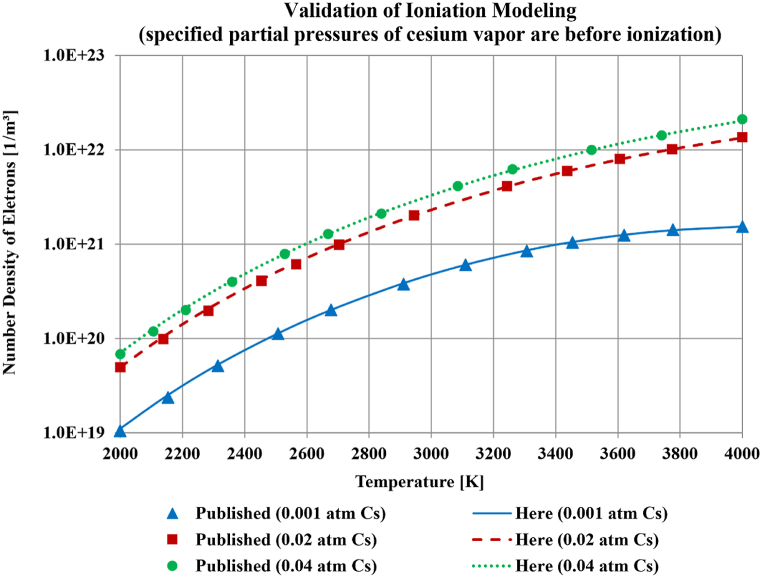
A complete model for estimating the electric conductivity of combustion product gases, with added cesium (Cs) or potassium (K) vapor for ionization, is presented. Neutral carrier gases serve as the bulk fluid that carries the seed material, as well as the electrons generated by the partial thermal (equilibrium) ionization of the seed alkali metal. The model accounts for electron-neutral scattering, as well as electron-ion and electron-electron scattering. The model is tested through comparison with published data. The model is aimed at being utilized for the plasma within magnetohydrodynamic (MHD) channels, where direct power extraction from passing electrically conducting plasma gas enables electric power generation. The thermal ionization model is then used to estimate the electric conductivity of seeded combustion gases under complete combustion of three selected fuels, namely: hydrogen (H2), methane (CH4), and carbon (C). For each of these three fuels, two options for the oxidizer were applied, namely: air (21 % molecular oxygen, 79 % molecular nitrogen by mole), and pure oxygen (oxy-combustion). Two types of seeds (with 1 % mole fraction, based on the composition before ionization) were also applied for each of the six combinations of (fuel-oxidizer), leading to a total of 12 different MHD plasma cases. For each of these cases, the electric conductivity was computed for a range of temperatures from 2000 K to 3000 K. The smallest estimated electric conductivity was 0.35 S/m for oxy-hydrogen combustion at 2000 K, with potassium seeding. The largest estimated electric conductivity was 180.30 S/m for oxy-carbon combustion at 3000 K, with cesium seeding. At 2000 K, replacing potassium with cesium causes a gain in the electric conductivity by a multiplicative gain factor of about 3.6 regardless of the fuel and oxidizer. This gain factor declines to between 1.77 and 2.07 at 3000 K. Based on the findings of this research study, the four analyzed factors to increase the electric conductivity of MHD plasma can be listed by their significance (descending order) as (1) type of additive seed type (cesium is better than potassium), (2) temperature (the higher the better), (3) carbon-to-hydrogen ratio of the fuel (the higher the better), and finally (4) the oxidizer type (air is generally better than pure oxygen). The relative size of the two electric conductivity components (due to neutrals scattering and Coulomb scattering) at various plasma conditions are discussed, and a threshold of 10-5 (0.001 %) electrons mole fraction is suggested to safely neglect Coulomb scattering.
Keywords: Cesium; Electric conductivity; MHD; Potassium; Seeded plasma; Thermal ionization.
© 2024 The Author.
Conflict of interest statement
The authors declare that they have no known competing financial interests or personal relationships that could have appeared to influence the work reported in this paper.
Figures




References
-
- NIST [United States National Institute of Standards and Technology] Fundamental Physical Constants: vacuum electric permittivity. 2023. https://physics.nist.gov/cgi-bin/cuu/Value?ep0
-
- NIST [United States National Institute of Standards and Technology] Fundamental physical constants: elementary charge. 2023. https://physics.nist.gov/cgi-bin/cuu/Value?e
-
- NIST [United States National Institute of Standards and Technology] 2023. Fundamental Physical Constants: Electron Volt.https://physics.nist.gov/cgi-bin/cuu/Value?evj
-
- NIST [United States National Institute of Standards and Technology] 2023. Fundamental Physical Constants: Planck Constant.https://physics.nist.gov/cgi-bin/cuu/Value?h
-
- NIST [United States National Institute of Standards and Technology] Fundamental physical constants: Boltzmann constant. 2023. https://physics.nist.gov/cgi-bin/cuu/Value?k
LinkOut - more resources
Full Text Sources
