Whole genome sequencing analysis on antibiotic-resistant Escherichia coli isolated from pig farms in Banten Province, Indonesia
- PMID: 38834513
- PMCID: PMC11156600
- DOI: 10.4142/jvs.24031
Whole genome sequencing analysis on antibiotic-resistant Escherichia coli isolated from pig farms in Banten Province, Indonesia
Abstract
Importance: The emergence and rapid increase in the incidence of multidrug-resistant (MDR) bacteria in pig farms has become a serious concern and reduced the choice of effective antibiotics.
Objective: This study analyzed the phylogenetics and diversity of antibiotic resistance genes (ARGs) and molecularly identified the source of ARGs in antibiotic-resistant Escherichia coli isolated from pig farms in Banten Province, Indonesia.
Methods: Forty-four antibiotic-resistant E. coli isolates from fecal samples from 44 pig farms in Banten Province, Indonesia, were used as samples. The samples were categorized into 14 clusters. Sequencing was performed using the Oxford Nanopore Technologies MinION platform, with barcoding before sequencing with Nanopore Rapid sequencing gDNA-barcoding (SQK-RBK110.96) according to manufacturing procedures. ARG detection was conducted using ResFinder, and the plasmid replicon was determined using PlasmidFinder.
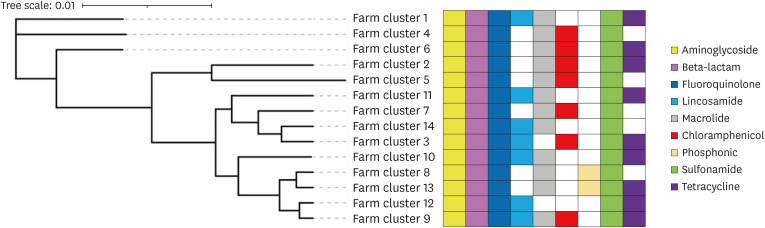
Results: Three phylogenetic leaves of E. coli were identified in the pig farming cluster in Banten Province. The E. coli isolates exhibited potential resistance to nine classes of antibiotics. Fifty-one ARGs were identified across all isolates, with each cluster carrying a minimum of 10 ARGs. The ant(3'')-Ia and qnrS1 genes were present in all isolates. ARGs in the E. coli pig farming cluster originated mainly from plasmids, accounting for an average of 89.4%.
Conclusions and relevance: The elevated potential for MDR events, coupled with the dominance of ARGs originating from plasmids, increases the risk of ARG spread among bacterial populations in animals, humans, and the environment.
Keywords: Antibiotic resistance; Escherichia coli; antibiotic resistance genes; multidrug-resistant; pig farm.
© 2024 The Korean Society of Veterinary Science.
Conflict of interest statement
The authors declare no conflicts of interest.
Figures

References
-
- Yao X, Doi Y, Zeng L, Lv L, Liu JH. Carbapenem-resistant and colistin-resistant Escherichia coli co-producing NDM-9 and MCR-1 . Lancet Infect Dis. 2016;16(3):288–289. - PubMed
-
- He T, Wang R, Liu D, Walsh TR, Zhang R, Lv Y, et al. Emergence of plasmid-mediated high-level tigecycline resistance genes in animals and humans. Nat Microbiol. 2019;4(9):1450–1456. - PubMed
-
- Van Boeckel TP, Pires J, Silvester R, Zhao C, Song J, Criscuolo NG, et al. Global trends in antimicrobial resistance in animals in low- and middle-income countries. Science. 2019;365(6459):1–5. - PubMed
-
- Andersson DI, Hughes D. Microbiological effects of sublethal levels of antibiotics. Nat Rev Microbiol. 2014;12(7):465–478. - PubMed
MeSH terms
Substances
Grants and funding
LinkOut - more resources
Full Text Sources
Medical