


Effect of early vs. delayed extubation on functional outcome among patients with acute ischemic stroke treated with endovascular thrombectomy under general anesthesia: the prospective, randomized controlled EDESTROKE trial study protocol
- PMID: 38835061
- PMCID: PMC11151624
- DOI: 10.1186/s13063-024-08181-y
Effect of early vs. delayed extubation on functional outcome among patients with acute ischemic stroke treated with endovascular thrombectomy under general anesthesia: the prospective, randomized controlled EDESTROKE trial study protocol
Abstract
Background: Recent meta-analyses and randomized studies have shown that among patients with acute ischemic stroke undergoing endovascular thrombectomy, general anesthesia with mechanical ventilation is associated with better functional status compared to local anesthesia and sedation, and they recommend its use. But once the procedure is completed, when is the optimal moment for extubation? Currently, there are no guidelines recommending the optimal moment for extubation. Prolonged mechanical ventilation time could potentially be linked to increased complications such as pneumonia or disturbances in cerebral blood flow due to the vasodilatation produced by most anesthetic drugs. However, premature extubation in a patient who has suffered a stroke could led to complications such as agitation, disorientation, abolished reflexes, sudden fluctuations in blood pressure, alterations in cerebral blood flow, respiratory distress, bronchial aspiration, and the need for reintubation. We therefore designed a randomized study hypothesizing that early compared with delayed extubation is associated with a better functional outcome 3 months after endovascular thrombectomy treatment under general anesthesia for acute ischemic stroke.
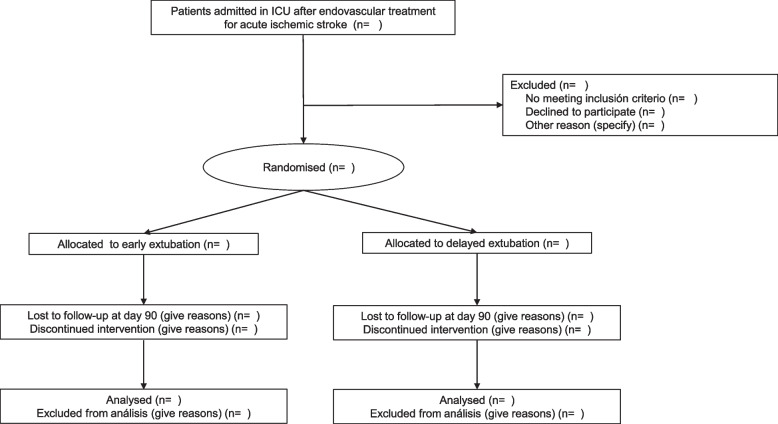
Methods: This investigator-initiated, single-center, prospective, parallel, evaluated blinded, superiority, randomized controlled trial will include 178 patients with a proximal occlusion of the anterior circulation treated with successful endovascular thrombectomy (TICI 2b-3) under general anesthesia. Patients will be randomly allocated to receive early (< 6 h) or delayed (6-12 h) extubation after the procedure. The primary outcome measure is functional independence (mRS of 0-2) at 90 days, measured with the modified Rankin Score (mRS), ranging from 0 (no symptoms) to 6 (death).
Discussion: This will be the first trial to compare the effect of mechanical ventilation duration (early vs delayed extubation) after satisfactory endovascular thrombectomy for acute ischemic stroke under general anesthesia.
Trial registration: The study protocol was approved April 11, 2023, by the by the Santiago-Lugo Research Ethics Committee (CEI-SL), number 2023/127, and was registered into the clinicaltrials.gov clinical trials registry with No. NCT05847309. Informed consent is required. Participant recruitment begins on April 18, 2023. The results will be submitted for publication in a peer-reviewed journal and presented at one or more scientific conferences.
Keywords: Endovascular treatment; Extubation; Functional status; Mechanical ventilation; Stroke.
© 2024. The Author(s).
Conflict of interest statement
None of the authors has any financial or other competing interests in relation to the study. The study is an investigator-initiated trial. The promotion of the study is carried in the University Clinical Hospital of Santiago de Compostela, and in the Health Research Institute of Santiago (IDIS). There is no industry support or involvement in the trial.
Figures
References
Publication types
MeSH terms
Associated data
LinkOut - more resources
Full Text Sources
Medical
Miscellaneous
