


Social control is associated with increased reproductive skew in a wild mammal
- PMID: 38835239
- PMCID: PMC11285479
- DOI: 10.1098/rsbl.2024.0003
Social control is associated with increased reproductive skew in a wild mammal
Abstract
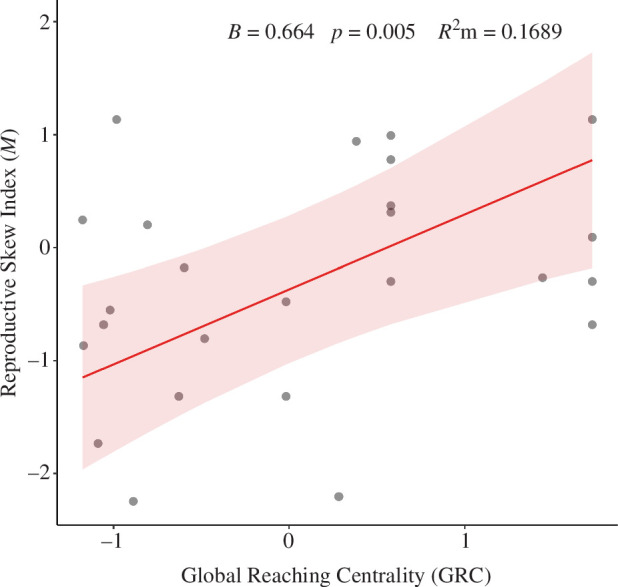
In group-living species, reproductive variation among individuals of the same sex is widespread. By identifying the mechanisms underlying this reproductive skew, we gain fundamental insights into the evolution and maintenance of sociality. A common mechanism, social control, is typically studied by quantifying dominance, which is one of many attributes of sociality that describes how individuals exert influence on others and is an incomprehensive measure of social control as it accounts only for direct relationships. Here, we use the global reaching centrality (GRC), which quantifies the degree of hierarchy in a social network by accounting for both direct and indirect social relationships. Using a wild, free-living population of adult female yellow-bellied marmots (Marmota flaviventris), we found a positive relationship between the reproductive skew index and GRC: more despotic social groups have higher reproductive skew. The GRC was stronger predictor for skew than traditional measures of social control (i.e. dominance). This allows deeper insights into the diverse ways individuals control other group members' reproduction, a core component in the evolution of sociality. Future studies of skew across taxa may profit by using more comprehensive, network-based measures of social control.
Keywords: despotism; egalitarianism; global reaching centrality; yellow-bellied marmot.
© 2024 The Authors.
Conflict of interest statement
We declare we have no competing interests.
Figures
References
-
- Johnstone RA. 2000. Models of reproductive skew: a review and synthesis (invited article). Ethology 106 , 5–26. (10.1046/j.1439-0310.2000.00529.x) - DOI
-
- Vehrencamp SL. 1983. A model for the evolution of despotic versus egalitarian societies. Anim. Behav. 31 , 667–682. (10.1016/S0003-3472(83)80222-X) - DOI
