


Mini-access ascending aorto-bifemoral bypass surgery for the treatment of aortic steno-occlusive disease
- PMID: 38835566
- PMCID: PMC11145077
- DOI: 10.1016/j.xjtc.2024.01.006
Mini-access ascending aorto-bifemoral bypass surgery for the treatment of aortic steno-occlusive disease
Abstract
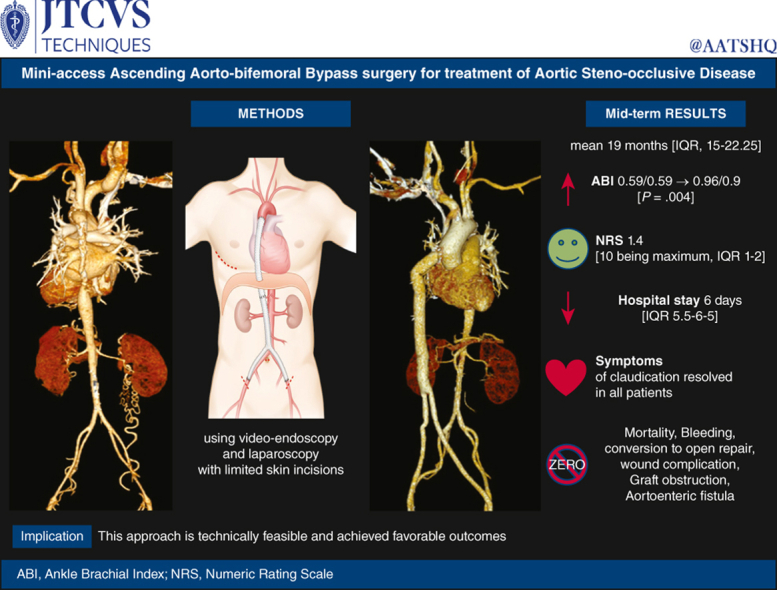
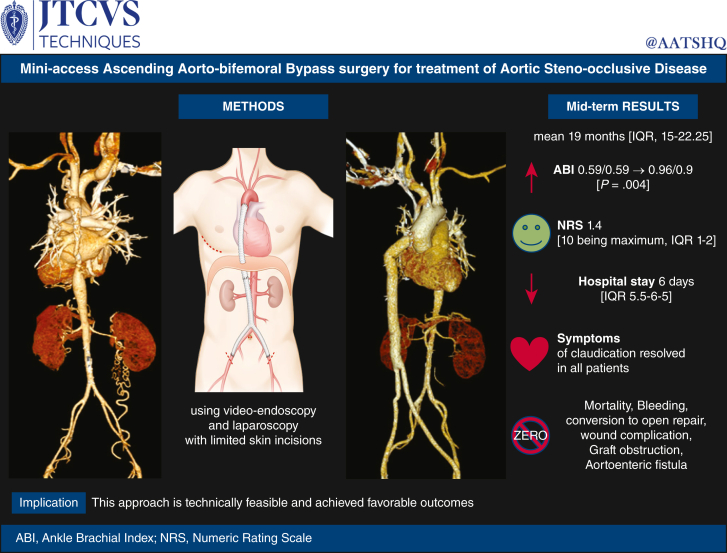
Objectives: Mid-aortic syndrome is a rare condition characterized by severe aortic narrowing, leading to high upper body blood pressure and organ hypoperfusion, necessitating surgical intervention. Although central bypassing is considered ideal, it involves extensive incisions. To overcome these limitations, less-invasive approaches have been developed. This study aims to introduce a mini-access approach using video-endoscopy and to evaluate the feasibility and outcomes of mini-access ascending aorto-bifemoral bypass surgery.
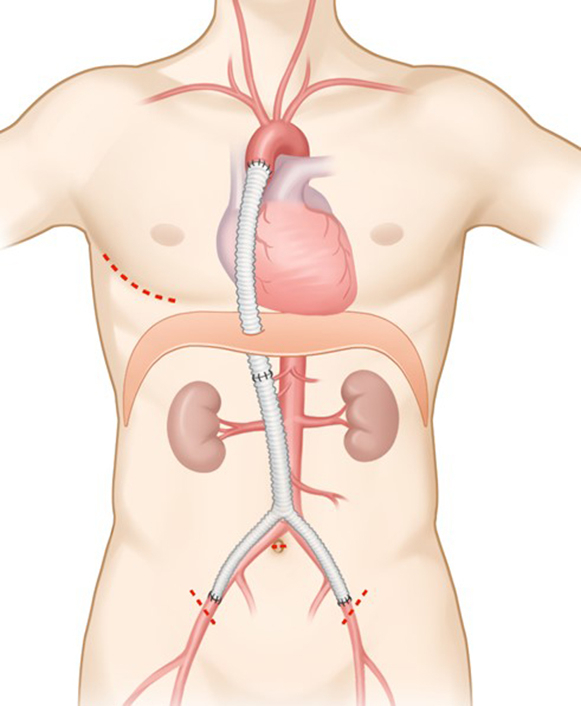
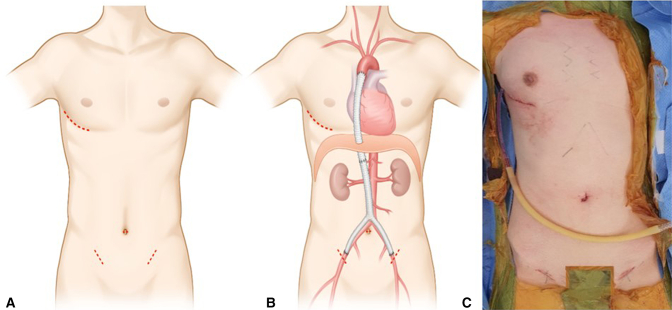
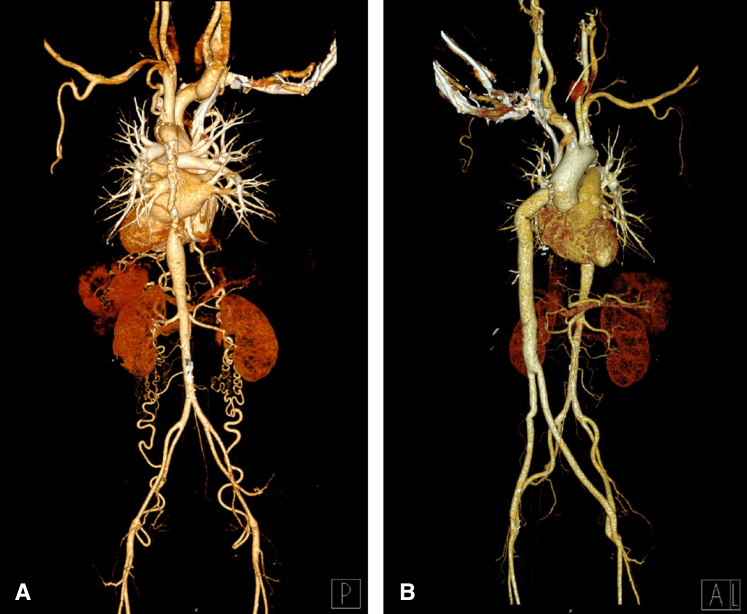
Methods: From November 2020 to May 2022, we performed ascending aorta to bifemoral artery bypass operations on 7 patients to treat steno-occlusive diseases in the downstream aorta. A Y-graft was created, and procedures were conducted under general anesthesia using video-endoscopy with limited skin incisions.
Results: Intraoperatively, there were no major complications, and none of the patients required cardiopulmonary bypass support. Furthermore, there were no postoperative mortalities or major complications. Postoperatively, the mean ankle-brachial index significantly improved from 0.59/0.59 to 0.96/0.92 (P = .004), and the mean glomerular filtration rate increased from 61.1 to 85.3 mL/min/1.73 mm2 (P = .012). Additionally, symptoms of claudication resolved in all patients.
Conclusions: Videoscope-assisted mini-access aortic bypass surgery not only provides favorable early postoperative outcomes but also represents a technically feasible alternative to traditional surgical approaches for the treatment of steno-occlusive aortic diseases.
Keywords: Takayasu arteritis; aortic bypass; minimally invasive surgery.
© 2024 The Author(s).
Conflict of interest statement
The authors reported no conflicts of interest. The Journal policy requires editors and reviewers to disclose conflicts of interest and to decline handling or reviewing manuscripts for which they may have a conflict of interest. The editors and reviewers of this article have no conflicts of interest.
Figures
References
-
- Patel R.S., Nguyen S., Lee M.T., et al. Clinical characteristics and long-term outcomes of midaortic syndrome. Ann Vasc Surg. 2020;66:318–325. - PubMed
-
- Peng Z., Qiu J., Wang D., Yang X., Yu C., Zhang L. Ascending aortoiliac bypass for one-stag repair of adult aortic coarctation with concomitant cardiac lesions. Vasc Endovascular Surg. 2022;56:11–17. - PubMed
-
- Laser A., Baker N., RVT, et al. Graft infection after endovascular abdominal aortic aneurysm repair. J Vasc Surg. 2011;54:58–63. - PubMed
-
- Yamamoto T., Endo D., Shimada A., et al. Surgical 5-year outcomes of extra-anatomical bypass for middle aortic syndrome: a case series. Vasc Endovascular Surg. 2022;56:85–94. - PubMed
LinkOut - more resources
Full Text Sources
